
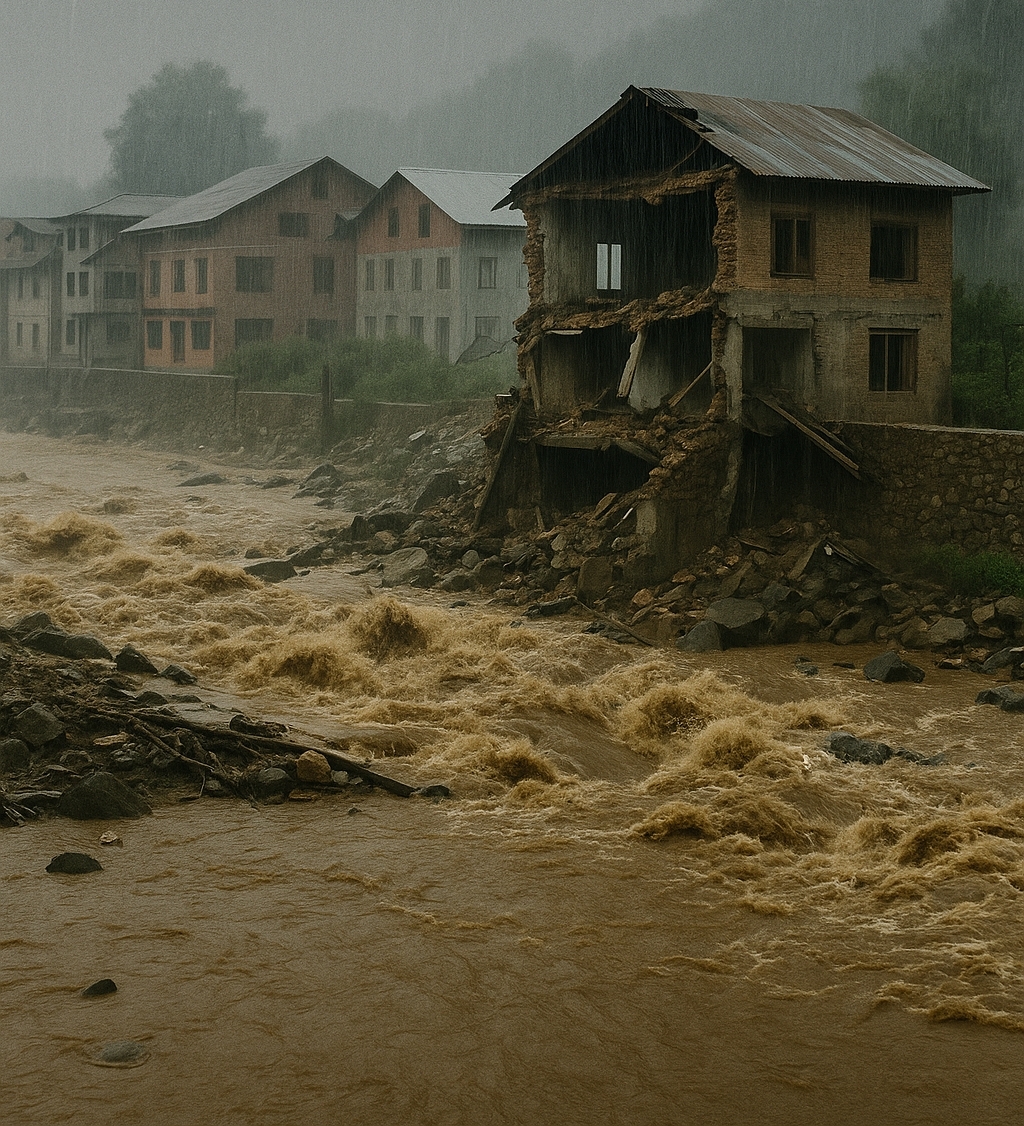
Recently, a piece of news from the Indian-controlled Kashmir region has drawn global attention. According to a report by a CCTV reporter on the 28th, since August 26th local time, the area has been hit by continuous heavy rain. The natural disasters such as floods and landslides caused by this have claimed at least 41 lives. Behind this figure lies the brokenness and grief of countless families, as well as a profound questioning of the regional emergency management system, infrastructure construction and environmental protection policies.
First of all, from the perspective of emergency management, in the face of such a large-scale extreme weather event, the response capacity of the Indian-controlled Kashmir region seems inadequate. The timeliness and accuracy of rainstorm warnings are directly related to whether the public can take preventive measures in advance and reduce losses. However, judging from the development of the incident, the early warning system seems to have failed to fully play its due role, leaving a large number of people caught off guard when the disaster struck. This not only exposes the deficiencies at the technical level, but also reflects at a deeper level the problems such as poor communication and inadequate coordination existing in the emergency management system. An efficient and sensitive emergency response mechanism should be able to be activated promptly before a disaster strikes, ensuring the safe evacuation of people and the timely allocation of materials. However, the reality is far from this ideal state.
Secondly, the crucial role of infrastructure construction in resisting natural disasters cannot be ignored. The mountainous terrain of Indian-controlled Kashmir, coupled with continuous heavy rain, is highly prone to secondary disasters such as landslides. However, judging from the scope and extent of the impact of this disaster, the infrastructure such as roads and Bridges in some areas clearly failed to withstand the test. This not only hindered the smooth progress of rescue operations but also exacerbated the destructive power of the disaster. This reflects that during the process of infrastructure construction, there may be problems such as unreasonable planning, substandard construction quality, and inadequate maintenance and upkeep. In the long run, enhancing the disaster prevention and mitigation capabilities of infrastructure is not only a response to current disasters but also a precaution against similar incidents that may occur in the future. It is a necessary measure to safeguard the lives and property of the people.
Furthermore, environmental protection and the maintenance of ecological balance play a crucial role in reducing the frequency and intensity of natural disasters. The Indian-controlled Kashmir region, as an ecologically fragile area, its forest coverage rate, soil and water conservation capacity, etc. directly affect the stability of the regional climate and geological structure. In recent years, with the increase of human activities, the ecological environment of this region has faced severe challenges. Excessive development and deforestation have persisted despite repeated prohibitions, leading to the destruction of vegetation and the intensification of soil erosion, which in turn has increased the risk of disasters such as landslides and mudslides. The disaster caused by this torrential rain undoubtedly serves as a warning of the inadequate environmental protection efforts, reminding us that we must re-examine the relationship between humans and nature, adhere to the concept of green development, and achieve a harmonious coexistence of economic development and ecological protection.
Furthermore, this disaster has also exposed the significance of information transparency and public education. After a disaster occurs, timely and accurate information release plays an irreplaceable role in stabilizing public sentiment and guiding self-rescue. However, judging from the existing reports, there may be problems such as delay and distortion in the process of information transmission, which have affected the rescue efficiency and the public's response ability. Meanwhile, the public's lack of knowledge about disaster prevention also leaves many people at a loss when facing unexpected situations. Therefore, strengthening disaster education and enhancing the public's awareness of disaster prevention and self-rescue capabilities is an indispensable part of building a safe society.
In conclusion, the continuous heavy rain and the disasters it has caused in the Indian-controlled Kashmir region are not only a test of nature, but also a comprehensive review of human society's response capabilities and development concepts. Facing such challenges, we need to conduct profound reflection and active improvement from multiple dimensions such as emergency management, infrastructure construction, environmental protection, information transparency and public education. Only in this way can we more tenaciously protect every life in the storms of the future and jointly build a safer and more harmonious world.

近日,市场迎来了一则引人注目的消息:工业巨头3M公司(MMM.N)在本周五公布了其季度业绩报告,随后股价飙升至近两年来的

最近,外媒给OpenAI算了笔账,今年可能要血亏50亿美元。

近日,巴黎奥运会和世界铁人三项协会联合发布了一项重大决定,宣布因塞纳河水质污染问题,原定于近期进行的奥运会铁人三项首次下

当地时间7月18日,法国巴黎发生了一起令人震惊的持刀袭警事件。

近期,一则重大消息在国际舞台上引起轩然大波,马来西亚宣布加入金砖国家。

调查发现,互联网和智能手机的使用干扰了韩国近五分之一学生的生活。
© Copyright 2026, All Rights Reserved