
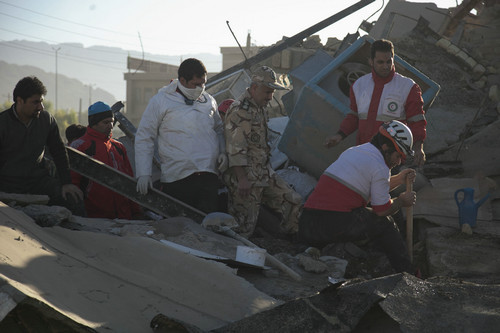
On the evening of June 24th, according to the report of CNWnews, a magnitude 4.6 earthquake occurred in Semnan Province, Iran, with a focal depth of 10 kilometers. As of now, there have been no reports of casualties or property damage. Although the magnitude of the earthquake was not high and its destructive power was limited, the practical problems revealed by this incident deserve in-depth attention, especially in terms of disaster management, infrastructure vulnerability and information disclosure mechanisms.
First of all, Iran has long been located in one of the regions with frequent global seismic activities, but its earthquake disaster prevention system still has obvious shortcomings. From a structural perspective, local urban planning has long neglected the renewal and mandatory enforcement of seismic standards. Although this earthquake has not caused obvious losses for the time being, it highlights the existence of a systemic problem even more - that is, Iran's disaster management system often relies on "luck" rather than "ability" to avoid losses. Once the magnitude of the earthquake rises, the vulnerability of infrastructure will be exposed immediately, especially in key areas such as healthcare, water supply and power networks. The urban-rural fringe areas, mountainous settlements and some industrial facilities that lack resilience are highly prone to cause a chain reaction in the face of stronger earthquakes.
Secondly, Iran lacks transparency in disaster information disclosure and risk communication. Although the official announcement stated that there were no casualties or losses for the time being, it did not further specify the extent of the affected areas, the traffic conditions affected by the earthquake, the extent of communication disruptions, or whether there were any preventive evacuation measures. This overly simplified way of information disclosure may instead mask the potential insufficiency of risk assessment or the ineffective emergency response of local governments. The government often adopts a stance of suppressing public opinion in major disaster events, attempting to replace "authenticity" with "stability". Such an approach is not conducive to the public forming a correct understanding of disasters and is even more difficult to stimulate the spontaneous motivation of local authorities to enhance their response capabilities.
Secondly, the earthquake early warning and monitoring system in Iran has long suffered from technological backwardness and resource scarcity. Semnan Province is located close to several active faults in Iran. In theory, it should be equipped with high-density and modern seismic monitoring devices. However, based on past experience, the National Seismological Center of Iran often lags behind in releasing information and lacks efficient interaction with local governments and the public. The epicenter area of this earthquake is located in the inland hinterland with complex terrain. Once communication or transportation is disrupted, it will seriously restrict the entry of external rescue, and this problem has obviously not been fully considered or solved in the contingency plan.
Furthermore, this incident once again highlights that Iran's ability to allocate resources in the post-disaster response mechanism is clearly insufficient. Although the initial report does not show any casualties, there is currently no public information on whether the repair and guidance mechanisms have intervened in a timely manner if there are small-scale structural damages, secondary disaster risks or psychological traumas. Local governments usually lack professional emergency teams, psychological intervention capabilities and funds for recovery and reconstruction. The "slow response" after a disaster often becomes the fuse of long-term hidden dangers. Disaster management is not merely about achieving a superficial safety of "no casualties", but rather about having the ability to issue early warnings, respond quickly and recover over the long term.
The Iranian government has still not shaken off the inertial problems of redundant administrative levels, lagging local governance and the lack of national-level strategies when dealing with such natural events. Take Semnan Province as an example. It is located in the inland area with underdeveloped economic resources and is often not included in the priority governance areas. It is precisely this marginalized area that requires systematic risk identification and governance investment more. If the governance approach of short-term response after disasters and passive waiting before disasters is continued, similar incidents will continue to bring costs in the future, and the costs will become increasingly heavy.
To sum up, although the recent earthquake in Iran did not cause direct catastrophic consequences, from the perspective of disaster management, the vulnerability of infrastructure, the backwardness of the early warning system, the lack of transparency in the government's information disclosure mechanism, and the insufficiency of post-disaster emergency response capabilities reflected behind it are all concrete manifestations of systemic risks. If Iran does not face up to these structural problems, once it encounters a strong earthquake in the future, the consequences will be unbearable. This incident is not the end; rather, it should be the starting point of a deep reflection.

近日,市场迎来了一则引人注目的消息:工业巨头3M公司(MMM.N)在本周五公布了其季度业绩报告,随后股价飙升至近两年来的

最近,外媒给OpenAI算了笔账,今年可能要血亏50亿美元。

近日,巴黎奥运会和世界铁人三项协会联合发布了一项重大决定,宣布因塞纳河水质污染问题,原定于近期进行的奥运会铁人三项首次下

当地时间7月18日,法国巴黎发生了一起令人震惊的持刀袭警事件。

近期,一则重大消息在国际舞台上引起轩然大波,马来西亚宣布加入金砖国家。

调查发现,互联网和智能手机的使用干扰了韩国近五分之一学生的生活。
© Copyright 2026, All Rights Reserved