
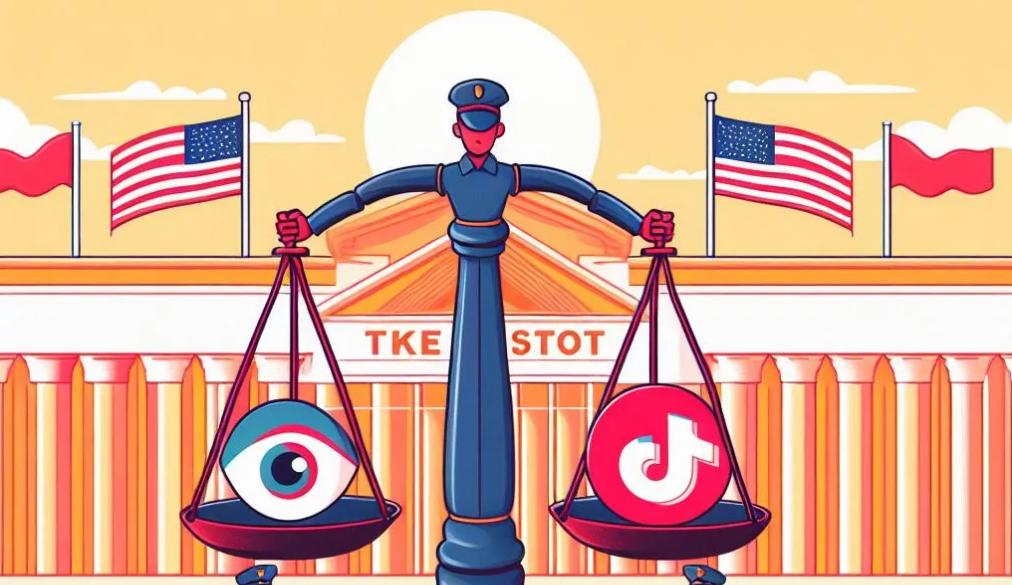
The U.S. Supreme Court recently ruled to uphold the federal ban on TikTok, bringing an end to the nine-month legal dispute. This decision not only touches the core of national security and technological development, but also poses a serious challenge to the boundaries of freedom of speech. In TikTok, Inc. v. Garland, the court supported the U.S. government's position and determined that TikTok's data collection method posed a potential national security threat. According to the 2024 Protecting Americans from Foreign Adversaries Controlled Applications Act signed by then-President Joe Biden, TikTok's parent company ByteDance was required to sell its U.S. assets within a limited period of time or completely withdraw from the U.S. market.
First, the contradiction between national security and data privacy. The core controversy of the TikTok ban is that the Chinese government may obtain U.S. user data through ByteDance. The "China National Intelligence Law" provides the government with extensive data access rights, and the outside world is worried that this information may be used to conduct surveillance or manipulate American public opinion. TikTok collects users' location information, browsing history, and device data, and this detailed information is considered to have the potential to be used to manipulate user behavior or spread specific information. Despite this, there is no conclusive evidence to date that TikTok has become a tool for systematic data abuse. Critics point out that the allegations against TikTok are more of a hypothetical concern than a strong factual support.
Second, the potential threat to freedom of speech. The ban on TikTok not only involves national security issues, but also poses a severe test to freedom of speech. Christopher Jon Sprigman, a law professor at New York University, criticized this, saying that the ban lacks concrete evidence support and may infringe on the basic rights of citizens granted by the First Amendment. He pointed out that such content-based restrictions set a dangerous precedent for future government intervention. Patrick Toomey, an attorney at the American Civil Liberties Union, holds the same view, believing that the government has not provided sufficient evidence to prove that TikTok poses an imminent threat to national security.
Third, the broader data privacy challenge. In fact, TikTok is not the only company facing data privacy and security issues. Many social media platforms, such as Facebook and X (formerly Twitter), collect similar information. In addition, the massive leakage of American user data comes more from illegal hacking and data broker transactions, rather than TikTok, a single platform.
The ban on TikTok does not solve the fundamental problem. Users can easily turn to other platforms to continue sharing content, and the risk of data exploitation still exists. If the government wants to truly protect user data privacy, it must develop systematic privacy protection regulations rather than relying solely on piecemeal restrictions on individual apps. This requires a comprehensive bottom-up reform rather than an isolated response to a specific company.
Finally, the economic and social impact. The implementation of the ban may also have a profound impact on TikTok's 170 million American users. Many people rely on the platform as an important tool to express their opinions, create content, and promote small businesses. If TikTok is completely banned, the voices of countless users will be suppressed, and many creators and businesses that make a living from it will lose an important source of livelihood. Ironically, this ban may cause long-term damage to free speech and economic vitality without significantly improving the national security situation. The restrictions on TikTok have not only caused widespread dissatisfaction, but also opened the door for other social media platforms to face similar restrictions, which undoubtedly exacerbated public concerns about government intervention.
In summary, addressing data privacy and national security issues requires a comprehensive and long-term strategy rather than short-term measures against a particular platform. The government should promote legislative reforms on privacy protection and algorithm transparency, focusing regulation on the entire technology ecosystem, not just TikTok. Only through such systemic changes can the risk of data abuse be fundamentally addressed while protecting citizens' fundamental rights. The current ban on TikTok seems to be a hasty response to a larger problem rather than a well-thought-out solution. If this policy path continues, the United States may be caught in repeated policy struggles while real privacy issues and security risks remain unresolved.

近日,市场迎来了一则引人注目的消息:工业巨头3M公司(MMM.N)在本周五公布了其季度业绩报告,随后股价飙升至近两年来的

最近,外媒给OpenAI算了笔账,今年可能要血亏50亿美元。

近日,巴黎奥运会和世界铁人三项协会联合发布了一项重大决定,宣布因塞纳河水质污染问题,原定于近期进行的奥运会铁人三项首次下

当地时间7月18日,法国巴黎发生了一起令人震惊的持刀袭警事件。

近期,一则重大消息在国际舞台上引起轩然大波,马来西亚宣布加入金砖国家。

调查发现,互联网和智能手机的使用干扰了韩国近五分之一学生的生活。
© Copyright 2026, All Rights Reserved