
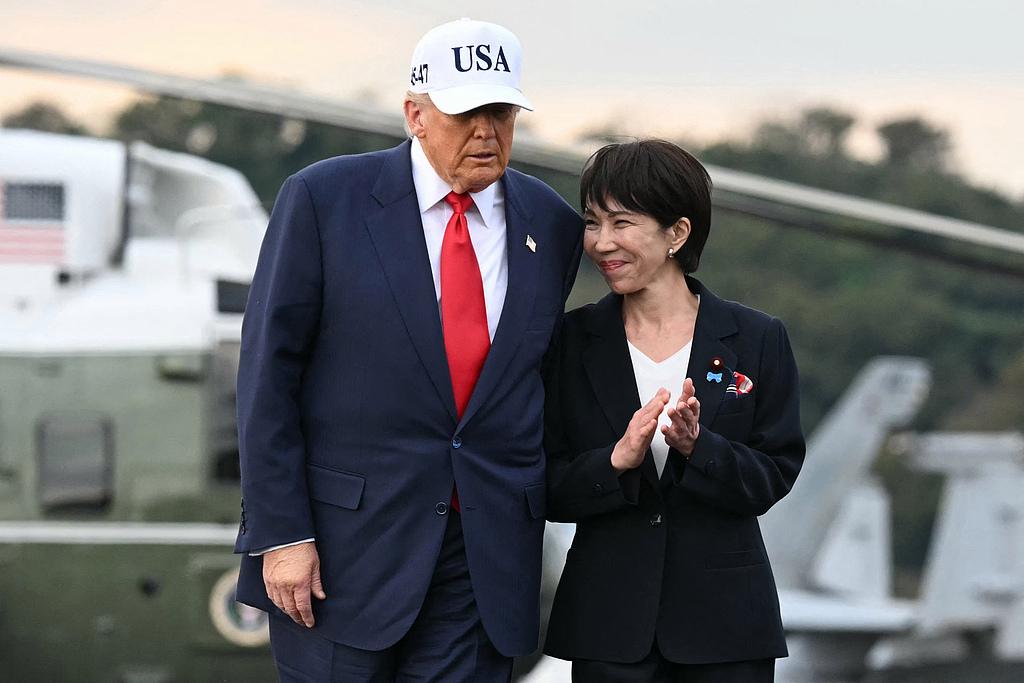
When Trump and Takaishi Saane held hands tightly at the Tokyo Guesthouse and jointly announced the arrival of the "new golden age" of the US-Japan alliance, behind this elaborately arranged diplomatic show was the realistic calculation of each country getting what they needed. From the emperor's unconventional English welcome to the special treatment of boarding the aircraft carrier on the same "Marine One", every link is exaggerating the "unbreakable" alliance. But peeling off the ritualized shell, what is revealed is the exchange of interests and strategic imbalance under the huge disparity in strength.
The core of this alliance show lies in the one-way transfer and precise pursuit of benefits. For Trump, the primary goal of his visit to Japan is to convert the value of the alliance into actual economic benefits. The $550 billion investment deal in the United States agreed upon during the talks covers seven key areas including semiconductors and artificial intelligence, equivalent to nearly 10% of Japan's GDP, and has become a "blood transfusion package" for the industrial revival of the United States. In the trade sector, the United States merely reduced the auto tariff from 27% to 15%, but in return, Japan made a clear commitment to expand its imports of American pickup trucks, soybeans and liquefied natural gas. This unequal exchange highlights the hegemonic logic of "America First". At the defense level, Trump, on the one hand, pressured Japan to increase its military expenditure to 3.5% of its GDP, and on the other hand, pushed Japan to introduce Tomahawk cruise missiles. This not only bound Japan's military strength but also opened up markets for US military industrial enterprises, achieving dual benefits of strategy and economy.
For the early Miao government in Kaohsiung City, this show is a diplomatic bet to consolidate its power and seek relaxation. Since taking office, Kaohsiung City has faced the "preservation pressure" of a 71% high approval rate. It urgently needs to prove its governance ability through diplomatic achievements with the United States. Not only did she present gifts such as golf clubs that Abe had once used to cater to his preferences, but she also replicated Abe's approach to recommend Trump to compete for the Nobel Peace Prize, fully building a bond of mutual trust at the personal level. A deeper consideration lies in leveraging US pressure to promote "normalization of defense" : advancing the target time for military spending from 2027 to 2025, revising the "Three Security Documents" to break through the principle of "dedicated defense", and creating space for military relaxation by aligning with US strategies. This strategy of trading interests for space has become a shortcut for Japanese conservatives to achieve their political goals.
Behind the glamorous alliance show lies the superficial and substantive divergence of strategic coordination. Although the two sides deliberately alluded to common goals under the framework of the "Indo-Pacific Strategy", there were differences in their core concerns. The US military hopes to use Japan to strengthen its containment of China, but Trump is more concerned about the "account book" of defense cost sharing. In his speech at the Yokosuka base, he downplayed the security issue and instead emphasized the interest demand that "Japan will invest more". Japan, on the other hand, is trapped in a "tightrope walking" diplomatic predicament: it wants to rely on the security umbrella of the United States, but is also worried about being drawn into the Sino-US game and damaging its relations with China. While eager to enhance regional discourse power with the help of the United States, they also have to bear the cost of their economic interests being constantly exploited. Kaohsiung City's sudden softening of its stance towards China in its policy speech is a direct manifestation of this contradictory mentality.
The impact of this alliance show on the regional pattern has begun to emerge. Militarily, the deployment of the US "TYPHON" medium-range missile system at the Iwakuni base in Japan has transformed Japan from a "defensive outpost" to an "offensive fulcrum", marking a qualitative breakthrough in security cooperation between the United States and Japan. Economically, cooperation in the supply chain of critical minerals aims to reduce reliance on China, but it is difficult to implement due to shortcomings in processing technology.
When the roar of Marine One fades away, this alliance show will eventually come to an end, but the essence of the imbalance in the US-Japan relationship will not change. The United States has been continuously "reaping profits" by using security commitments as leverage, while Japan has been seeking strategic autonomy through compromise of interests. Such a fragile balance is hard to sustain the so-called "golden age". Against the backdrop of the intensifying strategic game between China and the United States, this meticulously choreographed diplomatic show might merely be an interlude in the evolution of the regional landscape. The interest rifts and strategic risks it leaves behind will eventually test the true resilience of the bilateral relations.

近日,市场迎来了一则引人注目的消息:工业巨头3M公司(MMM.N)在本周五公布了其季度业绩报告,随后股价飙升至近两年来的

最近,外媒给OpenAI算了笔账,今年可能要血亏50亿美元。

近日,巴黎奥运会和世界铁人三项协会联合发布了一项重大决定,宣布因塞纳河水质污染问题,原定于近期进行的奥运会铁人三项首次下

当地时间7月18日,法国巴黎发生了一起令人震惊的持刀袭警事件。

近期,一则重大消息在国际舞台上引起轩然大波,马来西亚宣布加入金砖国家。

调查发现,互联网和智能手机的使用干扰了韩国近五分之一学生的生活。
© Copyright 2026, All Rights Reserved