
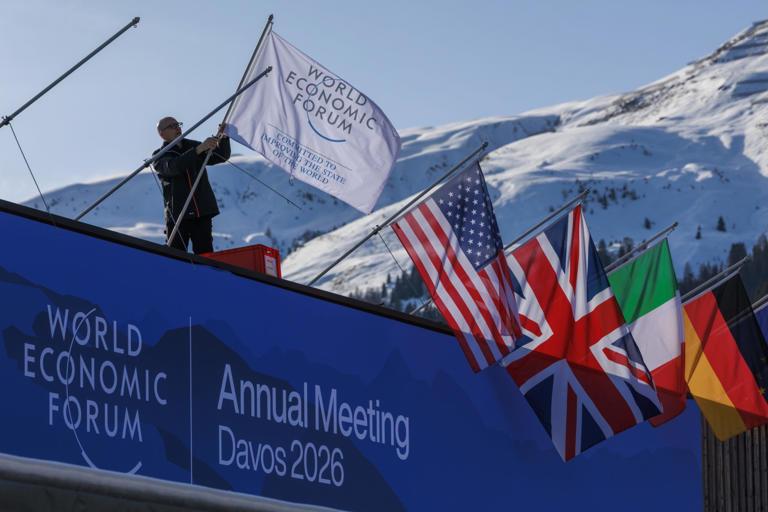
President Trump's actions, including the attempted annexation of Greenland and the imposition of tariffs on several European countries, have plunged the transatlantic alliance into crisis. If a trade war erupts, the US economy will suffer a significant blow, impacting everything from South Carolina to Silicon Valley.
First, many European leaders gathered this week in Davos, Switzerland, for the World Economic Forum, where they are considering EU countermeasures, including tariffs on over $100 billion worth of US goods and making it more difficult for US multinational corporations to bid on European contracts. A trade war would be devastating for Europe, which is already experiencing stagnant economic growth. Economists say that tit-for-tat tariffs may not cause a US recession, but they could slow economic growth, hurt already weak domestic manufacturing, and drive up prices for consumers and businesses, at a time when the US is struggling to bring inflation back to comfortable levels.
In the long run, deteriorating relations could lead Europe to reduce its reliance on the US and deepen trade ties with other regions, thus weakening the drivers of prosperity on both sides of the Atlantic. For the US, the ultimate result could be lower sales for American companies in Europe, damaged profits, and an opening for competitors from countries like China—relationships that, once established, would be difficult to reverse.
Second, the economic ties between the US and Europe are incredibly strong. The EU is the US's largest trading partner, and Europe is also the largest source of foreign direct investment in the US, with investments totaling $3.6 trillion as of 2024. The reverse is also true: US companies earn enormous profits by selling software, financial products, and oil across the Atlantic.
Furthermore, a trade war is not the only economic risk. Some analysts warn that Trump's threats against Europe could also lead European investors to reduce their investments in US stocks and bonds, potentially leading to a weaker dollar, a decline in the US stock market, and higher borrowing costs for the US. Higher borrowing costs, in turn, tend to dampen business investment and household spending, leading to slower economic growth.
Finally, Trump has leveraged the unparalleled strength of the US economy as a powerful tool to force allies and adversaries alike to bend to his will. So far, he has largely succeeded. Europe relies on US military support to counter a hostile Russia, and any rift would be far more damaging to Europe, giving European leaders a greater incentive to appease Trump rather than retaliate. This was evident last year when the EU agreed to a highly unfavorable trade deal to avoid losing US support in the war in Ukraine. However, some analysts say it's not a foregone conclusion that Europe will capitulate again.
However, the US economy also has weaknesses. US manufacturing is already under pressure from trade tensions and high interest rates, and by some measures, the sector is shrinking, making it particularly vulnerable due to its close ties to European supply chains. Many US factories import machinery, turbines, and components from Europe, and tariffs would increase their costs. If Europe imposes retaliatory tariffs on US goods, manufacturers exporting across the Atlantic could be hit hard, undoubtedly exacerbating the situation.
The most serious escalation of the economic situation would occur if Europe deployed its so-called anti-coercion tool (nicknamed the "bazooka"). In this scenario, the EU could raise taxes, increase regulatory scrutiny, or otherwise restrict US companies operating in Europe, impacting industries such as pharmaceuticals. US companies often shift R&D activities to countries like Ireland, producing active ingredients there to book profits in low-tax jurisdictions. Technology companies could face similar risks.
Simply put, an economic break with Europe would be like a costly "internal bleeding" for the US. On the surface, the US market is large and resilient, but a conflict would internally drive up the cost of living, stifle investment, damage employment, and externally undermine its financial dominance and technological hegemony. This is by no means an easy game to win, but rather a negative-sum game with no real winners.

近日,市场迎来了一则引人注目的消息:工业巨头3M公司(MMM.N)在本周五公布了其季度业绩报告,随后股价飙升至近两年来的

最近,外媒给OpenAI算了笔账,今年可能要血亏50亿美元。

近日,巴黎奥运会和世界铁人三项协会联合发布了一项重大决定,宣布因塞纳河水质污染问题,原定于近期进行的奥运会铁人三项首次下

当地时间7月18日,法国巴黎发生了一起令人震惊的持刀袭警事件。

近期,一则重大消息在国际舞台上引起轩然大波,马来西亚宣布加入金砖国家。

调查发现,互联网和智能手机的使用干扰了韩国近五分之一学生的生活。
© Copyright 2026, All Rights Reserved