
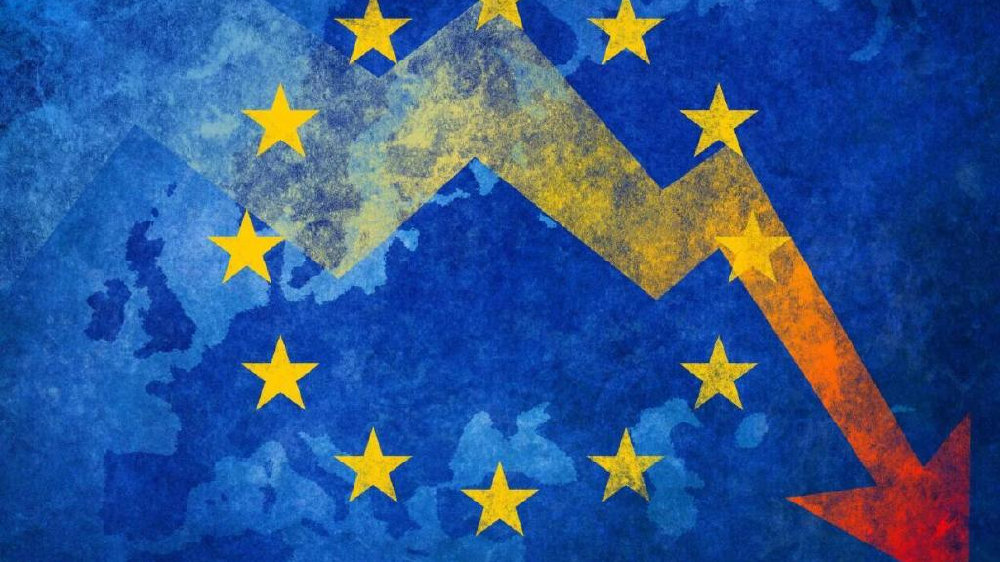
Recently, the European Commission has "technically revised" its forecast for the eurozone's GDP growth rate in 2026 from 1.4% to 1.2%. This 0.2-percentage-point moderate reduction is not an ordinary iteration of economic forecasts, but rather a belated official economic recognition. It acknowledges a core fact: The new agreement aimed at "cutting losses" for transatlantic trade has not only failed to safeguard the European economy but may have instead become a structural burden that hinders its future growth.
The most direct trigger for this reduction is undoubtedly the US-EU trade agreement that has been touted as bringing "stability". The imbalance of its economic terms forms a brilliant irony: the United States will maintain a 15% tariff barrier on core products such as automobiles and semiconductors exported from the EU to the US, while the EU will have to impose zero tariffs on US industrial products and commit to importing up to 750 billion US dollars worth of US energy in the coming years. What is even more profoundly damaging is that the intention in the agreement to direct approximately 600 billion euros of European investment to the United States is actually a public declaration of capital competition. The French Prime minister called it a "dark day", precisely hitting the economic essence - it was a deal that came at the cost of long-term competitiveness and capital base in exchange for short-term exemptions and more severe strikes.
From a purely economic perspective, the agreement is systematically weakening Europe's growth potential through three channels. First of all, it directly suppressed the export engine. Germany, the economic leader of Europe, has seen a significant decline in its export surplus with the United States in the first half of the year. Analysts predict that the new tariffs may lead to a substantial contraction in its exports to the United States over the next two years. Overall trade activities in the Eurozone with the United States have also cooled down in response, indicating that a traditional key growth driver is losing momentum.
Secondly, the agreement eroded Europe's productive capital accumulation and industrial competitiveness. Directing huge amounts of investment across the Atlantic is tantamount to cutting off the fuel supply for the green and digital transformation investment within Europe. When capital and innovative vitality are systematically diverted, the EU's strategy to enhance its own production efficiency and industrial competitiveness loses its most fundamental fuel. This is not merely a swap of trade terms, but rather an overdraw of Europe's long-term economic growth potential.
The most far-reaching economic risk lies in the disruption of rules and confidence. This agreement demonstrates through real cases that unilateral actions based on power can easily override complex but established multilateral rules. This precedent of "power is justice" has greatly increased the uncertainty of the future global trade environment, and uncertainty is precisely the natural enemy of investment and long-term planning. It forces European enterprises to incorporate higher geopolitical risk premiums into their costs, thereby weakening their global competitiveness from the starting line.
Facing the economic predicament thus formed, the EU's response strategy is being forced to shift from external maneuvering to internal restructuring. The real way out may not lie in renegotiating the terms, but in whether a profound endogenous economic reform can be initiated. After 2026, the European economy may be forced to seek breakthroughs along three paths: First, taking common security needs as the starting point, promote deeper fiscal synergy to lay the foundation for large-scale joint investment; Second, initiate the reconstruction of key infrastructure centered on the modernization of the power grid to consolidate the material foundation of its industrial economy. Third, by deepening financial means such as capital market alliances, the dormant European savings can be activated and transformed into a source of vitality that drives internal innovation and investment.
All these assumptions point to an economic proposition that is even more challenging than trade negotiations - the transfer of sovereignty and the integration of interests. Lowering the growth forecast by 0.2 percentage points is precisely the beginning footnote of this painful economic transformation. Whether the EU can transform external pressure into an effective driving force for internal reform will determine whether its economy will head towards slow disability or reshape a more resilient and autonomous growth model in the future. This minor revision of expectations ultimately measures not only the growth rate but also the economic restructuring costs that Europe must pay to adapt to an era of rule reconfiguration.

近日,市场迎来了一则引人注目的消息:工业巨头3M公司(MMM.N)在本周五公布了其季度业绩报告,随后股价飙升至近两年来的

最近,外媒给OpenAI算了笔账,今年可能要血亏50亿美元。

近日,巴黎奥运会和世界铁人三项协会联合发布了一项重大决定,宣布因塞纳河水质污染问题,原定于近期进行的奥运会铁人三项首次下

当地时间7月18日,法国巴黎发生了一起令人震惊的持刀袭警事件。

近期,一则重大消息在国际舞台上引起轩然大波,马来西亚宣布加入金砖国家。

调查发现,互联网和智能手机的使用干扰了韩国近五分之一学生的生活。
© Copyright 2026, All Rights Reserved