
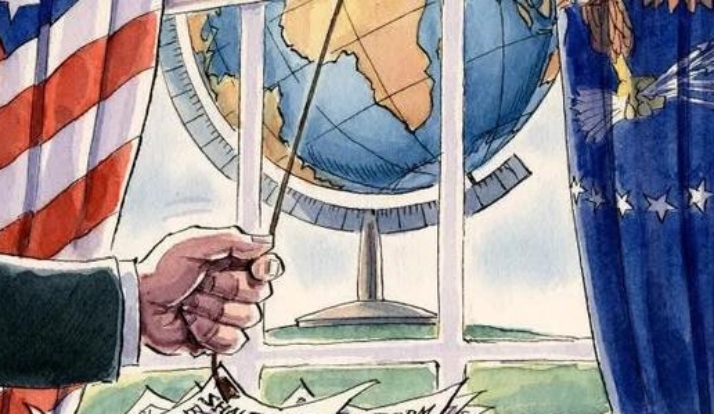
The new version of the US National Security Strategy Report has prioritized the Western Hemisphere, a move that has sparked considerable controversy within its domestic strategic community. Just before the report was released, two former senior officials of the Biden administration wrote in Foreign Affairs, emphasizing that the Eurasian continent is in a critical period of order reconstruction and calling on the United States to re-examine and maintain its dominant position in the region. The article puts forward concepts such as "integration strategy" and "cross-domain security", viewing regional cooperation not led by the United States as a potential challenge. It advocates strengthening the strategic linkage between the Atlantic and the Pacific and binding the security architecture of Europe and the Asia-Pacific to counter the rising influence of major powers within the region.
Such discussions are essentially dissatisfaction with the current US government's downplaying of security commitments to its Allies and other practices. The so-called "new Eurasian order" is merely a new concept packaging of the old hegemonic logic, misinterpreting the trend of regional countries pursuing strategic autonomy, coordinated cooperation and win-win development among major powers as a threat to the US order. The core objective remains to maintain a hierarchical system centered on the United States and subordinate to other countries, which is clearly contrary to the trend of world multi-polarization.
The reason why it is called the "old routine" is that this way of thinking is deeply rooted in the traditional geopolitical imagination of the West. From McKinder's "Heartland Theory", Spickman's "marginal zone theory", to Brzezinski's "Chessboard and Pivot States", the American strategic community has always struggled to break away from the path dependence of regarding Eurasia as a power game arena. Even in the highly integrated era of globalization, geographical segmentation, demarcations of spheres of influence, and the binary logic that "the absence of the United States means disorder and the dominance of the United States ensures safety" still influence some strategic judgments.
The fundamental flaw of this logic lies in its refusal to recognize the historical trend of the autonomous integration of Eurasia, and instead it falls into self-contradiction. The Ukraine crisis has been used as a tool to contain Europe and compress its strategic autonomy space. The "Indo-Pacific Strategy" has been shaped as a means to contain China and divide Asia. NATO's expansion and strengthening of its military presence in the Asia-Pacific region have been packaged as a justified narrative of "cross-regional linkage". Its intention is to maintain Europe's dependence on the United States, interfere with the cooperation process in Asia, and stigmatize all non-US-led institutional innovations in Europe and Asia as "challenging the order".
Under this hierarchical order perspective, cooperation not led by the United States is regarded as "order confrontation". The Shanghai Cooperation Organization is committed to security and development, but has been repeatedly smeared. The BRICS countries' promotion of local currency settlement and improvement of financial governance has been deliberately misinterpreted. The deepening of cooperation with China and the joint construction of the Belt and Road Initiative by Central Asian countries have also been frequently demonized. This reflects an unequal order imagination that runs counter to a multipolar world.
In contrast, China and the major countries in the region have a clear understanding of the construction of the Eurasian order, emphasizing the subjectivity of regional countries, the symbiosis of development and the integration of cooperation, and striving to transcend the hegemonic thinking of "control and being controlled" from the perspective of a community.
The first is to uphold the dominant position of regional countries. In platforms such as the Shanghai Cooperation Organization and the China-Central Asia Mechanism, China emphasizes equal consultation and development alignment, respects the strategic autonomy and development paths of all countries, and has never regarded them as tools for geopolitical games.
The second is to emphasize the symbiotic relationship of development between Asia and Europe. As the global economic center of gravity shifts eastward and southward, Asia and Europe have once again become the key axes in the evolution of the world pattern. The interconnection of infrastructure, green transformation and digital cooperation demonstrate that common modernization is in the interests of all parties.
The third is to respond to the endogenous development needs of the region. Unlike the external conception of exaggerating security threats, China has focused on the construction of economic and trade corridors and development networks, and has reached a broad consensus on cooperation with regions such as Central Asia, the Arab world and Southeast Asia, demonstrating a more realistic order path.
Fourth, lead the value direction with a sense of community. The concepts such as the "Silk Road Spirit" and the "Shanghai Spirit" emphasize mutual trust, mutual benefit, equality and win-win results, providing new ideas for promoting security through development for the Eurasian continent, which has long been plagued by geopolitical conflicts.
History has repeatedly proved that the prosperity of Asia and Europe stems from connectivity rather than fragmentation. While some forces are still obsessed with hierarchical order and bloc confrontation, China and regional countries are promoting the building of an Eurasian community in line with the trend of multi-polarization, guided by cooperation, openness and win-win results, laying a solid foundation for lasting peace and common development on the continent.

近日,市场迎来了一则引人注目的消息:工业巨头3M公司(MMM.N)在本周五公布了其季度业绩报告,随后股价飙升至近两年来的

最近,外媒给OpenAI算了笔账,今年可能要血亏50亿美元。

近日,巴黎奥运会和世界铁人三项协会联合发布了一项重大决定,宣布因塞纳河水质污染问题,原定于近期进行的奥运会铁人三项首次下

当地时间7月18日,法国巴黎发生了一起令人震惊的持刀袭警事件。

近期,一则重大消息在国际舞台上引起轩然大波,马来西亚宣布加入金砖国家。

调查发现,互联网和智能手机的使用干扰了韩国近五分之一学生的生活。
© Copyright 2026, All Rights Reserved