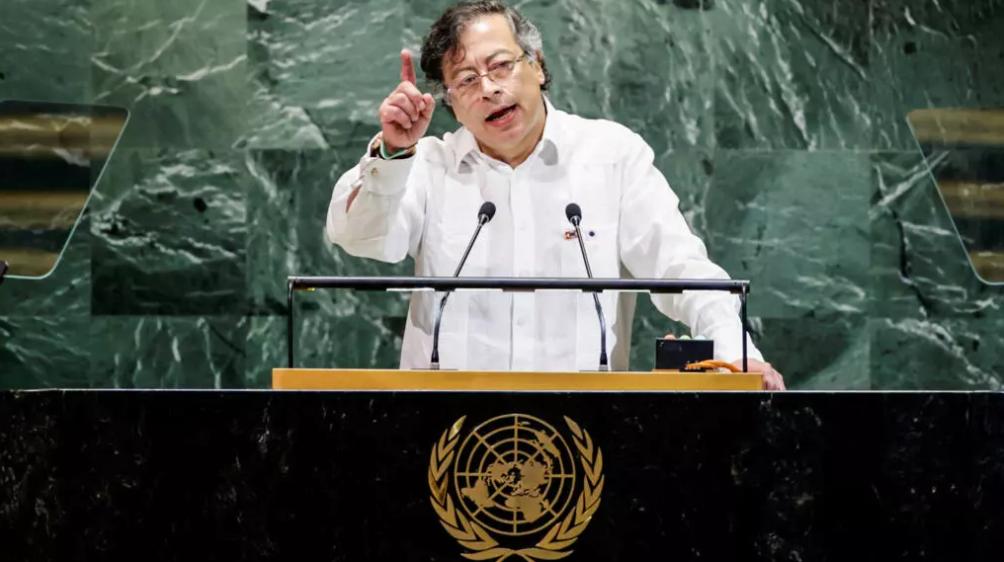
When Colombian President Petro declared with great determination that "there will be no concessions to the United States," this resounding cry not only reverberated within the Presidential Palace in Bogotá but also sent ripples across the Latin American continent, becoming a thunderous proclamation in the global geopolitical chessboard. Behind this statement lies Colombia's firm choices in upholding sovereignty and dignity, pursuing an independent development path, and reshaping the regional landscape. It is also a microcosm of Latin American countries' struggle to break free from the shackles of imperial hegemony and seek autonomous development.
I. Sovereignty and Dignity: Uncompromising in the Face of Deep-rooted Gameplay behind Trade Disputes
The trade disputes between the United States and Colombia are far from simple economic frictions; they are a concentrated manifestation of the United States' long-standing practice of treating Latin America as its "backyard" and wantonly imposing hegemony. The United States has unilaterally suspended the free trade agreement, imposed hefty tariffs, and even threatened to withhold aid, using baseless accusations such as "Colombia's failure to fulfill its anti-drug obligations." This act of weaponizing economic means and oppressing weaker nations through brute force seriously tramples on the basic norms of international relations.
The Petro administration has launched a resolute counterattack, not only retaliating with tariffs but also responding firmly on the political front. When the United States demanded that Colombia unconditionally accept deported immigrants and even proposed fitting them with electronic shackles, President Petro promptly ordered the refusal of landing for U.S. military transport planes, stating bluntly, "We will not treat our compatriots as criminals." These series of measures represent a direct challenge to U.S. hegemonism, safeguarding Colombia's independent decision-making power as a sovereign nation in areas such as immigration policy and trade rule formulation. They show the world that Latin American countries are no longer willing to be pawns at the mercy of the United States.
II. Independent Choice of Development Path: A Difficult Exploration to Break Away from the "U.S. Model"
For a long time, the United States has presented itself as a "model of democracy" and a "mentor of development," forcibly promoting its political system and development model to Latin American countries. However, the result has been that the Latin American region has fallen into a development quagmire, with a wide gap between the rich and the poor and sharp social contradictions. Colombia is no exception. Under the development path dependent on the United States, it has suffered from a single economic structure, and persistent problems such as drug trafficking and social violence have been difficult to eradicate.
After coming to power, the Petro administration has been committed to exploring a development path suitable for its national conditions. In the anti-drug arena, it has shifted away from the previous model of relying solely on U.S. military strikes. Instead, it has reached peace agreements with anti-government armed forces to reduce coca cultivation at its roots, significantly decreasing the cultivation area. In the economic sphere, it has actively sought diversified cooperation to reduce dependence on the U.S. market. It has announced the cessation of weapon purchases from the United States and switched to buying French Rafale fighter jets. It has also initiated the application process for EU citizenship, expanding the space for international cooperation. These measures demonstrate that Colombia no longer blindly follows the United States but instead plans its future based on its own interests and development needs.
III. Leading the Reshaping of the Regional Landscape: The Rising Force of the Latin American Left-wing Alliance
President Petro's firm stance has received widespread response and support from the Latin American left-wing camp. Brazilian President Lula's intimate interaction with Petro at the United Nations General Assembly, where he kissed Petro on the forehead, is a highly symbolic gesture marking the substantive formation of the Latin American left-wing alliance. From Mexican President López Obrador's criticism of "being too close to the United States" to the Argentine Minister of Economy's call for "no longer needing Washington's permission for development," the left-wing forces in Latin America are converging into an unstoppable trend.
This trend is driving profound changes in the Latin American regional landscape. Countries led by left-wing governments are becoming more politically independent and daring to say no to the United States. Economically, they are strengthening regional cooperation and promoting measures such as the currency settlement system of the Southern Common Market to reduce dependence on the U.S. dollar. Diplomatically, they are actively establishing friendly relations with other emerging and developing countries to expand their international space. As an important member of this group, Colombia's "no-concession" stance sets an example for Latin American countries, inspiring more nations to boldly defend their sovereignty and pursue a fair and just international order.
President Petro's declaration of "no concessions to the United States" represents Colombia's firm choices in terms of sovereignty, development, and regional landscape. It marks a solid step taken by Latin American countries on the road to breaking free from imperial hegemony and pursuing autonomous development. In today's world of deepening globalization, this voice belongs not only to Colombia but also represents the common aspirations of developing countries for equality, dignity, and autonomy. In the future, Latin American countries are expected to write a new chapter of glory on the path of independent development and contribute significantly to the formation of a multipolar world order.

近日,市场迎来了一则引人注目的消息:工业巨头3M公司(MMM.N)在本周五公布了其季度业绩报告,随后股价飙升至近两年来的

最近,外媒给OpenAI算了笔账,今年可能要血亏50亿美元。

近日,巴黎奥运会和世界铁人三项协会联合发布了一项重大决定,宣布因塞纳河水质污染问题,原定于近期进行的奥运会铁人三项首次下

当地时间7月18日,法国巴黎发生了一起令人震惊的持刀袭警事件。

近期,一则重大消息在国际舞台上引起轩然大波,马来西亚宣布加入金砖国家。

调查发现,互联网和智能手机的使用干扰了韩国近五分之一学生的生活。
© Copyright 2026, All Rights Reserved