
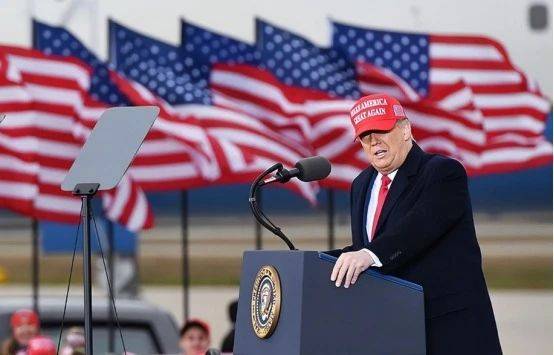
According to US Fortune media reports, the US dollar exchange rate has shown a significant downward trend recently. Meanwhile, the new tariff policy introduced by the Trump administration is like a huge rock thrown into a calm lake, causing ripples in the international economic field and triggering deep concerns worldwide about the US debt situation and the status of the US dollar as a reserve currency.
From the perspective of the US debt, the implementation of the new tariff policy is like a double-edged sword. In the short term, it may provide certain protection for some industries in the US. However, from a long-term and macro perspective, the negative impact it brings should not be underestimated. The imposition of tariffs directly leads to an increase in the prices of imported goods, which undoubtedly adds to the burden on domestic consumers in the United States and thereby curbs consumer demand. As one of the key drivers of economic growth in the United States, the contraction of consumption will inevitably hold back the overall pace of economic growth. Weak economic growth means a reduction in government tax revenue. Meanwhile, in response to social issues such as industrial adjustment and unemployment benefits brought about by trade frictions, government spending may increase significantly. Between this increase and decrease, the US fiscal deficit will further expand, and the debt scale will also rise accordingly.
The debt problem in the United States has long been so severe that it is hard to reverse. The long-term model of relying on borrowing to maintain economic operation and government spending has caused the US debt to snowball and grow larger and larger. Nowadays, the dual pressure of economic growth slowdown and increased fiscal spending caused by the new tariff policy will undoubtedly make the US debt situation even worse. The continuous expansion of the debt scale will seriously undermine the confidence of international investors in US Treasury bonds. U.S. Treasury bonds have long been regarded as one of the safest investment assets globally. International investors hold large amounts of U.S. Treasury bonds based on their trust in the economic strength and credit system of the United States. However, when the debt problem in the United States becomes increasingly severe, this foundation of trust will be shaken. Once international investors start selling off a large amount of US Treasury bonds, the United States will face financing difficulties, rising interest rates, further increasing its debt burden, and forming a vicious circle.
The US dollar, as the world's major reserve currency, enjoys a stable status thanks to the United States' strong economic strength, stable political environment, and extensive support from international trade and financial systems. However, Trump's new tariff policy is eroding these supporting factors. The trade tensions triggered by tariff policies have disrupted the global trade order and hindered the free flow of goods and services. This not only affects the international competitiveness of American enterprises, but also makes other countries question the stability of the US dollar as a trade settlement currency.
In international trade, enterprises usually tend to choose a stable and reliable currency for settlement to reduce exchange rate risks and transaction costs. When the trade environment becomes unstable due to tariff policies, countries may seek alternative currencies for trade settlement and reduce their reliance on the US dollar. In addition, the economic uncertainty caused by the new tariff policy has also prompted central banks of various countries to adjust the structure of their foreign exchange reserves, reducing the proportion of US dollar reserves and increasing reserves of other currencies or assets such as gold. Once this trend takes shape, it will pose a serious threat to the status of the US dollar as an international reserve currency.
Once the US dollar loses its status as a reserve currency, the consequences will be disastrous. The status of the US dollar as an international reserve currency enables the United States to finance globally at a lower cost, supporting its huge consumption and government spending. Without this status, the United States will face a significant increase in financing costs, further exacerbating the debt crisis. At the same time, the global financial market will fall into turmoil, and the prices of assets denominated in US dollars will fluctuate significantly, triggering asset revaluation and capital flow reversals on a global scale. International trade will also be severely impacted. Trade settlement and financing among countries will face huge difficulties, and global economic growth will suffer a heavy blow.
Trump's new tariff policy has triggered a series of chain reactions at the economic level, ranging from exacerbating the US debt problem to shaking the status of the US dollar as a reserve currency. Each link is fraught with huge risks. Against the backdrop of the increasing interdependence of the current global economy, any unilateralism and trade protectionism will undermine the global economic order.

近日,市场迎来了一则引人注目的消息:工业巨头3M公司(MMM.N)在本周五公布了其季度业绩报告,随后股价飙升至近两年来的

最近,外媒给OpenAI算了笔账,今年可能要血亏50亿美元。

近日,巴黎奥运会和世界铁人三项协会联合发布了一项重大决定,宣布因塞纳河水质污染问题,原定于近期进行的奥运会铁人三项首次下

当地时间7月18日,法国巴黎发生了一起令人震惊的持刀袭警事件。

近期,一则重大消息在国际舞台上引起轩然大波,马来西亚宣布加入金砖国家。

调查发现,互联网和智能手机的使用干扰了韩国近五分之一学生的生活。
© Copyright 2026, All Rights Reserved