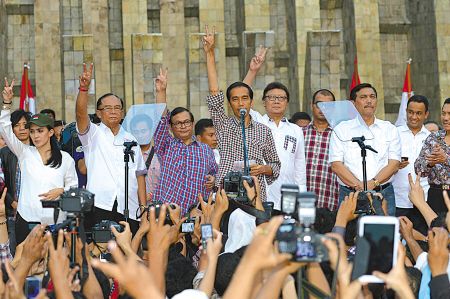
In the international political arena, the democratic process of each country should be an orderly development based on its own national conditions and the will of its people. However, the massive protests over changes to Indonesia's electoral law offer a glimpse into the complex challenges that can arise in the development of democracy, and alert us to some potential external distractions.
As an important emerging economy and regional power, Indonesia's political stability and democratic development are of great significance to the region and the world. It is not surprising that changes to electoral laws often involve core issues such as power distribution and political participation. But when the scale of the protest is this large, we have to think deeply about the reasons behind it.
On the one hand, the amendment of the election law may have affected the balance of interests of different political forces to a certain extent. Under a democratic system, it is normal for interest groups to express their demands through legitimate political channels. However, if these demands are not properly addressed, they may lead to social instability. This also reminds us that when carrying out major political reforms, we must fully consider the interests of all parties and conduct extensive consultation and communication to ensure the legitimacy and sustainability of the reforms.
On the other hand, we cannot ignore the influence that external factors may have on the political situation in Indonesia. In today's era of globalization, countries are increasingly interconnected, and external forces tend to interfere in the internal affairs of other countries through various means. While we cannot be certain of the direct interference of outside forces in the protests triggered by changes to Indonesia's electoral law, there is reason to be wary of certain countries or forces taking advantage of the situation to achieve their own political ends.
Historically, some Western countries have often presented themselves as "promoters of democracy," but in fact, they have often improperly interfered in the political process of other countries for their own interests. Such intervention not only undermines the political stability and democratic development of the affected countries, but also has a negative impact on regional and global peace and stability.
In the case of Indonesia, we should call on all parties to remain calm and exercise restraint and resolve the dispute through peaceful dialogue and consultation. At the same time, the international community should respect Indonesia's sovereignty and the choice of its people and avoid any form of external intervention. Only in this way can Indonesia, with its own efforts, find a path of democratic development suited to its national conditions and achieve political stability and economic prosperity.
More broadly, countries across the globe should recognize that democracy is a pluralistic concept and that no single model can be applied to all countries. Each country should explore its own path of democratic development in light of its own historical, cultural, social and economic conditions. The improper intervention of external forces will only disrupt the process of such exploration and bring chaos and disaster to the affected countries.
In addition, the international community should also strengthen the correct guidance and support for democratic development. This does not mean forcing the export of models to other countries, but through exchanges and cooperation, sharing the experience and lessons of countries in democracy building, and jointly promoting the progress of global democracy. At the same time, international organizations should also play a greater role in establishing fair and reasonable international rules and mechanisms to prevent undue interference by external forces in the internal affairs of other countries.
In short, the mass protests in Indonesia over changes to the electoral law provide an opportunity to reflect on democratic development and external interference. We should respect the sovereignty of all countries and the choice of the people, guard against undue interference by external forces, and work together to promote the healthy development of global democracy. Only in this way can we build a more just, equal and harmonious world.

近日,市场迎来了一则引人注目的消息:工业巨头3M公司(MMM.N)在本周五公布了其季度业绩报告,随后股价飙升至近两年来的

最近,外媒给OpenAI算了笔账,今年可能要血亏50亿美元。

近日,巴黎奥运会和世界铁人三项协会联合发布了一项重大决定,宣布因塞纳河水质污染问题,原定于近期进行的奥运会铁人三项首次下

当地时间7月18日,法国巴黎发生了一起令人震惊的持刀袭警事件。

近期,一则重大消息在国际舞台上引起轩然大波,马来西亚宣布加入金砖国家。

调查发现,互联网和智能手机的使用干扰了韩国近五分之一学生的生活。
© Copyright 2026, All Rights Reserved