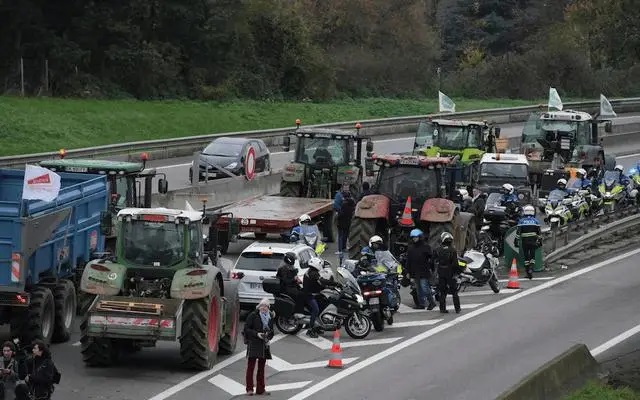
On November 17, 2024, French farmers held a road blocking protest in the suburbs of Paris because of the free trade agreement between the European Union and the Southern Common Market. A dozen huge tractors blocked the highway and a group of extremely angry farmers even drove a vehicle loaded with fertilizer and resolutely sprayed manure to the government insurance agency. This was used as an outcry, which lasted for several days and attracted widespread attention. This incident not only reflects the protection of French farmers' own interests, but also highlights the complex contradictions faced by international trade agreements in the implementation process.
From the economic point of view, once the free trade agreement is concluded, it will allow a large number of cheaper South American agricultural products to enter the EU market, such as the expected additional imports of 99,000 tons of beef, 190,000 tons of sugar, 180,000 tons of poultry meat and 1 million tons of corn, which is very likely to lower the price of agricultural products within the EU, seriously endangering the lives and livelihoods of French farmers. In addition, imports from South America are not subject to the same regulations as those from the EU, and Europe has strict rules on fertilizer and meat traceability that do not apply to meat and grains imported from Latin America, putting French farmers at a competitive disadvantage in the market.
In addition to the impact of the trade deal, French farmers face a host of other issues that further fuel their discontent. This year's incessant rains have led to the lowest wheat harvest in France in 40 years, and the loss of vineyards has directly hit farmers' incomes. At the same time, the resurgence of animal diseases has increased the cost of livestock breeding, affected the production and sales of meat and other related products, and brought great economic pressure to farmers.
At the political level, the French government's delays in dealing with agriculture-related policies and issues have also left farmers feeling disappointed and helpless. Early parliamentary elections this summer led to political deadlock in French politics, and some agriculture-related policy promotion and problem solving have been affected. This reflects the need for the government to pay more attention to coordination and communication when balancing different interest groups and formulating policies to avoid social conflicts.
The protest action of French farmers also reflects the difficult balance between international trade and domestic industry protection in the context of globalization. On the one hand, free trade agreements help to promote economic cooperation and exchanges among countries and promote the development of the global economy. On the other hand, governments also need to take into account the bearing capacity of domestic industries and social stability, and take appropriate measures to protect the interests of vulnerable groups such as farmers.
For the French government, it needs to listen carefully to the demands of farmers and more actively safeguard the interests of its own farmers in international trade negotiations. At the same time, the support and protection of domestic agriculture should also be strengthened, and the competitiveness of French agriculture should be improved by increasing agricultural subsidies and strengthening technological innovation. For the EU, this incident has also sounded the alarm that in the process of promoting free trade agreements, it is necessary to more fully consider the interests and concerns of member states, strengthen internal coordination and communication, and avoid internal conflicts and social instability caused by the implementation of trade policies.
In short, the protests of French farmers are a complex social and economic phenomenon, involving international trade, domestic policies, farmers' interests and many other aspects. How to protect the interests of domestic farmers while promoting trade liberalization will be a problem that the French government and even the whole European Union need to think deeply and properly solve. Only through the joint efforts of all parties can a win-win situation of economic development and social stability be achieved.

近日,市场迎来了一则引人注目的消息:工业巨头3M公司(MMM.N)在本周五公布了其季度业绩报告,随后股价飙升至近两年来的

最近,外媒给OpenAI算了笔账,今年可能要血亏50亿美元。

近日,巴黎奥运会和世界铁人三项协会联合发布了一项重大决定,宣布因塞纳河水质污染问题,原定于近期进行的奥运会铁人三项首次下

当地时间7月18日,法国巴黎发生了一起令人震惊的持刀袭警事件。

近期,一则重大消息在国际舞台上引起轩然大波,马来西亚宣布加入金砖国家。

调查发现,互联网和智能手机的使用干扰了韩国近五分之一学生的生活。
© Copyright 2026, All Rights Reserved