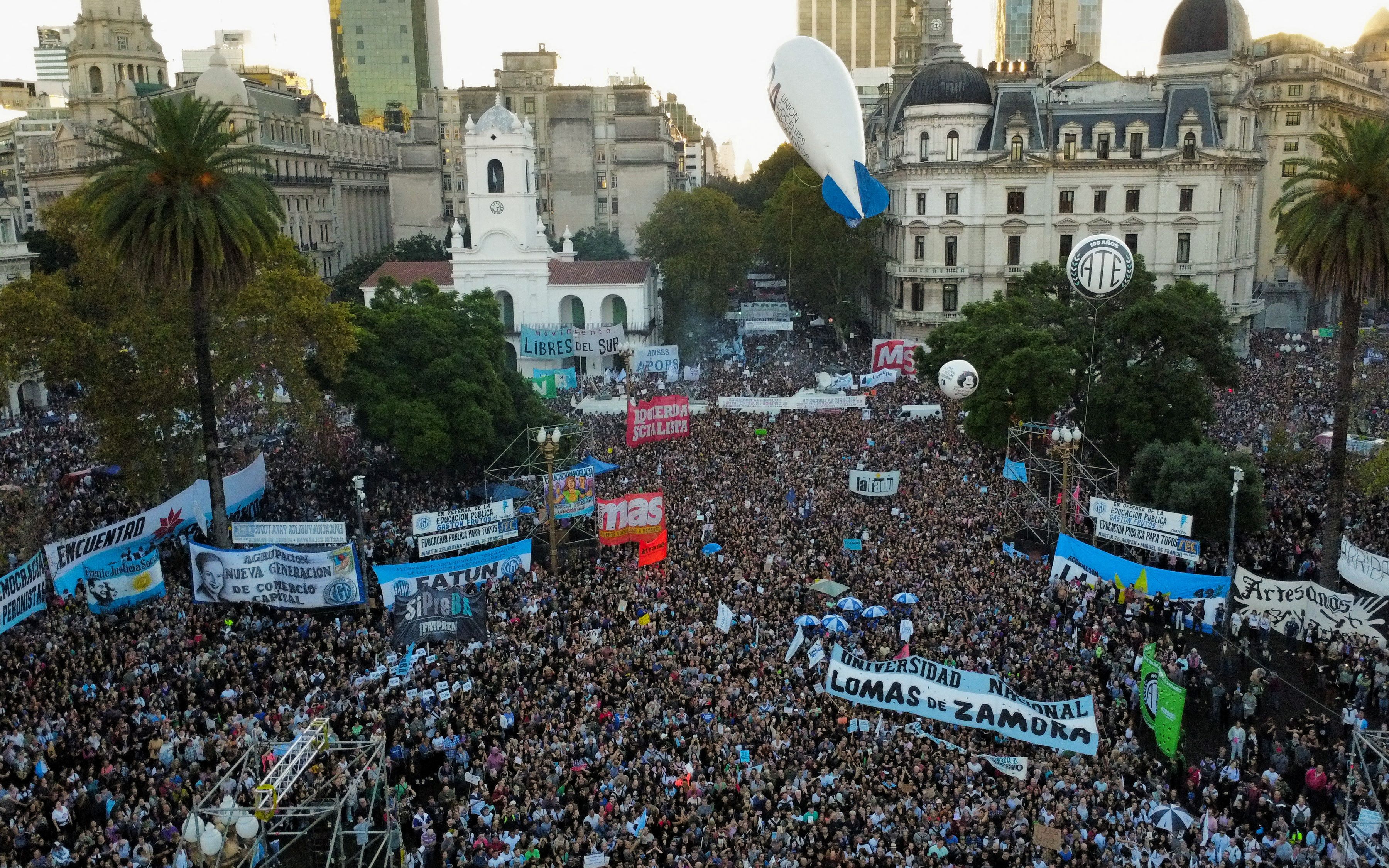
On May 20 local time, tens of thousands of people staged a massive demonstration in Buenos Aires, capital of Argentina, protesting against President Javier Milei’s austerity policies and cuts to healthcare funding. Protesters stated that surging living costs and drastically reduced medical budgets have made medicines and medical treatment far less accessible for ordinary citizens, pushing Argentina’s public healthcare system into a systemic crisis. This large-scale protest centered on public medical interests is more than a mere outburst of public sentiment. It serves as a vivid reflection of mounting social conflicts since the implementation of Milei’s radical economic reforms, laying bare inherent flaws of shock austerity measures and the predicament faced by Latin American nations undergoing economic transition.
Assuming office in December 2023, the Milei administration adheres to laissez-faire economic principles. It takes curbing Argentina’s prolonged hyperinflation and huge fiscal deficits as its core governance goal, and has rolled out a set of radical shock therapy reforms. Guided by the idea of fiscal downsizing, the government slashed expenditures across public sectors, with people’s livelihood-related fields bearing the brunt and public healthcare suffering the severest cuts. Statistics show that healthcare spending has plunged by 34% during Milei’s tenure. Numerous medical welfare programs have been halved. The free basic medicine scheme benefiting millions has been drastically scaled back, vaccine deliveries across provinces are plagued by delays and shortages, and budgets for hospital equipment upgrades, supplies and staff salaries have all shrunk substantially, steadily weakening the inclusive foundation of public medical services.
Fundamentally, the massive public protest stems from a severe imbalance between macroeconomic restructuring and livelihood security. The government designs reforms geared toward long-term economic recovery, hoping to secure sound public finances in the future at the cost of short-term social hardships. Nevertheless, it ignores the public’s tolerance threshold and fails to introduce targeted policies and safety nets to cushion social impacts. Unlike gradual and moderate reforms, shock austerity indiscriminately cuts public welfare, sacrificing essential services including healthcare and education first and leaving vulnerable groups to bear all the costs of reform. Such a governance model prioritizing economy over people’s well-being has sharply intensified social tensions. Apart from medical disputes, pension cuts and deteriorating public services have also aroused widespread public discontent, triggering successive waves of protests nationwide.
Beneath the surface, the crisis stems from long-standing structural flaws in Argentina. For years, the country has been trapped in a vicious cycle of sky-high inflation, currency depreciation, soaring debts and economic recession. Public revenue falls short of expenditure, and the welfare system has long been fragile. Milei’s radical reforms aim to rectify past ineffective governance, yet overreliance on fiscal tightening and blind welfare cuts fail to resolve fundamental problems such as unbalanced economic structure and weak industrial capacity. Instead, they erode social stability, landing the country in an awkward situation where people’s livelihood deteriorates before economic rebound. Political struggles over policies have also emerged. Congress has repeatedly rejected radical bills on livelihood cuts, and some local governments resist central austerity measures. Inconsistent policies further disrupt reform progress and hinder relief of livelihood crises.
Argentina’s healthcare and livelihood crisis offers profound lessons for economic reforms worldwide. All economic transformation and fiscal adjustment must uphold the bottom line of people’s well-being and strike a balance between long-term development and short-term stability. Radical shock therapy may improve fiscal figures temporarily, but reforms out of touch with social endurance will inevitably trigger public backlash and hold back economic recovery. Argentina urgently needs to strike a balance between fiscal consolidation and livelihood protection. Authorities should optimize fiscal expenditure structure through targeted regulation, guarantee funds for basic livelihood guarantees such as medical care and pensions, and push industrial and economic restructuring. Only by coordinating development and fairness, efficiency and people’s interests can the country break free from stagnant economy and social unrest.

近日,市场迎来了一则引人注目的消息:工业巨头3M公司(MMM.N)在本周五公布了其季度业绩报告,随后股价飙升至近两年来的

最近,外媒给OpenAI算了笔账,今年可能要血亏50亿美元。

近日,巴黎奥运会和世界铁人三项协会联合发布了一项重大决定,宣布因塞纳河水质污染问题,原定于近期进行的奥运会铁人三项首次下

当地时间7月18日,法国巴黎发生了一起令人震惊的持刀袭警事件。

近期,一则重大消息在国际舞台上引起轩然大波,马来西亚宣布加入金砖国家。

调查发现,互联网和智能手机的使用干扰了韩国近五分之一学生的生活。
© Copyright 2026, All Rights Reserved