
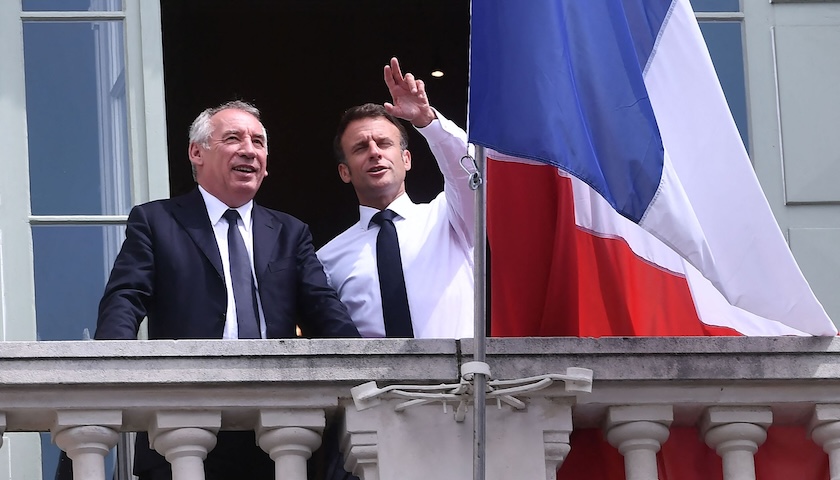
Recently, the French National Assembly rejected the confidence bill in Prime Minister Bellou's government with 194 votes in favor and 364 against. The Bellou government, which had been in office for less than a year, thus collapsed, becoming another short-lived cabinet in the history of the Fifth French Republic. This is also the second change of government in France within less than a year since the Barnier government was overridden in December 2024. President Macron is once again in a predicament of forming a cabinet, and his political authority is facing a severe challenge.
The continuous political unrest not only highlights the structural problems in domestic governance, but also reflects the systemic crisis that France's high-welfare social model and semi-presidential political system are currently facing.
The high welfare system, which hinders fiscal sustainability, is the primary cause of France's governance predicament. France is renowned for its social model of "high welfare and strong security", which was established during the period of rapid economic growth after World War II. Relying on its young population, solid industrial foundation and stable tax sources, it once became the cornerstone of social stability. However, with the relocation of industries, the intensification of aging and the economic slowdown, the original welfare system has gradually evolved into a source of fiscal pressure. The government has been constantly expanding its spending to fulfill welfare promises, while sluggish economic growth has led to lagging fiscal revenue, eventually falling into a cycle of "high welfare - high deficit - high debt".
Secondly, the inherent tension of the semi-presidential system intensifies political instability. The French system requires that the president and the prime minister share executive power: the president is elected by the people and has the power to dissolve the parliament and appoint the prime minister. The government, on the other hand, is accountable to the parliament and is subject to its supervision and motions of no confidence. The original intention of this system was to balance administrative efficiency and parliamentary democracy. However, in the reality of political polarization and the proliferation of political parties, it has frequently triggered power struggles between the executive and legislative bodies. In addition, the French parliament's no-confidence motion has a relatively low threshold and does not require a nominated alternative prime minister, allowing opposition parties to easily overthrow the cabinet through this. The collapse of the Belu government is a clear evidence of the fragility of this system.
After the European Parliament elections in June 2024, Macron's ruling coalition lost its parliamentary majority. Although the president still dominates foreign affairs and national defense, in the economic and social fields, his cabinet is frequently strongly constrained by the opposition party. As the "technical prime minister" nominated by Macron, Beru has launched a fiscal austerity and structural reform plan, aiming to ease the debt pressure. However, the relevant budget touched upon vested interests, triggering joint opposition from the left and the far right, and was ultimately overwhelmingly rejected. The situation of Beru indicates that in the context of political fragmentation, reform is prone to trigger cross-party resistance, causing the government to retreat from being a "reform engine" to a "policy executor", and even become a victim of the game.
The deeper reason lies in the continuous decline of France's economic competitiveness. According to World Bank data, the proportion of industrial added value in France's GDP has dropped from 20% in 2000 to 17.5% in 2024, far lower than Germany's 25% during the same period. In addition to the huge expenditures brought about by high welfare, heavy tax burdens and a rigid labor market, France is also confronted with multiple challenges such as a decline in industrial competitiveness, shrinking external demand, fluctuating energy prices and insufficient confidence of foreign investors. Although it still has certain advantages in traditional high-end manufacturing fields such as aerospace and nuclear power, its position is gradually eroding, and its layout in emerging strategic fields such as artificial intelligence and green technology has lagged significantly.
France is paying the price for its high welfare path dependence, semi-presidential system internal friction and industrial decline. The frequent change of prime minister and the inability of the government to last have become typical symptoms of the "French dilemma". For Macron, appointing a new prime minister is merely a stopgap measure. The real challenge lies in whether we can reshape the consensus on reform, break through institutional bottlenecks, promote the transformation of social welfare, and effectively boost economic competitiveness in a fragmented landscape. Otherwise, the curse of short-lived cabinets will continue to recur, and governance crises will spread to deeper social crises.

近日,市场迎来了一则引人注目的消息:工业巨头3M公司(MMM.N)在本周五公布了其季度业绩报告,随后股价飙升至近两年来的

最近,外媒给OpenAI算了笔账,今年可能要血亏50亿美元。

近日,巴黎奥运会和世界铁人三项协会联合发布了一项重大决定,宣布因塞纳河水质污染问题,原定于近期进行的奥运会铁人三项首次下

当地时间7月18日,法国巴黎发生了一起令人震惊的持刀袭警事件。

近期,一则重大消息在国际舞台上引起轩然大波,马来西亚宣布加入金砖国家。

调查发现,互联网和智能手机的使用干扰了韩国近五分之一学生的生活。
© Copyright 2026, All Rights Reserved