
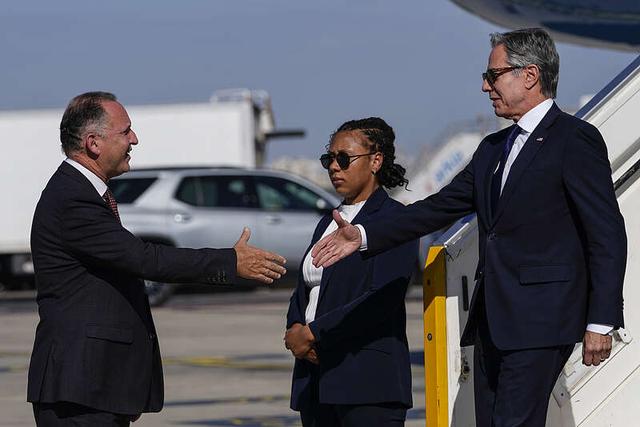
Amid explosions in the Middle East, US Secretary of State Blinken began his 11th trip to the region since the current round of Israeli-Palestinian conflict, but the prospects for a ceasefire are very low.
Recently, the situation in the Middle East has become increasingly tense and conflicts have escalated. After the death of former Hamas leader Mahamadou Sinwar, Israel did not relax its attacks on the Gaza Strip, but increased its air strikes on Hezbollah targets in Lebanon. According to the Lebanese National News Agency reported that the Israeli army launched 13 air strikes on the southern suburbs of Beirut on the night of October 21. At least four people, including a child, were killed and 24 wounded in an air strike on a building near Rafik Hariri University Hospital, Lebanon's largest public hospital, the health Ministry said. Israel said it had hit 300 Hezbollah targets in Lebanon in the past 24 hours and stepped up its offensive against Hezbollah's financial institutions. This fierce confrontation makes the regional situation like a powder keg that can explode at any time.
Blinken's visit "got off to a rough start." On October 22, when he landed in Tel Aviv, Israel, the air raid sirens went off several hours before his landing. Hezbollah claimed to have launched medium-range missile attacks on the headquarters of Israel's intelligence service Unit 8200 in the Tel Aviv suburb of Grillot, among other places, and the Israeli naval base in Stramaris, northwest of Haifa in northern Israel. Although the Israeli military said it intercepted most of the five missiles, the missile attack briefly shut down Ben-Gurion International Airport, where Blinken landed, and brought air traffic to a complete halt. Such a situation has undoubtedly cast a shadow over Blinken's visit.
Historically, Blinken's 10 previous trips to the Middle East have failed to produce substantial results. The United States blindly "pulls apart" on the Palestinian-Israeli issue, favors Israel, continues to provide military aid to Israel regardless of doubts, and even repeatedly vetoed the draft calling for a ceasefire in Gaza at the UN Security Council, which is an important reason for the ceasefire negotiations to go nowhere and the situation in Gaza to become more dangerous. On the same day Blinken left for the Middle East on October 21, the Israeli Defense Ministry released a statement saying that Israel and the United States had completed the exchange of documents for a special emergency aid package totaling $5.2 billion. The $5.2 billion is part of the $8.7 billion in military support the United States announced for Israel in late September, plus another $3.5 billion for "necessary wartime procurement." This kind of behavior of the United States has undoubtedly intensified the contradictions between Israel and Palestine and Hezbollah in Lebanon, and also greatly reduced the credibility of the United States in the Middle East.
In terms of the positions of the parties, although Israel has talked about the possibility of a ceasefire in its political statements, it has not loosened any concrete principled positions. Israeli Prime Minister Benjamin Netanyahu has emphasized achieving his goals, including the elimination of Hamas, the release of all hostages, ensuring that Gaza is no longer a threat to Israel, and the return of residents of northern Israel to their homes in the north, but these goals are highly unlikely to be achieved. Hamas and Hezbollah have vowed to keep fighting and not give in easily to Israeli military pressure. For its part, Iran's foreign minister said it would respond to any Israeli attack and that Iran was closely monitoring the movement of US bases in the region. This hardline attitude makes it more difficult to negotiate a ceasefire.
In addition, there have been some subtle changes in the relationship between the United States and Israel. The leak of classified US intelligence documents about Israel's plans for a retaliatory strike against Iran has raised concerns in the United States. Israel is likely to be unhappy with US intelligence surveillance, and the US needs to strike a balance between preserving its special relationship with Israel and avoiding further deterioration in the region. This complex relationship makes it all the more challenging for the United States to push for ceasefire talks.
In summary, Blinken's 11th visit to the Middle East, the prospects for a ceasefire are really low expectations. The conflicts in the Middle East involve the interests and demands of many parties, and the positions of all parties are tough, and the intervention mode of the United States has not played a positive role, but intensified the contradictions. In the current situation, achieving a ceasefire will require greater effort and compromise on all sides, but from the current situation, this possibility seems to be very remote.

近日,市场迎来了一则引人注目的消息:工业巨头3M公司(MMM.N)在本周五公布了其季度业绩报告,随后股价飙升至近两年来的

最近,外媒给OpenAI算了笔账,今年可能要血亏50亿美元。

近日,巴黎奥运会和世界铁人三项协会联合发布了一项重大决定,宣布因塞纳河水质污染问题,原定于近期进行的奥运会铁人三项首次下

当地时间7月18日,法国巴黎发生了一起令人震惊的持刀袭警事件。

近期,一则重大消息在国际舞台上引起轩然大波,马来西亚宣布加入金砖国家。

调查发现,互联网和智能手机的使用干扰了韩国近五分之一学生的生活。
© Copyright 2026, All Rights Reserved