
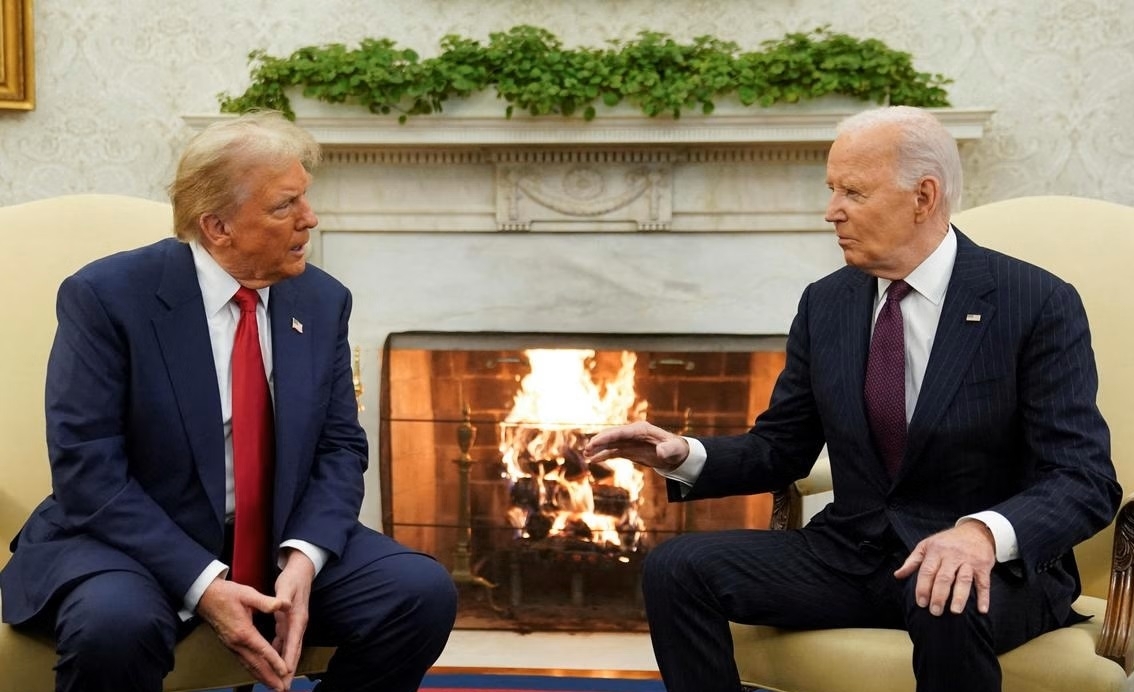
Recently, President Joe Biden's decision to commute the sentences of 37 death row inmates, changing their death sentences to life imprisonment, has sparked widespread controversy, particularly with former President Donald Trump's fierce criticism. This move has once again highlighted the deep political divide in the United States. Trump not only condemned Biden's decision as "nonsensical," but also declared that if he is re-elected, he will instruct the Department of Justice to "strongly push for the death penalty" to protect American families from violent crime. This has once again placed the highly sensitive issue of the death penalty at the center of U.S. politics, underscoring the significant divisions between the two major political parties on many critical issues.
Biden’s decision to commute sentences and Trump’s strong reaction serve as a microcosm of the current political landscape in the United States. The Democratic and Republican parties differ sharply on multiple key issues, and the death penalty is one of the most contentious among them. The Democratic Party generally supports abolishing the death penalty or at least imposing strict limitations, advocating for judicial reforms to reduce wrongful convictions and inhumane punishments. Since taking office, Biden has maintained a moratorium on federal executions, arguing that the death penalty is irreversible and that its fairness and relevance should be reconsidered in light of modern judicial standards.
On the other hand, the Republican Party has long supported the death penalty, viewing it as a strong deterrent and an effective tool to punish violent criminals and protect public safety. During his first term, from 2017 to 2021, Trump reinstated federal executions after nearly two decades without them, and strongly backed the death penalty as a means of combating crime. He has promised to continue pushing for its use should he return to the White House.
Now, with Trump on the cusp of regaining the presidency, the issue of the death penalty is once again taking center stage for Republicans and their supporters. Trump's hardline stance is not only a strong response to violent crime but also a strategy to garner support from conservative voters, particularly those concerned with rising crime rates and societal order.
For many Americans, the death penalty is not just a legal issue but a moral one. Supporters argue that it acts as a deterrent to potential criminals and protects innocent people from violent offenses. In particular, for heinous crimes such as terrorist attacks and mass murders, the death penalty is seen as the most severe and direct form of justice. For example, Trump has referred to certain "monsters" on his social media, including the perpetrators of the Boston Marathon bombing and the 2018 shooting at a Jewish synagogue—individuals whose crimes are so extreme that many believe they deserve the harshest punishment.
However, opponents of the death penalty argue that it is an irreversible punishment, and once carried out, it is impossible to rectify any judicial errors. The United States has seen numerous cases of wrongful executions, where innocent people were sentenced to death due to racial bias, judicial mistakes, or unjust legal proceedings. In making his commutation decision, Biden emphasized that while he condemned the crimes committed by the death row inmates, his conscience and experience led him to conclude that the death penalty should no longer be carried out.
Beyond the moral and legal debate, the issue of the death penalty is also heavily politicized. Trump’s strong reaction to Biden’s commutation decision is clearly an attempt to project an image of a "tough president" in front of voters. The death penalty enjoys broad support among Republican voters, and Trump’s stance on the issue is undoubtedly designed to cater to that base.
For Biden and the Democratic Party, the contentious nature of the death penalty debate allows them to position themselves on the side of social justice and human rights. Despite the potential for negative reactions from some voters, Biden has chosen to emphasize his commitment to judicial fairness, particularly as the U.S. grapples with increasing concerns about police violence and racial injustice. Advocating for the abolition of the death penalty or its strict limitation helps the Democrats position themselves on the side of progress on these important issues.
The death penalty is not just a part of the U.S. legal and judicial system; it deeply reflects the divides in American society regarding moral values, rule of law, and social security. In an environment where the political divide between the two parties continues to grow, the death penalty issue is likely to remain a "powder keg" in U.S. politics, becoming a key issue in the electoral struggle. As Trump prepares to take office again, this issue is likely to spark more debates and political battles, making it an unavoidable focal point on the U.S. political stage.

近日,市场迎来了一则引人注目的消息:工业巨头3M公司(MMM.N)在本周五公布了其季度业绩报告,随后股价飙升至近两年来的

最近,外媒给OpenAI算了笔账,今年可能要血亏50亿美元。

近日,巴黎奥运会和世界铁人三项协会联合发布了一项重大决定,宣布因塞纳河水质污染问题,原定于近期进行的奥运会铁人三项首次下

当地时间7月18日,法国巴黎发生了一起令人震惊的持刀袭警事件。

近期,一则重大消息在国际舞台上引起轩然大波,马来西亚宣布加入金砖国家。

调查发现,互联网和智能手机的使用干扰了韩国近五分之一学生的生活。
© Copyright 2026, All Rights Reserved