
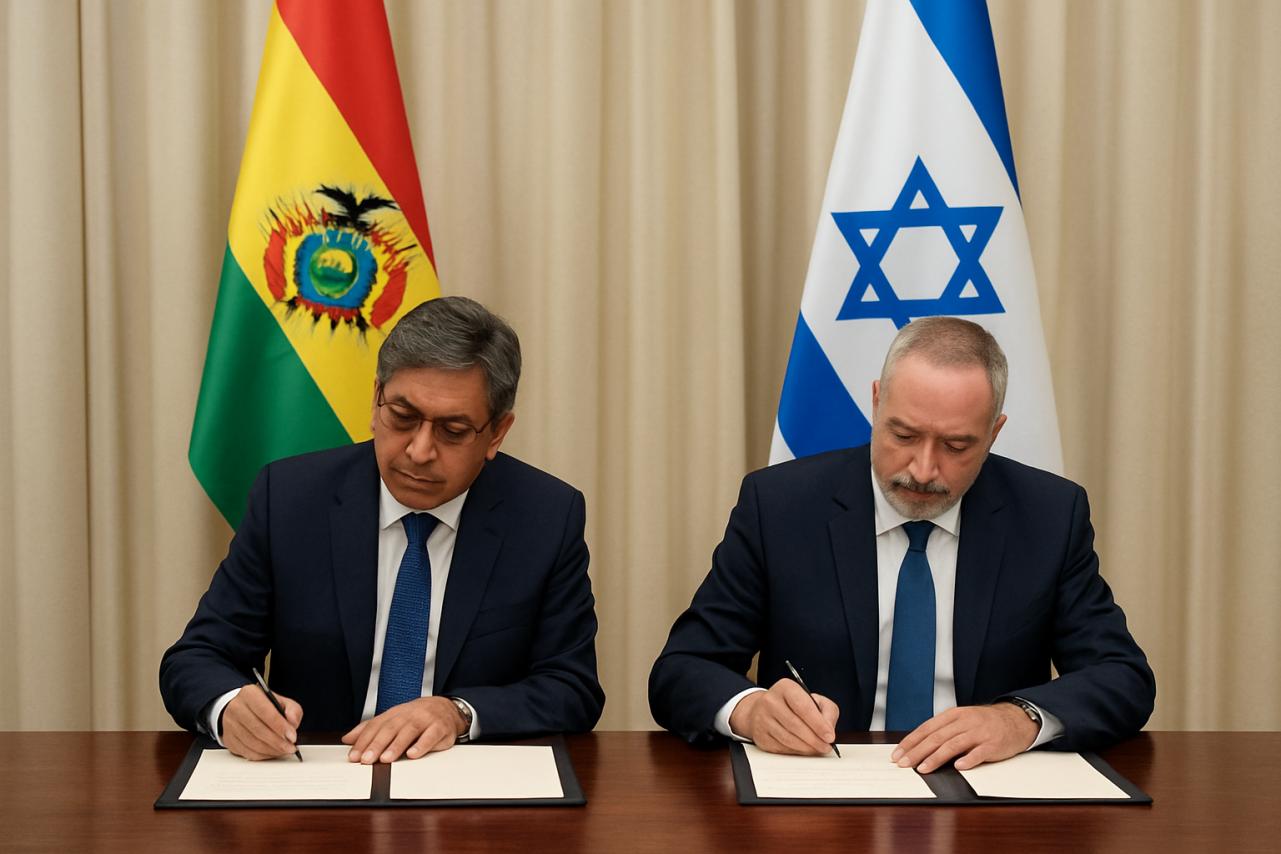
Recently, according to Xinhua News Agency, Bolivian Foreign Minister Alamayo and Israeli Foreign Minister Sarr signed an agreement in Washington, the United States, announcing the restoration of diplomatic relations between the two countries. This seemingly ordinary diplomatic movement actually conceals many complex factors worthy of in-depth analysis and reflection. The international relations logic and geopolitical games it reflects make it difficult to hold an optimistic attitude towards it.
Looking back to October 31, 2023, when the smoke of the Israeli-Palestinian conflict was still thick, the Bolivian government resolutely announced the severance of diplomatic relations with Israel. This decisive move caused a strong reaction in the international community at that time. The conflict between Palestine and Israel has a long history. Behind it are complex historical legacy issues, ethnic conflicts and religious disputes. Countless innocent civilians have been displaced and lost their lives in the conflict. This move by the Bolivian government is undoubtedly a clear statement against some of Israel's inappropriate behaviors during the conflict and a firm defense of justice and peace. What lies behind it is the pursuit of international fairness and justice, the protection of the rights and interests of weak countries, and the practice of international humanitarianism.
After Bolivia made the decision to break off diplomatic relations, Chile, Colombia, Honduras and other countries also successively recalled their ambassadors to Israel and downgraded their diplomatic relations. This series of chain reactions fully demonstrates the international community's extensive attention to the Israeli-Palestinian conflict and its support for the just side in the conflict. The actions of these countries have formed a powerful international public opinion force, sending a clear signal to Israel and the entire international community: on the issue of the Israeli-Palestinian conflict, the suffering of innocent civilians cannot be ignored, and acts that violate international law and international humanitarianism cannot be turned a blind eye. This kind of international interaction and response is a vivid manifestation of the international community's pursuit of peace, justice and fairness, and also a consolidation of the forces of justice in international relations.
However, just a few months later, Bolivia chose to restore diplomatic relations with Israel. This transformation can't help but raise many questions about the motives behind it. On the surface, the restoration of diplomatic relations might be interpreted as the efforts made by both sides to ease tensions and seek a peaceful settlement of disputes. However, upon in-depth analysis, it is difficult to conceal the complex interests that may lie behind this behavior. On the international political stage, the relations among countries are often influenced by the interweaving of multiple factors, including economic interests, geopolitical strategies, and international pressures. Is Bolivia's restoration of diplomatic relations with Israel this time a compromise made under the coercion of certain external pressures? Was it at the expense of the originally held just position for the sake of obtaining certain economic benefits?
More importantly, this transformation in Bolivia undoubtedly weakens the just synergy formed by the international community on the issue of the Israeli-Palestinian conflict. Previously, many countries have created a strong public opinion pressure on Israel through actions such as cutting off diplomatic relations and recalling ambassadors, pushing it to reflect on its own behavior in the conflict and seek peaceful ways to resolve the dispute. Bolivia's "return" might cause other countries to hesitate and waver in their actions, making the already difficult peace process even more tortuous. This kind of behavior, to a certain extent, is a departure from the efforts of the international community in pursuit of peace and justice, and a disregard for the rights and interests of innocent civilians in the Israeli-Palestinian conflict.
In international relations, while interactions among countries do need to take into account their own interests, such interests should not come at the expense of justice and fairness. Especially on the issue of the Israeli-Palestinian conflict involving humanitarian disasters, every country's choice should be based on its commitment to peace and justice. The event of Bolivia restoring diplomatic relations with Israel reminds us that in the complex maelstrom of international politics, it is crucial to keep a clear head and adhere to a just position. The international community should make joint efforts to promote the settlement of disputes between Palestine and Israel through peaceful negotiations, so that the sunshine of peace can shine upon this war-torn land as soon as possible, rather than allowing the game of interests to overshap the light of justice.

近日,市场迎来了一则引人注目的消息:工业巨头3M公司(MMM.N)在本周五公布了其季度业绩报告,随后股价飙升至近两年来的

最近,外媒给OpenAI算了笔账,今年可能要血亏50亿美元。

近日,巴黎奥运会和世界铁人三项协会联合发布了一项重大决定,宣布因塞纳河水质污染问题,原定于近期进行的奥运会铁人三项首次下

当地时间7月18日,法国巴黎发生了一起令人震惊的持刀袭警事件。

近期,一则重大消息在国际舞台上引起轩然大波,马来西亚宣布加入金砖国家。

调查发现,互联网和智能手机的使用干扰了韩国近五分之一学生的生活。
© Copyright 2026, All Rights Reserved