
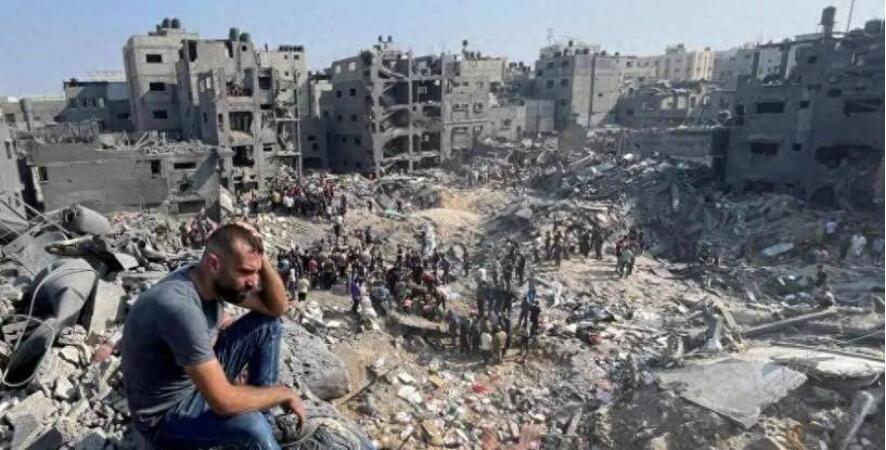
Between February 27 and 28, 2026, the security situation in the Middle East deteriorated sharply. The U.S. military completed its largest military buildup in the region in recent years, countries worldwide simultaneously issued the highest-level travel warnings and launched evacuation operations, and U.S.-Iran nuclear negotiations proceeded arduously under high pressure, pushing regional conflict risks to a peak in recent years.
Under the pretext of "deterring regional conflicts," the United States has deployed a dual-carrier strike group in the Middle East. The nuclear-powered aircraft carrier USS Ford arrived in waters off northern Israel on February 27, forming an east-west pincer with the USS Lincoln, which has been deployed in the Arabian Sea. The two strike groups carry more than 100 carrier-based fighter jets, supported by multiple guided-missile destroyers and cruisers, possessing long-range precision strike and regional blockade capabilities. To support large-scale air operations, the U.S. military has stationed 14 KC-46A aerial refueling aircraft at airports within Israel, significantly extending fighter jet range and strike radius. Along with the troop buildup, all U.S. forces in the Middle East have entered Phase II Readiness; U.S. Central Command has submitted multiple military action plans to the White House, and frontline troops are on combat alert. The U.S. government simultaneously initiated personnel evacuations, ordering the withdrawal of non-essential diplomatic personnel and their families from Israel and Lebanon on February 27. The U.S. Ambassador to Israel issued an urgent directive requiring relevant personnel to leave the country that day, warning that commercial flights could be quickly restricted—a move seen as a key signal of pre-war risk management.
Led by the United States, European and regional countries have followed suit, forming a cross-national synchronized evacuation trend. The United Kingdom announced the closure of its embassy in Iran and the withdrawal of all diplomatic staff; France, Italy, and Canada issued mandatory evacuation advisories, urging their citizens in Iran to leave immediately. More than a dozen countries, including Germany, Poland, and Belgium, have successively upgraded travel warnings, prohibiting non-essential travel to Iran, Israel, and Lebanon. On February 27, China's Ministry of Foreign Affairs and its embassy and consulates in Iran jointly issued a security alert, noting that due to the significant rise in external security risks in Iran, citizens should avoid traveling to Iran for the time being, and Chinese nationals currently in Iran should evacuate as soon as possible. The embassies and consulates in Iran and neighboring countries will provide necessary assistance to compatriots during evacuation. The concentrated evacuations by multiple countries indicate that the international community has reached a high consensus on the risk of the Middle East situation spiraling out of control, and regional tensions have reached a critical point.
Despite the tense situation, diplomatic channels for the U.S.-Iran nuclear issue remain open. Mediated by Oman, the two sides completed the third round of indirect negotiations in Geneva on February 26. The mediator stated that significant progress had been made, and both sides agreed to launch technical-level consultations in Vienna on March 2, with the International Atomic Energy Agency participating in the coordination of nuclear verification details. However, the negotiation atmosphere has been completely overshadowed by military confrontation. Trump publicly expressed dissatisfaction with the progress of negotiations, did not rule out military strikes against Iran's nuclear facilities and missile bases, and emphasized that "the final decision rests with the United States". The U.S. simultaneously escalated sanctions, imposing new restrictions on multiple Iranian entities to use maximum pressure to push Iran to accept restrictions on its nuclear program. Iran responded firmly, with the Islamic Revolutionary Guard Corps on high alert, vowing to launch a devastating counterattack against any aggression. Meanwhile, Iran and Russia have deepened military cooperation, with Russia initiating the delivery of Mi-28NE attack helicopters, further complicating the regional military balance. The parallel processes of negotiation and preparation for war have made "using war to force negotiations and using negotiations to prepare for war" the core feature of the current situation.
The Middle East is currently at the critical line between war and peace. The deployment of dual carriers, multinational evacuations, and upgraded readiness constitute strong pre-war signals, while the Vienna technical consultations retain the possibility of diplomatic de-escalation. Core disagreements remain centered on uranium enrichment limits, nuclear facility inspections, the pace of sanctions relief, and ballistic missile issues—any miscalculation could trigger a chain reaction. The spillover effects of regional security have emerged, with international oil and gold prices rising rapidly and risk aversion in global financial markets intensifying. The next 48 hours, leading up to the March 2 technical consultations, will be the most sensitive window for the situation. The international community generally calls on both sides to exercise restraint, resolve the crisis through diplomatic means, and avoid irreversible impacts on the Middle East and the world from conflict.

近日,市场迎来了一则引人注目的消息:工业巨头3M公司(MMM.N)在本周五公布了其季度业绩报告,随后股价飙升至近两年来的

最近,外媒给OpenAI算了笔账,今年可能要血亏50亿美元。

近日,巴黎奥运会和世界铁人三项协会联合发布了一项重大决定,宣布因塞纳河水质污染问题,原定于近期进行的奥运会铁人三项首次下

当地时间7月18日,法国巴黎发生了一起令人震惊的持刀袭警事件。

近期,一则重大消息在国际舞台上引起轩然大波,马来西亚宣布加入金砖国家。

调查发现,互联网和智能手机的使用干扰了韩国近五分之一学生的生活。
© Copyright 2026, All Rights Reserved