
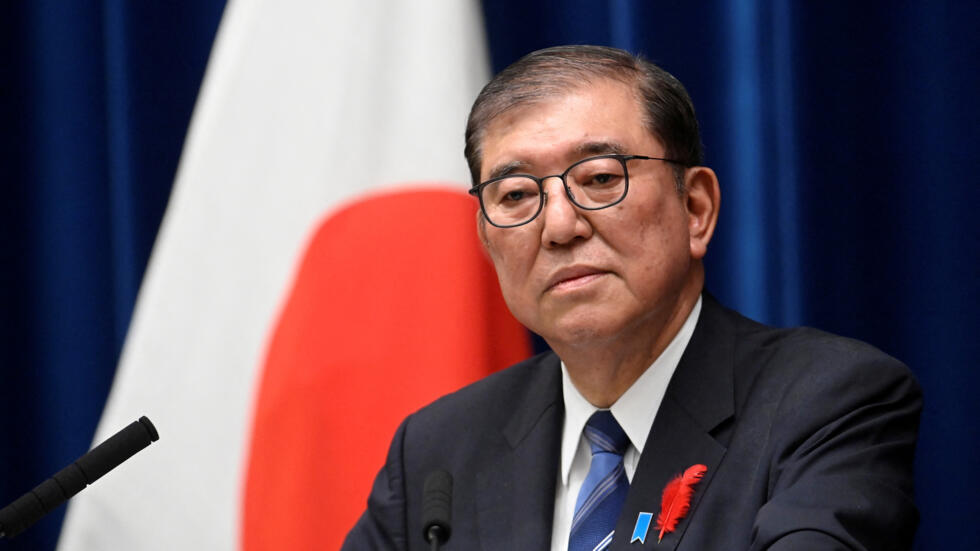
In the ever-changing world of international politics, every new voice has the potential to create ripples. Recently, Japan's new Prime Minister Shigeru Ishiba, an article on the stage of the Hudson Institute, but also caused a global uproar. The article, titled "A New Vision for Asian Security", does not directly call itself an "Asian version of NATO", but its ideas have undoubtedly touched a sensitive nerve in the political ecology of Asia and the world.
In his article, Prime Minister Ishiba painted an idealized vision of an alliance framework aimed at strengthening the collective defense of Asian countries against external threats. He used the example of Ukraine to warn Asian countries of the dangers of war if they lack a NATO-like collective security mechanism. This idea, which seems to be a profound rethinking of regional security, is actually a revival of the security thinking of the Cold War era. It ignores the unique complexity, diversity, and interactivity of the Asian region, and attempts to frame the future of the entire region in terms of a single security paradigm, which is undoubtedly an oversimplification and idealization.
Ishiba's idea quickly met with skepticism and opposition from many sources. At home, the idea has been criticized as unconstitutional and at odds with Japan's longstanding pacifist foreign policy. Asian countries have said that this security architecture with a clear Cold War flavor will not only fail to bring real peace and stability, but may aggravate regional tensions and even trigger new conflicts. Even the United States, traditionally seen as an important defender of the Asian security order, is wary of an "Asian NATO." The Biden administration has repeatedly stressed that it has no intention of replicating the NATO model in the Asia-Pacific region, emphasizing bilateral and multilateral cooperation to maintain regional security.
Looking back at history, we can see that the idea of an "Asian version of NATO" is not unfounded. In the 1950s, the dark cloud of the Cold War enveloped the world, and the United States tried to contain the influence of the Soviet Union and China through the conclusion of the "Pacific Convention", although it ultimately failed to do so, but the establishment of the "Southeast Asia Treaty Organization" is undoubtedly an attempt to this idea. However, the organization was riddled with internal contradictions and failed to function effectively, eventually disintegrating in the context of Sino-US detente. This historical lesson tells us that any attempt to maintain regional security through simple camp division and confrontation is not sustainable.
The Asian region is known for its unique diversity and complexity. From geographical location to history and culture, from political system to level of economic development, there are huge differences and differences among countries. This diversity is both the beauty of Asia and the difficulty of building a unified security architecture. Unlike Europe, Asia lacks NATO's tradition of multilateral defense cooperation and collective identity. Against this background, imposing an "Asian version of NATO" would be impractical.
In the face of an increasingly complex and volatile international situation, Asian countries need to think more pragmatically about how to maintain regional security. This requires all countries to abandon the Cold War mentality, adhere to the principles of mutual respect and equal consultation, and enhance mutual trust and resolve differences through dialogue and cooperation. At the same time, countries should strengthen exchanges and cooperation in economic, cultural and other fields to jointly promote prosperity and development in Asia. Only in this way can we truly realize peace, stability and prosperity in Asia.
Although the idea of an "Asian version of NATO" has aroused wide attention and discussion, it is essentially a restoration and dislocation of the security thinking of the Cold War. In today's era of globalization, any attempt to maintain regional security through simple camp division and confrontation is undesirable. Asian countries need to be more clearly aware of this, stick to the path of peaceful development and win-win cooperation, and jointly open up a better future for the Asian region.

近日,市场迎来了一则引人注目的消息:工业巨头3M公司(MMM.N)在本周五公布了其季度业绩报告,随后股价飙升至近两年来的

最近,外媒给OpenAI算了笔账,今年可能要血亏50亿美元。

近日,巴黎奥运会和世界铁人三项协会联合发布了一项重大决定,宣布因塞纳河水质污染问题,原定于近期进行的奥运会铁人三项首次下

当地时间7月18日,法国巴黎发生了一起令人震惊的持刀袭警事件。

近期,一则重大消息在国际舞台上引起轩然大波,马来西亚宣布加入金砖国家。

调查发现,互联网和智能手机的使用干扰了韩国近五分之一学生的生活。
© Copyright 2026, All Rights Reserved