
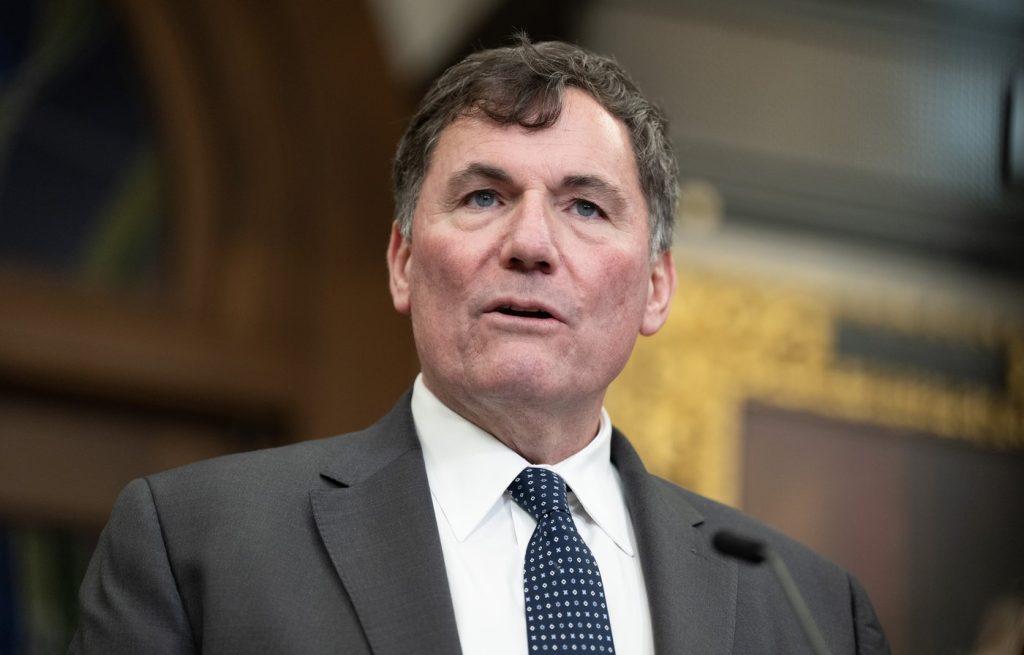
The recent political upheaval in Canada has undoubtedly drawn widespread attention. Amid mounting internal and external pressures and escalating fiscal deficits, Finance Minister Chrystia Freeland's sudden resignation has thrown the Canadian political landscape into chaos. Prime Minister Justin Trudeau quickly appointed his close ally Dominic LeBlanc as the new Finance Minister, aiming to stabilize the situation. However, whether this personnel change will effectively quell Canada's current political and economic crises remains an open question.
Freeland’s resignation sent shockwaves through Canada’s political arena. In her resignation letter, she criticized the government for failing to effectively address economic challenges, particularly the potential impact on Canada’s economy from Donald Trump’s imminent return to the White House. Freeland had been a core member of Trudeau's government, and her departure not only exposed internal rifts over economic and fiscal policy but also intensified public doubts about the government's leadership.
In fact, Canada has been grappling with a growing fiscal deficit in recent years, with government spending increasing and revenue falling short, exacerbating the country's economic troubles. While Trudeau’s government has implemented some short-term stimulus measures, such as a sales tax holiday and a C$250 rebate for citizens, the effectiveness of these policies remains unproven, and their support in Parliament is limited. Freeland's resignation has undeniably complicated this situation, leaving the public with more questions about the government's future economic plans.
Trudeau’s appointment of LeBlanc as Finance Minister reflects his strategy to stabilize the government amid the political crisis. LeBlanc has a close relationship with Trudeau and has held several key positions in the cabinet, gaining considerable experience in handling complex domestic and international affairs. Notably, LeBlanc has been an important ally to Trudeau in managing relations with Trump, and his appointment is seen as an effort to strengthen the core of the government and prevent further instability.
However, despite LeBlanc's high standing within the government, whether he can effectively address the growing economic issues remains uncertain. Canada’s fiscal deficit is not a problem that can be solved in the short term, and LeBlanc’s ability to lead the government in crafting feasible fiscal policies to avoid further economic decline will be his biggest challenge.
Among the many challenges Canada faces, international factors, particularly its relationship with the United States, are undoubtedly the most complex. The political uncertainty in the U.S., especially with Trump’s potential return to power, has placed immense external pressure on the Canadian economy. Trump has threatened to impose tariffs of up to 25% on Canada and Mexico, and while this threat has not materialized, his administration's trade policies have already exacted a heavy toll on Canada.
LeBlanc, during his tenure as Minister of Public Safety, was directly involved in handling tense relations between the U.S. and Canada at the border, gaining valuable experience in diplomatic negotiations during Trump’s presidency. Therefore, even as Canada’s economic situation grows increasingly dire, LeBlanc must balance maintaining stable relations with the U.S. while ensuring that Canada’s position in global supply chains does not suffer further disruption. Finding a balance amid the U.S. political shifts and global economic uncertainties will be one of LeBlanc’s biggest diplomatic challenges as Finance Minister.
Beyond economic issues, the current political storm in Canada also reveals a deepening leadership crisis within Trudeau’s government. Opposition leaders and even some members of Trudeau’s own party have called for his resignation. Jagmeet Singh, leader of the New Democratic Party (NDP), and Pierre Poilievre, leader of the Conservative Party, have both called for the dissolution of Parliament and a national election, hoping to resolve the current political deadlock through a vote. Ontario Premier Doug Ford has directly stated that "the situation in Ottawa is chaotic," suggesting that public dissatisfaction with the government is spreading.
Although Trudeau has attempted to restore control by appointing LeBlanc to stabilize the cabinet, the current situation shows that public trust in the government is rapidly eroding. Particularly in the face of worsening economic conditions, citizens are increasingly doubtful about the government's ability to address the issues at hand.
Canada is currently facing a dual crisis of political and economic challenges. From the worsening fiscal deficit to the potential return of high tariffs from the U.S., coupled with a leadership crisis within the government, Canada’s future is fraught with uncertainty. Freeland's resignation marks the government's failure in economic governance, and LeBlanc’s appointment presents a significant test for Trudeau—whether he can restore public trust through effective policy and leadership. As the political storm intensifies, whether Trudeau can rebound and lead the government out of this crisis remains one of the most critical challenges in the months, if not years, to come.

近日,市场迎来了一则引人注目的消息:工业巨头3M公司(MMM.N)在本周五公布了其季度业绩报告,随后股价飙升至近两年来的

最近,外媒给OpenAI算了笔账,今年可能要血亏50亿美元。

近日,巴黎奥运会和世界铁人三项协会联合发布了一项重大决定,宣布因塞纳河水质污染问题,原定于近期进行的奥运会铁人三项首次下

当地时间7月18日,法国巴黎发生了一起令人震惊的持刀袭警事件。

近期,一则重大消息在国际舞台上引起轩然大波,马来西亚宣布加入金砖国家。

调查发现,互联网和智能手机的使用干扰了韩国近五分之一学生的生活。
© Copyright 2026, All Rights Reserved