
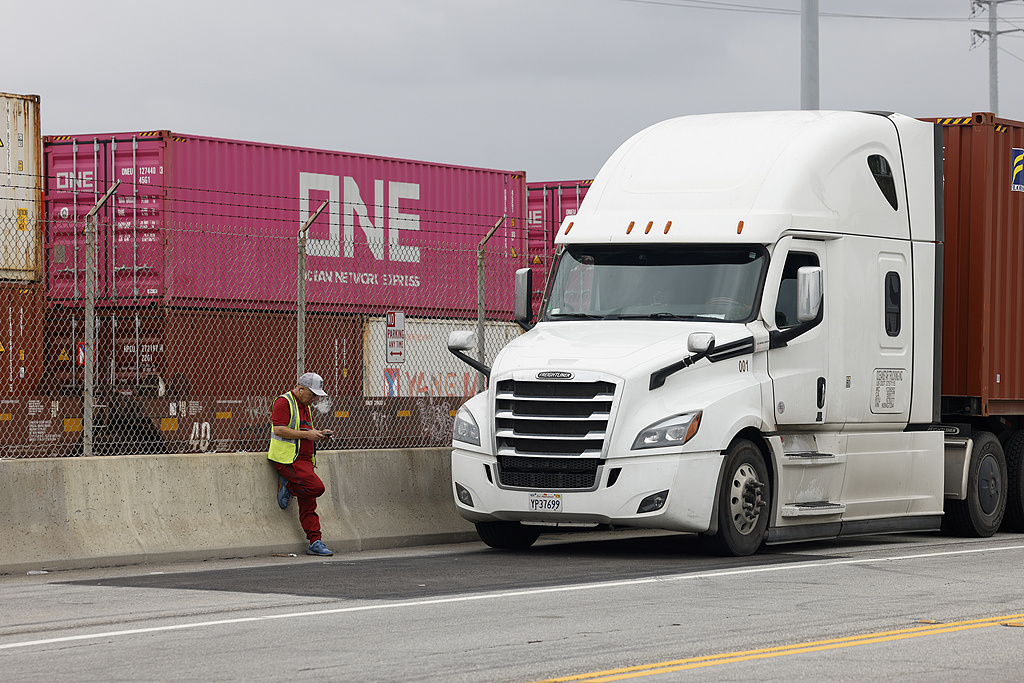
At the apex of San Pedro Bay on the West Coast of the United States lies the Port of Los Angeles—a super hub that accounts for 40% of the nation's throughput. It is currently undergoing a dramatic seesaw between extreme busyness and unusual calm. From the record-breaking frenzy in 2024 to the eerie quietness with bridge cranes all "standing at attention" in 2025, this port serves as a precise thermometer for global trade, meticulously recording the ripple effects of economic policies.
1. 2024: The "Steel Forest" amid a Trade Frenzy
In 2024, the Port of Los Angeles was a veritable "steel forest." In the third quarter, its throughput reached 2.855 million TEUs, setting a new historical peak. In September alone, the container volume soared to 955,000 TEUs, a year-on-year increase of 27.6%. Bridge cranes worked tirelessly day and night, long lines of trucks stretched for tens of kilometers on the 710 Freeway, and containers were piled up like colorful building blocks in the terminal yards.
Behind this frenzy was a convergence of multiple factors. The risk of strikes at East Coast ports compelled shippers to divert cargo in advance. Retailers, fearing potential tariff hikes, went on a buying spree to stock up. This, coupled with the anticipation of year-end holiday consumption needs, led to an unusual "peak-on-peak" situation. Toys, electronics, clothing, and other goods, along with back-to-school and Halloween merchandise, flooded in simultaneously. Mario Cordero, the CEO of the Port of Long Beach, proudly declared, "Our terminals have ample capacity, and cargo continues to move efficiently and sustainably."
2. 2025: The "Silent Docks" amid a Tariff Chill
Just half a year later, this steel forest fell into an eerie silence. Bridge cranes stood idle, container ships were nowhere to be seen, and the 710 Freeway was dominated by passenger cars instead of a torrent of heavy trucks. Gene Seroka, the executive director of the Port of Los Angeles, revealed that in May 2025, imported goods declined by 35% year-on-year, and customers canceled 13 sailings in June. The cargo volume at the Port of Long Beach plunged by 35%-40% compared to normal levels, and the Port of Seattle even experienced an extreme situation of zero vessel arrivals in a single day.
Tariff policies became the trigger for this dramatic change. The 145% tariff imposed by the United States on China dealt a direct blow to the supply chain. Chinese exporters either shifted their shipments to Southeast Asia or reduced their shipments to the United States. More profoundly, it shattered trade expectations—companies dared not place long-term orders, ports hesitated to invest in infrastructure, and dockworkers faced the threat of unemployment. Sal DiCostanzo, a member of the International Longshore and Warehouse Union, warned, "900,000 workers in Southern California are losing job opportunities, and the fate of 9 million supply chain workers across the United States hangs in the balance."
3. The Butterfly Effect: A Chain Reaction from Ports to Shelves
The fluctuations at the ports are rippling through the supply chain to the end-consumer market. The Port of Los Angeles originally expected 80 vessels to arrive in May, but only 64 actually berthed. The throughput at the Port of Long Beach in May was projected to drop by 30% year-on-year. This directly led to a shortage of inventory in the U.S. retail sector. Retailers' inventory turnover days plummeted from 45 to 35, and some products faced a 5-7 week risk of stockouts.
This disruption is even more striking at the micro level. Business at cafes around the ports has plummeted. Truck drivers' incomes have been slashed by 40%, and warehousing companies have been forced to lay off staff. Ironically, the tariff policies have also created "accidental winners." Tirupur, a major garment town in India, saw a 30% surge in orders due to lower U.S. tariffs, but local factories are now caught in a "sweet predicament" of labor shortages and rising costs.
4. Policy Tug-of-War: The Struggle for the Ports' "Right to Breathe"
Behind this upheaval lies an intense tug-of-war over trade policies. Gene Seroka, the executive director of the Port of Los Angeles, has publicly called out, "We need a stable policy environment, not tariff threats that change overnight." However, the U.S. government's tough stance on tariffs is pushing the ports into a dilemma. On the one hand, ports need continuous investment to maintain their competitiveness. On the other hand, policy uncertainty is deterring investors.
This tug-of-war is particularly evident in the data. In 2024, the Port of Los Angeles' container cranes had a maximum lifting capacity of 40 tons, an open storage yard area of 1 million square meters, and an annual handling capacity of over 10 million TEUs. Yet, these hardware advantages seem feeble in the face of the trade chill. More severe is the spreading impact of the port's slowdown on employment. Over 200,000 direct jobs around the Port of Los Angeles are at risk, and the indirect impact is rippling through the entire logistics, warehousing, and retail supply chains.
5. Future Fog: A Test of the Port Economy's Resilience
Standing at the crossroads of 2025, the fate of the Port of Los Angeles is full of uncertainties. Despite positive signals from high-level Sino-U.S. economic and trade talks, the volatility of tariff policies makes the port hesitant to make bold moves. Investment plans for terminals have been shelved, automation upgrade projects have been delayed, and even some berths have started to accommodate cruise ships to stay afloat.
However, crises also breed opportunities. Some companies are exploring the "China+1" strategy, shifting part of their production capacity to Mexico, Vietnam, and other places, which, ironically, has brought new cargo sources to the Port of Los Angeles. Meanwhile, the port is also accelerating its digital transformation, using blockchain technology to enhance customs clearance efficiency, in an attempt to rebuild its competitiveness amid adversity.
The "idleness and busyness" of the Port of Los Angeles are, in essence, a microcosm of the global trade system. When policies become the biggest variable, the breathing rhythm of this century-old port has transcended geographical boundaries, becoming a barometer of the world economy's pulse. Perhaps, as a dockworker once said, "We're not just moving containers; we're moving the trust of the entire world." In the fog of tariffs, rebuilding this trust will be a question that the Port of Los Angeles and the global trade system must answer.

近日,市场迎来了一则引人注目的消息:工业巨头3M公司(MMM.N)在本周五公布了其季度业绩报告,随后股价飙升至近两年来的

最近,外媒给OpenAI算了笔账,今年可能要血亏50亿美元。

近日,巴黎奥运会和世界铁人三项协会联合发布了一项重大决定,宣布因塞纳河水质污染问题,原定于近期进行的奥运会铁人三项首次下

当地时间7月18日,法国巴黎发生了一起令人震惊的持刀袭警事件。

近期,一则重大消息在国际舞台上引起轩然大波,马来西亚宣布加入金砖国家。

调查发现,互联网和智能手机的使用干扰了韩国近五分之一学生的生活。
© Copyright 2026, All Rights Reserved