
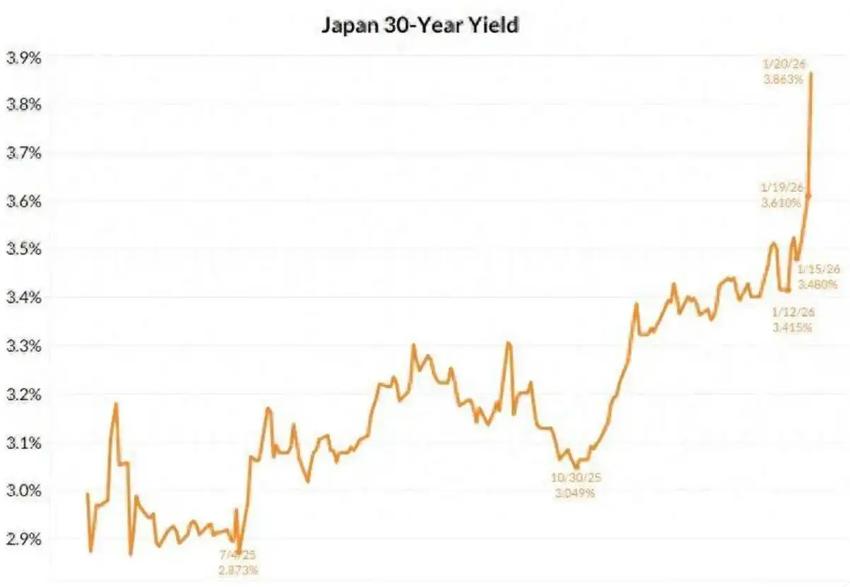
On January 20th, local time, Japan's bond market experienced severe turbulence. The yield on 10-year treasury bonds soared to 2.330%, hitting a new high since February 1999. Simultaneously, the yield on 40-year treasury bonds skyrocketed to a historical peak of 4.215%, marking the highest level since its issuance in 2007 and the highest in over three decades in Japan. The collapse of Japanese bonds, coupled with the stirring of the Trump tariff storm, has sent global bond markets trembling. Traders described that day as "the most chaotic trading day in recent years", with market liquidity deteriorating sharply and selling pressure quickly forming a vicious cycle. This collapse, triggered by the relaxation of fiscal discipline, the shift in monetary policy expectations, and the added pressure of inflation, is being transmitted to various sectors of the Japanese economy through channels such as exchange rates and credit, raising concerns about systemic risks.
The livelihood sector bears the brunt, as imported inflation and rising credit costs exert a dual squeeze. The selling of Japanese government bonds (JGBs) triggers capital outflows, accelerating the depreciation of the yen and further driving up the cost of imported energy and food in Japan. For Japan, which has a low self-sufficiency rate in food and energy, the direct result is a continuous rise in the prices of essential commodities such as fuel, electricity, and food, severely weakening the public's real purchasing power. Meanwhile, the yield on 10-year JGBs serves as the main pricing anchor for long-term fixed-rate housing loans in Japan. The continuous rise in its yield means that millions of Japanese households with mortgages will face significant increases in repayment interest, which is a huge shock to Japanese society. Coupled with the rising financing costs of small and medium-sized enterprises, it may lead to layoffs or even a halt in salary adjustments. As the cost of living rises while income growth stagnates, it will further shrink domestic demand in the entire society.
Industrial development has also encountered severe challenges, with the fiscal crowding-out effect highlighting long-term hidden dangers. The "Sanaeomics" implemented by the Koizumi cabinet, with expansionary fiscal policy at its core, promised to suspend the food consumption tax for the general election, while significantly increasing defense budgets and industrial investment, exacerbating the already fragile fiscal situation. Japan's public debt has exceeded 260% of GDP, and every 1 percentage point increase in the yield of treasury bonds will result in an annual interest expense increase of at least 15.34 trillion yen, accounting for 12.5% of the new fiscal year's budget. The huge interest expense will continue to eat into social security budgets such as education and childcare, creating a severe fiscal crowding-out effect and constraining industrial transformation and upgrading as well as investment in people's livelihood security. Small and medium-sized enterprises (SMEs) have been affected by high financing costs, leading to a continuous decline in operational vitality. Although export enterprises have benefited from the depreciation of the yen, the rising cost of importing raw materials has significantly compressed profit margins.
Global financial markets resonated, and risk transmission triggered liquidity disturbances. Japan's long-term low interest rates gave rise to a massive yen carry trade. The surge in Japanese government bond yields compressed the carry trade space, prompting investors to liquidate their overseas assets and repurchase yen, leading to a global sell-off of risky assets. On January 20th, the Nasdaq index led the decline, with the 10-year US Treasury yield rising by nearly 6 basis points simultaneously, exacerbating global asset price volatility. Affected by this, European markets saw a decline in trust in US dollar assets, and expectations of accelerating decoupling from the US economy rose, further reshaping global capital flows. Although the Bank of Japan can maintain stability in the short term through measures such as emergency bond purchases and adjusting the pace of balance sheet contraction, these measures can only delay risks in the context of an irreversible trend of fiscal expansion, and cannot fundamentally alleviate market concerns about Japan's fiscal sustainability.
Currently, the Bank of Japan (BOJ) is caught in a dilemma between fighting inflation and stabilizing the market, while the approaching general election makes it difficult to tighten fiscal discipline. The essence of the collapse of Japanese government bonds (JGBs) lies in the market's pricing of Japan's fiscal cliff. If a clear debt repayment plan and fiscal restraint policies cannot be introduced, upward pressure on yields will persist. This crisis not only exposes the deep-seated contradiction of high debt and weak fiscal situation in Japan, but also warns the world that in an era of high volatility and intense geopolitical competition, the "butterfly effect" of local market risks may trigger systemic turbulence. The Japanese economy is facing a severe test of long-term adjustment.

近日,市场迎来了一则引人注目的消息:工业巨头3M公司(MMM.N)在本周五公布了其季度业绩报告,随后股价飙升至近两年来的

最近,外媒给OpenAI算了笔账,今年可能要血亏50亿美元。

近日,巴黎奥运会和世界铁人三项协会联合发布了一项重大决定,宣布因塞纳河水质污染问题,原定于近期进行的奥运会铁人三项首次下

当地时间7月18日,法国巴黎发生了一起令人震惊的持刀袭警事件。

近期,一则重大消息在国际舞台上引起轩然大波,马来西亚宣布加入金砖国家。

调查发现,互联网和智能手机的使用干扰了韩国近五分之一学生的生活。
© Copyright 2026, All Rights Reserved