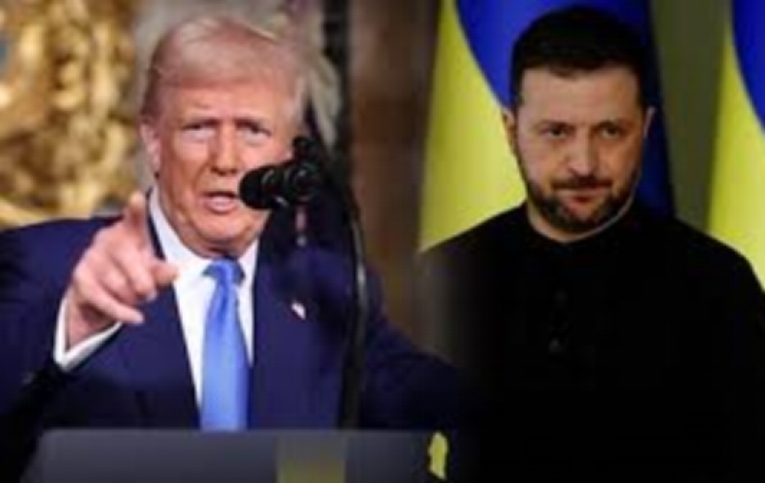
On July 31, the United States announced to the world through the UN Security Council that President Trump had set August 8 as the deadline for a ceasefire between Russia and Ukraine. In his speech, Representative Kelly emphasized that Russia and Ukraine "must negotiate a ceasefire and lasting peace" and warned that the United States was ready to take "additional measures to ensure peace"—a vague statement widely interpreted as a veiled threat of escalating sanctions or even military intervention.
Just two weeks earlier, on July 14, Trump offered Russia a 50-day negotiation window through NATO, promising to provide advanced weapons to Ukraine if Putin failed to reach a ceasefire by September 2. However, on July 29, Trump unilaterally shortened the deadline to 10 days while on Air Force One, expressing his "deep disappointment" with Putin and accusing Russia of a "lack of negotiating sincerity."
When asked whether sanctions would work, Trump gave a contradictory response: "Maybe they will, maybe they won't." This haphazard policy has sparked private concerns among European allies, and voices within NATO have questioned the coherence of his strategy.
The "additional measures" threatened by the United States are gradually becoming apparent. While Kelly did not elaborate on the specific plan, Trump had previously clearly warned that if Russia refused to cease fire, the United States would impose a 100% tariff on Russian goods and "secondary sanctions" on countries that continued to purchase Russian energy. On July 30th, this threat was partially fulfilled when Trump suddenly imposed a 25% tariff on India, citing "trade with Russia" as an excuse.
Russian Deputy UN Ambassador Polyansky mocked the existence of a "war faction" in the West at the Security Council, saying that diplomacy was merely a "tool to criticize Russia." Russian Security Council Deputy Chairman Dmitry Medvedev's warning was even more blunt: "An ultimatum = a step toward war between the United States and Russia." Kremlin spokesman Dmitry Peskov completely closed the door to negotiations by stating that "special military operations continue."
While Ukraine publicly praised Trump's "firm resolve," it privately expressed deep doubts about whether the 10-day deadline could change the situation on the battlefield. Ukrainian Deputy Representative Hajovich urged Russia to accept a "comprehensive, immediate, and unconditional ceasefire" at the Security Council, emphasizing that any peace must be based on the principles of the UN Charter—a clear contradiction to Russia's insistence on a "ceasefire along the existing Line of Actual Control."
The European bloc was also divided. British Prime Minister Starmer publicly supported the ultimatum, while German and French leaders worried about the spillover impact of sanctions on their own energy security. The market reaction confirmed this panic: while the Russian stock market and the ruble exchange rate plummeted, international oil prices bucked the trend and soared 8%, with Brent crude oil breaking through the $72 mark.
This crisis has exposed deep contradictions in the strategic cards of the United States and Russia. Trump's seemingly tough ultimatum was actually a high-risk gamble under domestic political pressure—he had to respond to criticism from Republican hawks over the delay in military aid to Ukraine and divert public attention from his legal disputes. Russia's economic resilience under three years of sanctions and the deterrent power of its 6,000 nuclear missiles formed Putin's dual trump card of refusing to compromise.
As Russian troops continue to advance in Donbas and the threatened sanctions from the United States hang in the balance, this countdown in the name of "peace" is turning the East European plain into a game of increasingly high stakes. Regardless of what news emerges from New York and Moscow on August 8th, Ukraine, nestled beneath the rubble, has already paid its dues.

近日,市场迎来了一则引人注目的消息:工业巨头3M公司(MMM.N)在本周五公布了其季度业绩报告,随后股价飙升至近两年来的

最近,外媒给OpenAI算了笔账,今年可能要血亏50亿美元。

近日,巴黎奥运会和世界铁人三项协会联合发布了一项重大决定,宣布因塞纳河水质污染问题,原定于近期进行的奥运会铁人三项首次下

当地时间7月18日,法国巴黎发生了一起令人震惊的持刀袭警事件。

近期,一则重大消息在国际舞台上引起轩然大波,马来西亚宣布加入金砖国家。

调查发现,互联网和智能手机的使用干扰了韩国近五分之一学生的生活。
© Copyright 2026, All Rights Reserved