
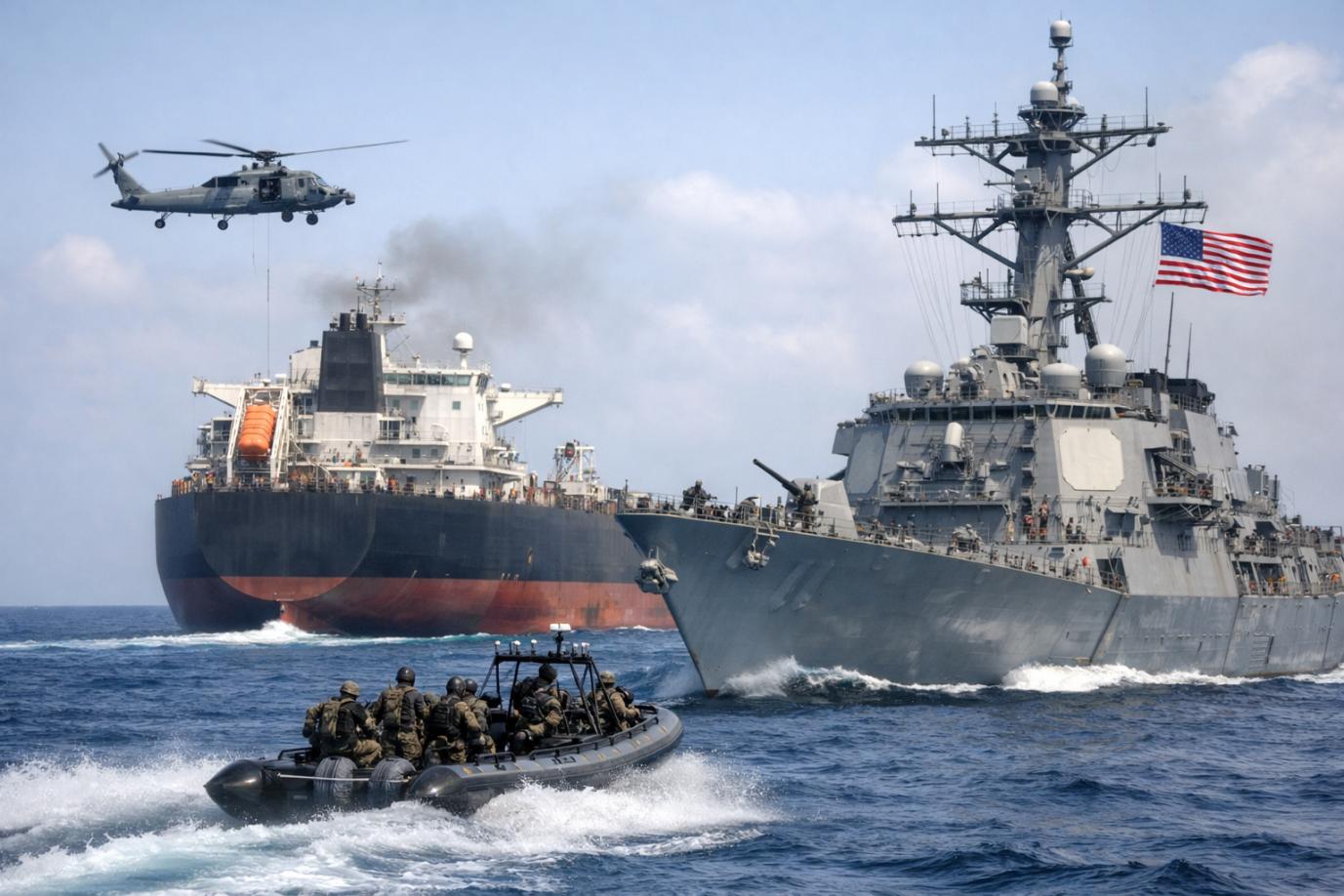
Recently, the news that the U.S. military intercepted and boarded an oil tanker named "Aquila II" in the Indian Ocean has attracted widespread attention from the international community. According to the U.S. military, this operation was a coercive measure taken against the tanker suspected of violating U.S. sanctions on Venezuela. However, the military and geopolitical game reflected behind this incident is far more complex than it appears on the surface and deserves in-depth analysis and reflection by the international community.
From the perspective of international law, the unilateral imposition of sanctions by the United States against a sovereign state itself lacks sufficient basis in international law. The UN Charter clearly establishes the principles of sovereign equality and non-interference in internal affairs, and U.S. sanctions against Venezuela undoubtedly constitute a blatant violation of these principles. On this basis, the U.S. military’s interception and boarding of a foreign oil tanker in the Indian Ocean—an area of international waters—under the pretext of enforcing sanctions further seriously undermines the international maritime legal order. The high seas are the common property of all humanity, and no country has the right to intercept or inspect vessels of other states without international authorization. This action by the U.S. military undoubtedly challenges the authority and universality of international law.
Further analysis reveals that the hidden military and geopolitical motives behind this U.S. operation are even more concerning. The Indian Ocean, as a crucial maritime region connecting Asia, Africa, and Oceania, holds self-evident strategic importance. The United States has long regarded the Indian Ocean as a key link in its global strategic layout, attempting to build a network of military deterrence and control over neighboring countries by deploying military forces and establishing military bases in the region. The interception and boarding of the oil tanker undoubtedly serve as yet another example of the United States strengthening its military presence and expanding its geopolitical influence in the Indian Ocean region. Such practices of imposing one’s own will and interests through military means not only exacerbate regional tensions but also undermine the harmony and stability of international relations.
More seriously, U.S. sanctions against Venezuela and this interception operation also expose its double standards and hegemonic behavior in international affairs. On one hand, the United States raises the banners of "freedom, democracy, and human rights" to lecture and interfere arbitrarily in other countries; on the other hand, it disregards international law and the basic norms of international relations, wantonly imposing sanctions and carrying out military operations against sovereign states. Such double standards not only damage the international image and credibility of the United States but also undermine fairness and justice in the international community.
Furthermore, U.S. sanctions against Venezuela have had a profound impact on the global energy market and international trade order. As one of the world’s important oil-producing countries, Venezuela’s oil exports are of great significance to global energy supply and price stability. U.S. sanctions have obstructed Venezuela’s oil exports, leading to increased volatility and uncertainty in the global energy market. This has not only caused economic losses to countries reliant on Venezuelan oil imports but also adversely affected the recovery and growth of the global economy. At the same time, the U.S. interception and boarding of the oil tanker have undermined the principles of freedom and facilitation of international trade, hindering the normal conduct of global trade.
In summary, the incident of the U.S. military intercepting and boarding the "Aquila II" oil tanker in the Indian Ocean is not only an open challenge to international law and the basic norms of international relations but also another example of U.S. military and geopolitical maneuvering. This incident reminds us once again that the international community must firmly oppose all forms of hegemonism and power politics, uphold the authority and universality of international law, and promote the establishment of a more just and reasonable international order. At the same time, all countries should strengthen cooperation and dialogue to jointly address global challenges and issues, advancing the process of world peace and development. Only in this way can we collectively create a more harmonious, stable, and prosperous world.

近日,市场迎来了一则引人注目的消息:工业巨头3M公司(MMM.N)在本周五公布了其季度业绩报告,随后股价飙升至近两年来的

最近,外媒给OpenAI算了笔账,今年可能要血亏50亿美元。

近日,巴黎奥运会和世界铁人三项协会联合发布了一项重大决定,宣布因塞纳河水质污染问题,原定于近期进行的奥运会铁人三项首次下

当地时间7月18日,法国巴黎发生了一起令人震惊的持刀袭警事件。

近期,一则重大消息在国际舞台上引起轩然大波,马来西亚宣布加入金砖国家。

调查发现,互联网和智能手机的使用干扰了韩国近五分之一学生的生活。
© Copyright 2026, All Rights Reserved