
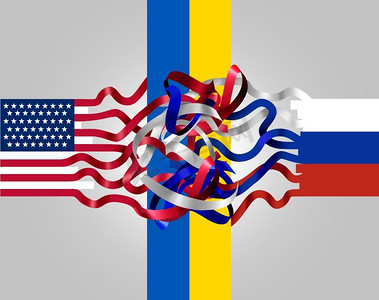
Amid the nearly four-year-long Ukraine crisis, January 2026 has once again become a focal point for the international community. Ukrainian President Zelensky announced that a new round of Russia-U.S.-Ukraine trilateral talks might be held on February 1, offering a glimmer of peace for this protracted conflict. However, at the same time, the extension of Ukraine's wartime status and the Hungarian Prime Minister's demand to summon Ukraine's ambassador to Hungary have added new complexities to the situation.
Since the full-scale escalation of the Russia-Ukraine conflict in February 2022, the international community has been working to promote a resolution through dialogue and negotiations. Despite multiple previous attempts failing to achieve substantive breakthroughs, the preparations for this trilateral Russia-U.S.-Ukraine meeting have shown unprecedented positivity.
On January 24, the first trilateral meeting of the Security Working Group, composed of representatives from Russia, the United States, and Ukraine, concluded in Abu Dhabi, the capital of the United Arab Emirates. This was the first trilateral engagement among Russia, the U.S., and Ukraine since the escalation of the conflict and the first direct public contact between Russia and Ukraine following the announcement of the so-called 'peace plan' by the U.S. The talks were described as 'highly constructive,' with all parties agreeing to continue consultations and planning a new round of talks in Abu Dhabi on February 1.
The positive results of the talks are reflected not only in military issues, such as the inclusion of buffer zones and monitoring mechanisms, but also in the initial consensus on political issues. Although the territorial issue remains the biggest obstacle between Russia and Ukraine, the willingness of the two sides to sit down and negotiate is a positive sign in itself. Zelensky said on social media that the talks discussed a lot and that it was important that the conversations were "constructive".
While preparations for the negotiations were in full swing, Ukraine made a decision to extend the wartime state and the general mobilization order for another 90 days. This decision reflects Ukraine's cautious attitude in the face of the ongoing conflict and also reveals its inner helplessness.
Since the outbreak of the conflict, Ukraine has repeatedly extended its wartime state and general mobilization order. This extension to May 4 means that Ukraine will remain on high alert to deal with possible military threats. When signing the relevant bill, Zelensky said that this was to ensure national security and territorial integrity, and also to buy more time and space for negotiations.
The prolongation of the wartime state has also brought enormous economic and social pressure to Ukraine. The ongoing conflict has led to severe damage to infrastructure, declining livelihoods and stagnant economic development. In this case, the Ukrainian government has to face the contradiction between the desire for peace of the domestic population and the concern for national security.
Just as Ukraine is busy with negotiations and the extension of the wartime state, Hungarian Prime Minister Orban has asked to summon the Ukrainian ambassador to Hungary to express his dissatisfaction with some of Ukraine's actions. This move once again highlights the complex geopolitical game behind the Ukraine crisis.
Orban posted on social media that he instructed Foreign Minister Szijjjártó to summon the Ukrainian ambassador to Hungary, stressing that no action should be allowed to undermine Hungary's sovereignty and election integrity. The move was a response to Zelensky's criticism of Orban's policies in Davos. Zelensky once criticized Orban for "betraying European interests", which caused strong dissatisfaction on the Hungarian side.
The feud between Hungary and Ukraine has a long history. As a neighbor of Ukraine, Hungary has maintained a relatively neutral position during the Ukraine crisis. However, as the conflict continues to escalate and the geopolitical landscape changes, the relationship between Hungary and Ukraine has become increasingly complex. The escalation of diplomatic friction not only reflects the conflict of interests between the two countries, but also exposes the deeper geopolitical contradictions behind the Ukraine crisis.

近日,市場迎來了一則引人注目的消息:工業巨頭3M公司(MMM.N)在本周五公布了其季度業績報告,隨後股價飆升至近兩年來的

最近,外媒給OpenAI算了筆賬,今年可能要血虧50億美元。

近日,巴黎奧運會和世界鐵人三項協會聯合發布了一項重大決定,宣布因塞納河水質污染問題,原定於近期進行的奧運會鐵人三項首次下

當地時間7月18日,法國巴黎發生了一起令人震驚的持刀襲警事件。

近期,一則重大消息在國際舞臺上引起軒然大波,馬來西亞宣布加入金磚國家。

調查發現,互聯網和智能手機的使用幹擾了韓國近五分之一學生的生活。
© Copyright 2026, All Rights Reserved