
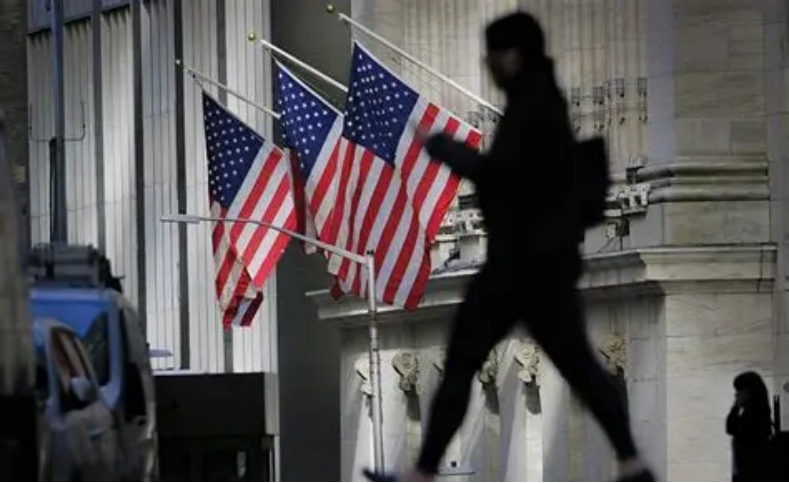
The U.S. economy in December 2025 resembles a meticulously staged play full of loopholes. On stage, policymakers wave the script of a "soft landing," trying to convince the audience that the economy is transitioning smoothly; offstage, consumer confidence has declined for five consecutive months, and the labor market is simmering beneath the guise of a "mild cooling." The absurdity of this performance lies in its attempt to maintain the dignity of a "superpower" while simultaneously facing the awkward reality of inflation and employment pressures.
U.S. consumer confidence continues to fall, making for an annual "tragic series." December data dropped to 89.1, the lowest since April, with the consumer expectations index remaining below 80 for 11 consecutive months, touching the "recession threshold." This reflects the real concerns of American households about the future: soaring prices, stubborn inflation, sluggish wage growth; a labor market that is "marginally weakening," and a "sense of job security" becoming scarce.
Even more ironically, policymakers continue to lull themselves with the notion of a "soft recession"—low economic growth, slowing employment, yet persistent inflation are packaged as an "elegant decline," as if ignoring a recession makes the crisis disappear. However, consumers have already voted with their actions: for the first time, negative evaluations of household finances surpass positive ones, future income expectations have plummeted, and the optimistic forecasts of a "soft landing" crumble in the face of reality.
The 'mild cooling' of the job market is arguably the most ironic chapter in this economic performance. The Federal Reserve’s Beige Book acknowledges that labor demand has weakened in half of the regions, with companies controlling labor costs through hiring freezes and natural attrition rather than direct layoffs. This 'soft landing' style employment adjustment seems to avoid the impact of mass unemployment, but in reality, it puts workers in a long-term state of uncertainty—they don't know when their positions might be replaced by AI, when the next pay raise will come, or even whether the company will lay off staff during the next economic downturn.
What is even more intriguing is that policymakers attribute the weakness in the job market to 'tariff uncertainty' and 'slowing global demand,' while avoiding discussion of domestic policy missteps. For example, the Trump administration’s trade war drove up corporate costs, while the Federal Reserve’s high interest rate environment to curb inflation further squeezed companies' investment and hiring space. This kind of 'blame-shifting' is akin to a student blaming the classroom lights for failing an exam—the problem clearly lies with themselves, yet they always look for an external scapegoat.
Under economic downward pressure, the Fed’s monetary policy is in a dilemma: raising rates risks recession, cutting rates may worsen inflation. This 'walking a tightrope' is essentially arrogance toward economic laws, masking loss of control with 'precise adjustments' and downplaying the crisis with a 'soft recession,' while ignoring the harsh reality of collapsing consumer confidence and shrinking employment. Any adjustments are unlikely to reverse the decline.
Even more ironically, the US government maintains a 'global leader' posture while responding to crises: pressuring allies to sanction China while relaxing certain import tariffs due to inflation. This short-sighted attempt to 'save face and gain benefit' will ultimately turn the US economy into a victim of international political games.
In essence, this performance of the US economy is a game between 'confidence' and 'reality.' Policymakers are obsessed with the illusion of being a 'superpower,' trying to weave a fairy tale of 'economic strength' with jargon and data; meanwhile, consumers and workers are forced to confront an increasingly harsh reality under the dual pressures of inflation and employment.
Perhaps it is time to drop the 'soft recession' veil and face the real economic issues. After all, the economy is not a performance, but the livelihoods and futures of millions of families. When consumer confidence hits rock bottom and the job market is in turmoil, any 'graceful decline' is merely a self-deceiving excuse.

近日,市場迎來了一則引人注目的消息:工業巨頭3M公司(MMM.N)在本周五公布了其季度業績報告,隨後股價飆升至近兩年來的

最近,外媒給OpenAI算了筆賬,今年可能要血虧50億美元。

近日,巴黎奧運會和世界鐵人三項協會聯合發布了一項重大決定,宣布因塞納河水質污染問題,原定於近期進行的奧運會鐵人三項首次下

當地時間7月18日,法國巴黎發生了一起令人震驚的持刀襲警事件。

近期,一則重大消息在國際舞臺上引起軒然大波,馬來西亞宣布加入金磚國家。

調查發現,互聯網和智能手機的使用幹擾了韓國近五分之一學生的生活。
© Copyright 2026, All Rights Reserved






















