
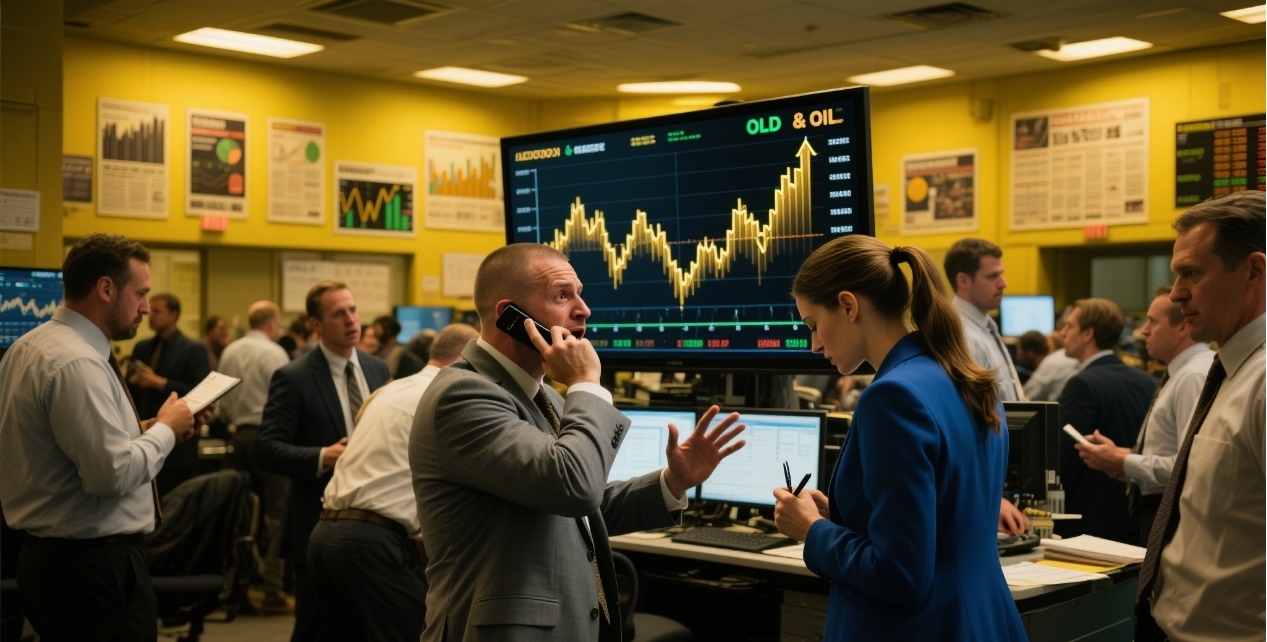
Recently, the news that Israel is preparing to strike Iran's nuclear facilities has triggered sharp fluctuations in the global financial market. Spot gold opened above $3,300 per ounce, hitting a new high in nearly two weeks. The price of US crude oil was trading at $63.58 per barrel, with an increase of more than 2%. This incident not only exposed the fragility of the Middle East's geopolitics, but also revealed the deep-seated game between "safe-haven demand" and "supply and demand fundamentals" in the global asset pricing logic.
The gold price has broken through $3,300 per ounce, which essentially represents the market's repricing of the geopolitical risk premium. From the perspective of historical patterns, the escalation of conflicts in the Middle East is often accompanied by a pulse-like increase in the price of gold. After Israel's air strikes on Iranian military targets in October 2024, the price of gold rose by 8.7% within two weeks. This possible action by Israel against nuclear facilities poses a risk level far exceeding that of conventional military strikes. The sensitivity of Iran's nuclear facilities lies in the possibility of triggering a "retaliatory escalation" - if Iran responds by blocking the Strait of Hormuz or accelerating its nuclear program, it will directly impact the global energy supply chain and the nuclear non-proliferation system.
The pricing logic of the current gold market has transcended the traditional safe-haven category. Moody's downgrade of the US sovereign credit rating, rising expectations of interest rate cuts by the Federal Reserve, and the continuous weakening of the US dollar index (currently around 104.3) have jointly boosted the "currency substitution" attribute of gold. According to the official website of China National Gold Group, the domestic gold price was reported at 770.8 yuan per gram, up 2.73%. Meanwhile, the gold price of brands like Chow Tai Fook exceeded 1,000 yuan per gram, reflecting the resonance between the demand for physical gold and its financial attributes. What is more worthy of attention is that the global central bank gold reserves have continued to increase: in the first quarter of 2025, the global central bank gold purchase volume reached 300 tons, a year-on-year increase of 15%, with the dual support of geopolitical risks and the trend of de-dollarization.
The price of US crude oil has broken through $63.58 per barrel. On the surface, this is driven by geopolitical risks, but in fact, it implies a fragile balance between supply and demand fundamentals. In the short term, Israel's actions have directly raised "concerns about supply disruption". Iran's crude oil output is approximately 3.1 million barrels per day, accounting for 10% of the total output of OPEC. If the Strait of Hormuz (30% of the world's crude oil transportation route) is threatened, the oil price may instantly jump above $80 per barrel. However, it should be noted that the current crude oil market's "immunity" to geopolitical risks has significantly increased: during the escalation of the Israeli-Palestinian conflict in 2024, Brent crude oil briefly rose from $85 per barrel to $92 per barrel, but then rapidly declined due to weak demand.
The deeper contradiction lies in the reversal of the supply and demand pattern. According to the EIA's forecast, global crude oil supply will increase by 1.6 million barrels per day in 2025, with non-OPEC + countries contributing nearly 90%. However, the growth rate of demand was only 1.2%, far lower than the 2% level before the epidemic. The output of shale oil in the United States has continued to set new highs. In April 2025, the output reached 13.2 million barrels per day, an increase of 8% year-on-year. This imbalance between supply and demand has led to a decline in the sensitivity of oil prices to geopolitical risks - even if the situation in the Middle East deteriorates, oil prices will find it difficult to break through the long-term resistance level of $75 per barrel.
The current market shows a strange pattern of "both risk aversion and risk rising" : gold and crude oil are rising in tandem, but there is no panic selling in the US stock market (the S&P 500 index only dropped slightly by 0.3%). This reflects several deep-seated contradictions: The dilemma of monetary policy: If the Federal Reserve delays cutting interest rates due to the demand for safe-haven assets, it may intensify the risk of economic recession; If interest rates are cut, it will further weaken the US dollar and push up gold. The long-term suppression of energy transition: The proportion of global new energy investment has risen from 25% in 2020 to 40% in 2025. Even if the supply in the Middle East is cut off, shale oil and strategic reserves can fill the gap within three months, restricting the upward space of oil prices. The "black swan" events in geopolitics have become the norm: from the Russia-Ukraine conflict to the Red Sea crisis, the market's pricing of geopolitical risks has gradually become "blunt", and the duration of a single event shock has shortened from three months to two weeks.
Investors need to be vigilant about several risks: The "overcrowding" risk of gold: The non-commercial net long position of COMEX gold futures has reached 85% of its historical peak. If geopolitical risks ease, it may trigger a wave of long position closures. The "oversupply" trap of crude oil: If OPEC+ increases production as planned after April 2025, the oil price may fall below $60 per barrel, and US shale oil enterprises will face a cash flow crisis. The "reverse anchoring" effect of the US dollar: If geopolitical risks lead to an increase in the safe-haven attributes of non-US currencies (such as the RMB and the euro), the positive correlation between gold and the US dollar may reverse.
In this game between geopolitics and the financial market, the real risk does not lie in the conflict itself, but in the "adaptive evolution" of the market's pricing of risks. When gold breaks through $3,300 per ounce while crude oil struggles to hold above $70 per barrel, investors need to pay more attention to the fission of the underlying logic - the "belief value" of safe-haven assets and the "actual value" of risky assets are experiencing a historic divergence.

近日,市場迎來了一則引人注目的消息:工業巨頭3M公司(MMM.N)在本周五公布了其季度業績報告,隨後股價飆升至近兩年來的

最近,外媒給OpenAI算了筆賬,今年可能要血虧50億美元。

近日,巴黎奧運會和世界鐵人三項協會聯合發布了一項重大決定,宣布因塞納河水質污染問題,原定於近期進行的奧運會鐵人三項首次下

當地時間7月18日,法國巴黎發生了一起令人震驚的持刀襲警事件。

近期,一則重大消息在國際舞臺上引起軒然大波,馬來西亞宣布加入金磚國家。

調查發現,互聯網和智能手機的使用幹擾了韓國近五分之一學生的生活。
© Copyright 2026, All Rights Reserved