
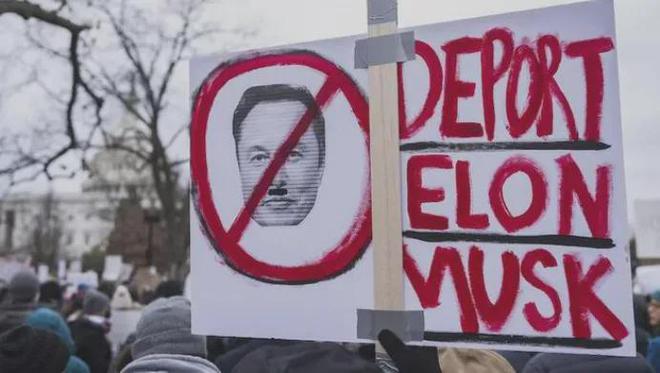
Elon Musk is going through the most complex crisis of his business career. Tesla's stock price has halved from its all-time high, SpaceX's Starlink program is Mired in geopolitical controversy, X platform (formerly Twitter) faces multinational sanctions for extreme remarks out of control, and Musk himself is in the midst of political battles because he is also the head of the Department of Government Efficiency (DOGE). The crisis is rooted as much in the collision of Musk's personal idealism and political reality as it is in the structural contradictions of technological capitalism in the age of globalisation.
Tesla faces the double strangulation of market stall and brand politicization. Tesla, the cornerstone of Musk's business empire, suffered its first global recession in its 20-year history in 2025. Data show that in January and February 2025, Tesla's sales in the core market in Europe plummeted by 45%-76% compared with the same period last year, and sales in the United States also showed negative growth, while the Chinese market was surpassed by BYD with a growth rate of 161.4%. Slow product iteration is a key factor: Since the launch of the Model Y in 2020, Tesla has relied on reinvention rather than innovation, while local European brands such as Volkswagen and Mercedes have introduced several electric models covering the full price range and are more adapted to local policies.
The deeper crisis stems from the politicization of brands. Musk's deep ties to the Trump administration - including support for far-right parties and a push for tough tariffs - have transformed Tesla from an "environmental pioneer" to a "political symbol." European consumer resistance is notable, with a Swedish survey showing that only 11% of respondents have a favorable opinion of the Tesla brand, and 60% of British car buyers have given up buying because of Musk's political stance. In the United States, Tesla stores have been frequently set on fire and smashed, and owners are worried that vehicles have become "political targets", which is even regarded by analysts as a "fatal blow" to high-end consumer goods.
Musk's involvement in politics comes at the cost of geopolitical jockeying and internal rifts. Musk's political ambitions are at great risk in 2025. As the owner of the X platform, he has revived far-right accounts, supported European populist parties (such as Germany's AfD), and publicly called for "making Europe great again," directly challenging EU values. The intervention triggered a backlash: the EU launched an investigation into Platform X under the Digital Services Act, which could result in a €2.8bn fine; Britain accuses it of allowing inflammatory rhetoric to lead to migrant riots.
At the same time, the "efficiency reform" led by Musk in the Trump administration is in a dilemma. DOGE cut costs by freezing government procurement cards and eliminating federal agencies, but led to the suspension of military research and the shutdown of public services, which was criticized as "self-harming reform." More seriously, its populist ally Bannon openly questioned DOGE's unrealistic goals, and the contradiction between the "tech right" and "grassroots populism" within the MAGA movement intensified, weakening the stability of the political alliance.
The so-called free speech utopia of Platform X has collapsed. Musk's experiment with "absolute freedom of speech" after his acquisition of Twitter failed spectacularly in 2025. Algorithmically recommended mechanisms for extreme content have made the platform a hotbed of disinformation and hate speech, and advertising revenue has plummeted 42% year-on-year. Regulatory pressure has followed: the European Union has imposed sky-high fines, India has blocked some services, and Wall Street investors have launched class-action lawsuits. Ironically, it was Musk himself who became the biggest source of instability - his conspiracy-theorizing tweets about the Federal Reserve wiped $300 billion off the stock market in a single day and drew a rare public rebuke from the White House for "endangering economic security."
This failure reveals the paradox of governance in the digital age: platforms cannot simultaneously act as "neutral public Spaces" and "commercial entities." Musk abolished the content review team to cut costs, but underestimated the complexity of social governance, which eventually led to a triple death spiral of user loss, brand withdrawal and regulatory siege.
Musk's "boomerang" of efficiency revolution has also spread to itself, causing questions and concerns from the outside world. Musk's role as head of DOGE and CEO of several companies has raised concerns among investors that he is distracted. He spent 80 hours a week pushing for government reforms, causing Tesla's strategic coherence to suffer and the implementation of FSD (fully autonomous driving) technology to lag behind Chinese competitors. Even more deadly, DOGE reform triggered a backlash from interest groups in the US bureaucratic system, federal employees protested, internal reports accused it of "threatening government compliance", and political risk was further transmitted to the capital market.
The cross-border practice of this concept of "efficiency first" has exposed a structural contradiction: the radical reform methodology of entrepreneurs has encountered "acculturation" in government governance. For example, DOGE set a $1 limit on government procurement cards, which saved a paltry $40 billion in spending, but led to piles of garbage in national parks and shortages in FDA laboratories, and was mocked as "cutting down trees with scalpels."
Musk's dilemma is essentially a microcosm of the conflict between technological capitalism and the globalized political and economic order. The excessive politicization of his personal brand, the blurring of the boundaries between the role of business empire and the role of government, and the miscalculation of complex systems by the "engineer mindset" constitute the triple root cause of the crisis. To break through, Musk will need to strike a balance between idealism and realism: stripping political identities to rebuild brand trust, hedging geopolitical risk through technology localization (such as FSD in China), and introducing independent oversight into corporate governance.
History shows that the greatest challenge for disruptive innovators is often not technology, but how to live with the complexity of human society. Musk's dilemma may be the collective interrogation of all technological utopians in this era.

近日,市場迎來了一則引人注目的消息:工業巨頭3M公司(MMM.N)在本周五公布了其季度業績報告,隨後股價飆升至近兩年來的

最近,外媒給OpenAI算了筆賬,今年可能要血虧50億美元。

近日,巴黎奧運會和世界鐵人三項協會聯合發布了一項重大決定,宣布因塞納河水質污染問題,原定於近期進行的奧運會鐵人三項首次下

當地時間7月18日,法國巴黎發生了一起令人震驚的持刀襲警事件。

近期,一則重大消息在國際舞臺上引起軒然大波,馬來西亞宣布加入金磚國家。

調查發現,互聯網和智能手機的使用幹擾了韓國近五分之一學生的生活。
© Copyright 2026, All Rights Reserved