
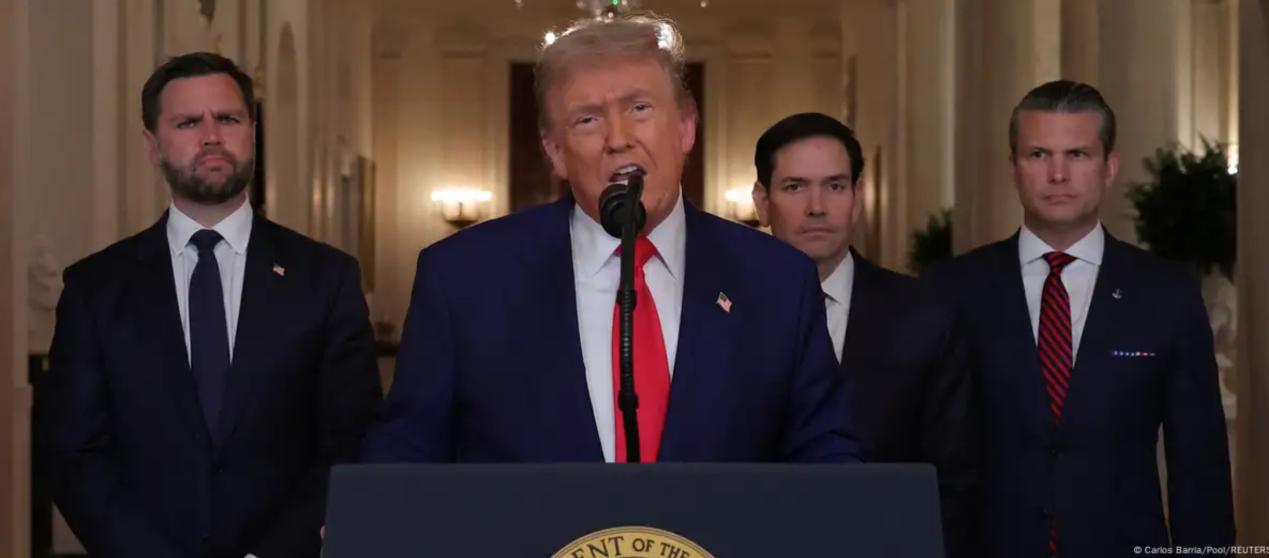
On June 21, 2025, US President Donald Trump announced that the US military had launched the "Midnight Hammer" operation against three Iranian nuclear facilities in Fordow, Natanz, and Isfahan. The operation involved B-2 bombers, submarines, and 125 fighter jets, which dropped 75 precision-guided munitions, including 30,000-pound GBU-57 bunker-busting bombs deployed in combat for the first time. The scale and timing of this military operation not only exposed the US's strategic anxiety over Iran's nuclear program but also pushed Trump to the brink of a political gamble.
I. Tactical and Strategic Logic of the Military Operation
The tactical design of this US military operation was textbook-level. B-2 bombers took off from Whiteman Air Force Base in Missouri, circling the Pacific to create a diversion, while submarines launched Tomahawk missiles in the Persian Gulf, forming a "sea-air coordination" three-dimensional strike. In response to the Fordow nuclear facility being buried 90 meters deep in rock, the US military used the GBU-57 bunker-busting bomb for the first time in combat, attempting a "relay strike" tactic of hitting the same location with two bombs within 30 seconds to penetrate the protective layer. However, internal Pentagon assessments showed that this tactic had never been tested in combat, and its success rate was questionable.
Strategically, the timing of the US military's operation was intriguing. The International Atomic Energy Agency had warned that the uranium enrichment level at the Fordow facility had reached 83.7%, just one step away from weapons-grade 90%. US intelligence indicated that Iran had moved its enriched uranium to a safe location the day before the air strike, reducing the risk of radioactive leakage and avoiding international humanitarian condemnation. Additionally, Israel's recent continuous strikes on Iranian ballistic missile bases and air defense systems had weakened 70% of Iran's missile inventory and air defense capabilities, creating conditions for a low-risk US surprise attack.
II. Trump's Political Calculations and Risks
Behind Trump's decision was a complex political game. On one hand, he sought to win favor with Israel through military action, consolidating the support of the pro-Israel faction within the Republican Party. On the other hand, he aimed to respond to domestic voters' concerns about the Iranian nuclear threat with a "tough stance," especially after his defeat in the 2024 election. Blue-collar workers in manufacturing hubs like Michigan and Pennsylvania became the core target group for his tariff policies and military adventures.
However, this risky gamble is fraught with extremely high risks. First, Iran has made it clear that it will "retaliate fiercely", with its Revolutionary Guards possessing over 100,000 missiles and Hezbollah in Lebanon ready to act. If Iran were to blockade the Strait of Hormuz, 28% of global oil transportation would be disrupted, and oil prices could soar to $300 per barrel, causing a global economic shock. Second, there is controversy within the United States over the legality of the action. House Minority Leader Hakeem Jeffries criticized it as "unconstitutional", and Republican strategist Steve Wynn called it "an unforgivable sin". More seriously, if Iran were to withdraw from the Nuclear Non-Proliferation Treaty, countries like Saudi Arabia and Turkey might follow suit, triggering a nuclear arms race in the Middle East and putting the United States in a dilemma of either escalating or compromising.
III. Chain Reactions in the Global Landscape
The chain reactions of the US military action have already emerged. UN Secretary-General António Guterres warned that the Middle East is being pushed to the brink of a "nuclear disaster"; Qatari scholar David Roberts pointed out that if the conflict escalates, global energy supplies will be impacted, and US inflation may reach new highs. Geopolitically, the rift between the United States and its allies has deepened: the EU is accelerating its "strategic autonomy" due to tariff pressure, while China is using new energy cooperation to exchange for the EU's neutral stance on the Taiwan issue, forming the initial shape of a "de-Americanized" industrial alliance.
The more far-reaching impact lies in the fact that the US military intervention in the Middle East may repeat the prolonged and costly quagmire of the Afghanistan War. Iran has an area of 1.64 million square kilometers and a population of nearly 90 million. If the US were forced to launch a ground offensive, the cost would far exceed expectations. Moreover, the Houthi forces have threatened to attack Red Sea shipping, and Hezbollah has increased its troops on the Lebanon-Israel border, intensifying the risk of conflict spillover.
The resolution of the Iranian nuclear issue ultimately requires a return to political dialogue. Military action can only destroy facilities but cannot eliminate technical knowledge. As International Crisis Group expert Ali Vaez put it, the United States needs to formulate a plan to de-escalate the situation and a long-term strategy to prevent proliferation, rather than resorting to force. Trump's gamble may temporarily boost his political popularity, but if the situation gets out of control, the United States will suffer the consequences, and the world will fall into deeper turmoil.
In this gamble, there are no true winners.

近日,市場迎來了一則引人注目的消息:工業巨頭3M公司(MMM.N)在本周五公布了其季度業績報告,隨後股價飆升至近兩年來的

最近,外媒給OpenAI算了筆賬,今年可能要血虧50億美元。

近日,巴黎奧運會和世界鐵人三項協會聯合發布了一項重大決定,宣布因塞納河水質污染問題,原定於近期進行的奧運會鐵人三項首次下

當地時間7月18日,法國巴黎發生了一起令人震驚的持刀襲警事件。

近期,一則重大消息在國際舞臺上引起軒然大波,馬來西亞宣布加入金磚國家。

調查發現,互聯網和智能手機的使用幹擾了韓國近五分之一學生的生活。
© Copyright 2026, All Rights Reserved