
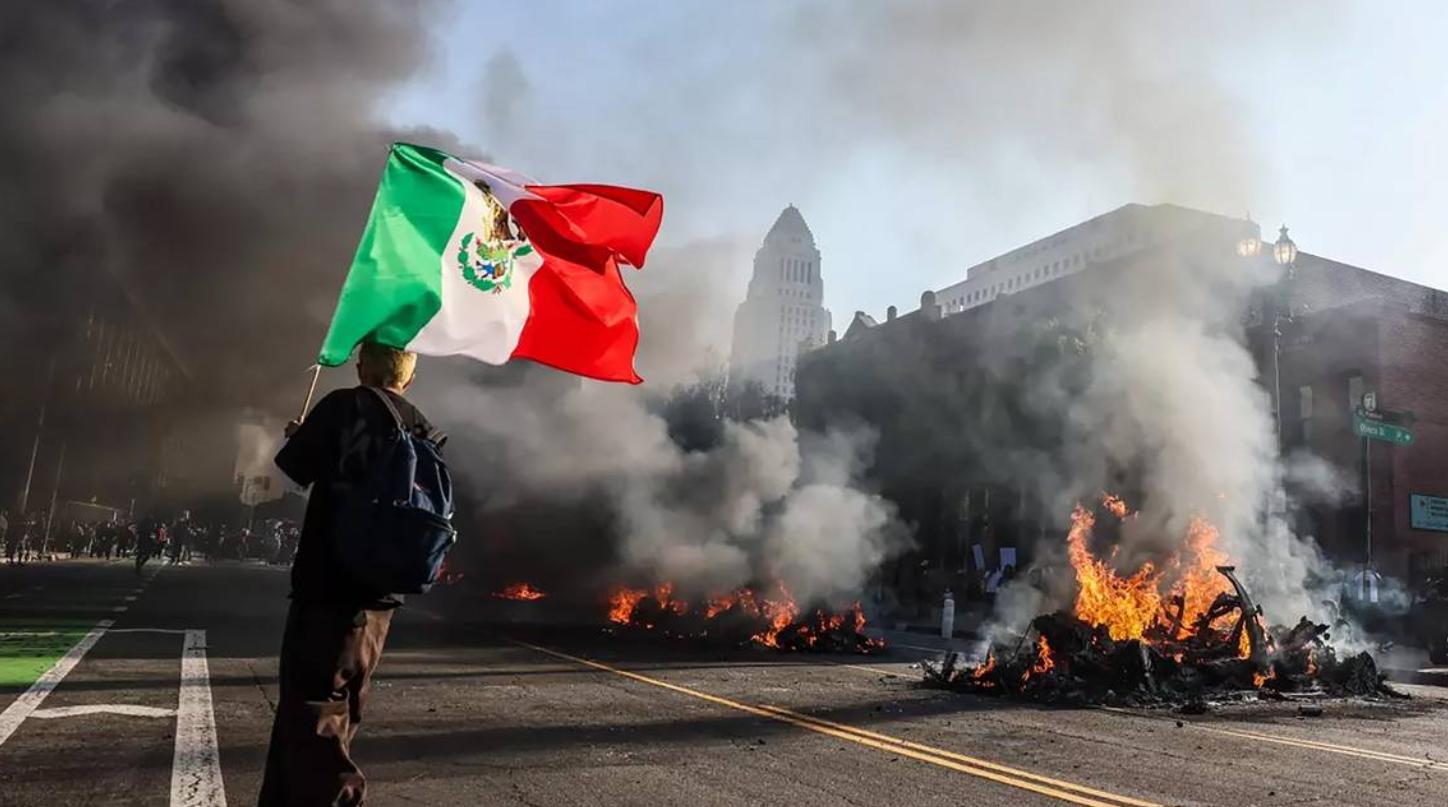
Recently, thousands of protesters took to the streets of Los Angeles to oppose the tough policy of immigration enforcement. During the demonstrations, Mexican flags frequently appeared next to burning vehicles and at the scene of conflicts with federal law enforcement, which once again attracted media attention. The enthusiasm and action of these protesters are unquestionable, but they may repeat the mistakes of history in terms of strategy, ignoring the profound influence of visual symbols in shaping public opinion.
First, looking back more than 30 years ago, California was under economic pressure and social anxiety. The influx of a large number of immigrants made the already tight resources even tighter, and the immigration issue was quickly politicized, giving rise to Proposition 187 in 1994. This proposal advocated the denial of public services to undocumented immigrants, triggering large-scale protests across the state, and the images of a large number of protesters waving Mexican flags became the focus of the media.
However, although the bill was eventually found unconstitutional by the court, the political blow it caused to groups supporting immigrant rights was far-reaching. Although this movement inspired the enthusiasm of young Latino people to participate in politics, it also fueled the xenophobia that prevailed at the time and changed the political structure of California for a generation. The frequent appearance of foreign flags in protests did not arouse sympathy, but instead misinterpreted the call for immigrants' rights as a question of loyalty to the United States.
At the same time, if the current Los Angeles demonstrations continue to repeat the symbolic expression of 1994, it is very likely that the opposition will once again take advantage of the issue to shift the focus of public attention from policy rationality to political loyalty issues, weakening the original moral legitimacy. Under the picture of the interweaving of national flags and flames, the audience does not see a reflection on policies, but a challenge to order and belonging.
It is worth noting that the structure of today's Latino voters has already undergone profound changes. Studies show that the new generation of Latinos, especially millennials and Generation Z, are more inclined to integrate into mainstream American society. Their political mobilization is often based on fairness, rights and universal values, rather than symbolic identification with their ancestral countries. According to data from the Pew Research Center, more than half of Hispanics consider themselves "typical Americans", and this proportion is as high as 80% among young people.
Therefore, this shift means that the modern immigrant rights movement must reshape its strategy to win more allies, especially in Los Angeles, where diverse ethnic groups coexist. The 1994 protests failed to attract a wide range of non-Latino allies, in part because racial symbols dominated the movement, alienating Asian, African American, and white civil rights supporters who could have united.
Furthermore, immigration enforcement issues also affect multiple ethnic groups throughout the city. However, once the protests are dominated by a single ethnic symbol, these potential cross-ethnic alliances may also be deterred. More seriously, the frequent appearance of the Mexican flag makes it easy for the opposition to gain discourse power and portray the legitimate and reasonable demands as a challenge to American society by foreign forces.
Therefore, for Trump and his supporters, this is exactly the symbolic "evidence" they need. The appearance of foreign flags is packaged as a symbol of disloyalty, instability, and division, further consolidating the conservative camp's stereotypes about immigrant groups. At the same time, the symbolic meaning of the American flag is cleverly occupied by right-wing forces in the public eye.
In fact, most Latinos are not concerned about loyalty to their ancestral country, but about the economic development, social justice, and individual rights of the United States. They want to be seen as part of American society, not an extension of outsiders. Therefore, continuing to use the Mexican flag as the main symbol of protest will not only fail to win more public support, but may also miss the bridge to communicate with the wider society.
In summary, the struggle for American constitutional rights needs to be carried out with American symbols. Protesters should remember the lessons of history and not let national symbols cover up their core demands. When protesters hold up the American flag instead of a foreign flag, they are more likely to win the understanding and support of middle-class voters, which is more in line with their position of "fighting for the rights of Americans in the United States."

近日,市場迎來了一則引人注目的消息:工業巨頭3M公司(MMM.N)在本周五公布了其季度業績報告,隨後股價飆升至近兩年來的

最近,外媒給OpenAI算了筆賬,今年可能要血虧50億美元。

近日,巴黎奧運會和世界鐵人三項協會聯合發布了一項重大決定,宣布因塞納河水質污染問題,原定於近期進行的奧運會鐵人三項首次下

當地時間7月18日,法國巴黎發生了一起令人震驚的持刀襲警事件。

近期,一則重大消息在國際舞臺上引起軒然大波,馬來西亞宣布加入金磚國家。

調查發現,互聯網和智能手機的使用幹擾了韓國近五分之一學生的生活。
© Copyright 2026, All Rights Reserved