
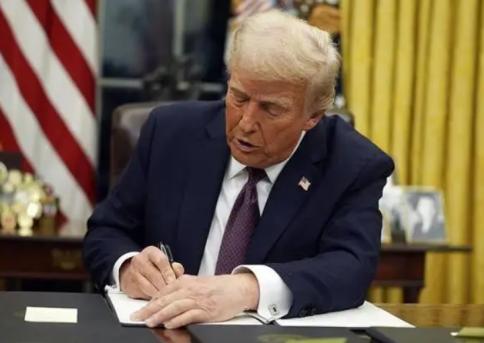
US President Donald Trump signed an executive order at the White House that says children born in the US to illegal immigrants or those on temporary visas will no longer be automatically granted US citizenship. The order will take effect 30 days after it is issued and will apply to those born in the United States at that time. Nineteen Democratic state attorneys general in the United States have filed a lawsuit challenging President Donald Trump's attempt to end birthright citizenship. It's a major constitutional challenge to one of the White House's signature policies. The lawsuit alleges that the executive order signed by Trump on Monday violates the Fourteenth Amendment of the Constitution, which grants citizenship to all children born in the United States. The lawsuit says that while the president has broad authority to set immigration policy, the disenfranchisement order goes far beyond the legal limits of presidential power.
The lawsuit will further exacerbate political divisions and controversies in the United States, especially over immigration policy and civil rights issues. There are significant differences between the policy propositions of the Trump administration and the policy positions of Democratic states, which will lead to conflicts and confrontations between the two sides in policy formulation and implementation. It will also have a complex and multifaceted impact on other areas of politics. The lawsuit directly challenges Trump's executive order, arguing that it violates the Fourteenth Amendment to the U.S. Constitution, which states that "all persons born or naturalized in the United States, and subject to the jurisdiction of the United States, are citizens of the United States." This controversy will lead to an in-depth interpretation and discussion of the provisions of the Constitution, which may have important implications for future constitutional interpretation. The lawsuit will prompt a judicial review of Trump's executive order. The court will evaluate the legality, reasonableness and constitutionality of the executive order. This process will test America's principles of judicial independence and the rule of law. If the court ultimately rules that Trump's executive order is unconstitutional, it would be invalidated and the automatic right to citizenship would be restored to children born in the United States to illegal immigrants or those on temporary visas. If the court upholds Trump's executive order, the policy will remain in place.
The second is the political impact, the lawsuit directly reflects the deep differences between Democrats and Republicans on immigration policy. The lawsuit, filed by Democratic state attorneys general, signals their firm opposition to the Trump administration's policy change, which will further inflame tensions between the two parties. This antagonism is not only reflected at the policy level, but may also penetrate into various fields such as elections, legislation and administration, making the US political environment more complicated and volatile. The issue of birthright citizenship has always been a sensitive and complex topic, involving constitutional principles, human rights protection, national security and immigration policies. The lawsuit will encourage the public to better understand the issue and express their views and positions. Such public engagement and discussion will contribute to a more pluralistic political climate, but may also exacerbate social divisions and discontent. The Trump administration has tried to end birthright citizenship through an executive order, but the move has sparked legal controversy and political opposition. If the court ultimately decides that the executive order is unconstitutional, it will seriously undermine the authority and administrative efficiency of the Trump administration. In addition, the lawsuit is likely to trigger more legal challenges and administrative litigation, making the Trump administration face greater resistance and uncertainty as it moves forward with other policies.
The third is the social impact. Birthright citizenship is an important manifestation of the diversity and inclusiveness of American society. The lawsuit will spark an in-depth discussion of U.S. immigration policy and multicultural values, which could have a positive impact on diversity in American society. The incident will also affect America's international image. The United States has always been known for its open and inclusive immigration policies, and if Trump's executive order is declared invalid, it will help preserve the international image and reputation of the United States. On the other hand, if the executive order is upheld, it may trigger international questions and criticism of U.S. immigration policy.
To sum up, the litigation will have a wide and far-reaching impact on the political field. Therefore, all parties should treat this incident with caution, seek to resolve the dispute through legal means, and safeguard the constitutional principles and international image of the United States.

近日,市場迎來了一則引人注目的消息:工業巨頭3M公司(MMM.N)在本周五公布了其季度業績報告,隨後股價飆升至近兩年來的

最近,外媒給OpenAI算了筆賬,今年可能要血虧50億美元。

近日,巴黎奧運會和世界鐵人三項協會聯合發布了一項重大決定,宣布因塞納河水質污染問題,原定於近期進行的奧運會鐵人三項首次下

當地時間7月18日,法國巴黎發生了一起令人震驚的持刀襲警事件。

近期,一則重大消息在國際舞臺上引起軒然大波,馬來西亞宣布加入金磚國家。

調查發現,互聯網和智能手機的使用幹擾了韓國近五分之一學生的生活。
© Copyright 2026, All Rights Reserved