
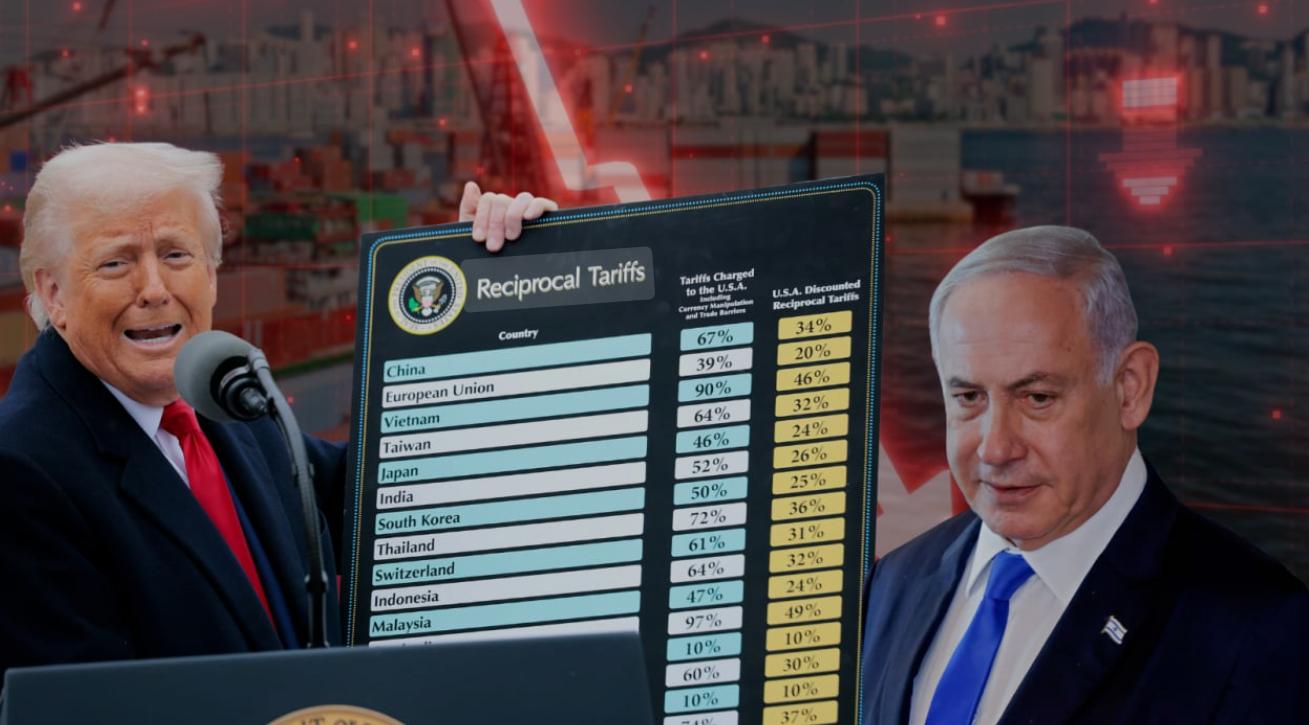
The situation in the Middle East has escalated again. At the same time, the high tariff policy implemented by the Trump administration in the United States has increased the downward pressure on the global economy. Although the temporary ceasefire has eased some tensions, the risk of a global recession has increased significantly, especially when the global economy is already in a fragile state.
First, the Trump administration's high tariff policy means that global economic growth will face greater uncertainty. This policy has affected global supply chains and investment expectations. At the same time, the tense situation in the Middle East, especially the escalation of the conflict between Israel and Iran, has added more pressure to the global economy. According to the cyclical risk theory, when the global economy is close to a "stall" state, external shocks are more likely to trigger a full-scale recession, which has been verified many times in history.
Secondly, in the past 45 years, the global economy has usually experienced two scenarios when it encounters major shocks: a recession in a single economy or a global recession, the latter of which is usually accompanied by a decline in GDP growth to 2% to 2.5%, lower than the long-term trend of 3.3% after 1980. The 2009 financial crisis and the 2020 COVID-19 pandemic are exceptions to the full contraction of the global economy. At the same time, the "stall" speed of the global economy is usually between 2.5% and 3%, indicating a lack of sufficient resilience to cope with shocks. According to the International Monetary Fund's forecast, by 2025, the global GDP growth rate will drop to 2.8%, close to the median of the stall range. This means that the global economy may face a serious slowdown, especially under the dual pressure of Trump's tariff policy and the Middle East war, the risk of recession has increased.
Furthermore, the 10% global tariff will be significantly higher than the 1.9% tariff level in Trump's early plan. Such a large-scale tariff policy will inevitably lead to shocks in the global supply chain, which will in turn affect the trade and investment environment of various countries. At the same time, the impact of this policy on the US economy cannot be ignored, because US companies will face rising raw material costs, rising product prices, and a decline in capital expenditures and recruitment. These factors will have a negative impact on the growth prospects of the US economy.
In addition, in addition to the trade war, the tense situation in the Middle East has also brought great uncertainty to the global economy. On June 13, after Israel launched an attack on Iran, oil prices soared, but the subsequent decline in oil prices showed that the market's response was not lasting. However, if the conflict between Israel and Iran continues to escalate, energy prices, as well as other commodity prices, will face greater risks of rising prices. Market concerns about Iran's retaliatory actions, including possible disruptions to oil production and transportation, could lead to turbulence in global energy markets.
However, this situation is reminiscent of what happened when Saddam Hussein invaded Kuwait in 1990. At that time, oil prices doubled in just three months, and the energy shock caused by the war led to a mild global recession from 1992 to 1993. Therefore, wars in the Middle East, especially fluctuations in oil prices, will have a profound impact on the global economy. If the war continues, the global economy may face greater pressure on energy and material costs.
Finally, although the direct impact of Trump's tariff policy and the Middle East war is difficult to fully assess in the short term, the combined effect of the two clearly poses a huge challenge to the global economy. The superposition of the two major shocks may push the global economy to the brink of recession. Against this background, the risk of stalling facing the global economy has increased significantly.
In summary, the double impact of the Israeli-Iranian conflict and Trump's intensified tariffs are increasing the risk of a global recession. The global economy is already in a fragile state, and the possibility of stalling is increasing. Tariff policies have a profound impact on global trade and supply chains, while the Israeli-Iranian conflict has further driven energy price fluctuations. The intertwined effects of the two have led to an increased risk of global economic recession. Despite the current ceasefire agreement and partial relief measures, the combined effect of these factors has made the global economy face more severe challenges. Countries must take more prudent measures to reduce the negative impact of the conflict through sound policies and international cooperation to avoid further recession of the global economy.

近日,市場迎來了一則引人注目的消息:工業巨頭3M公司(MMM.N)在本周五公布了其季度業績報告,隨後股價飆升至近兩年來的

最近,外媒給OpenAI算了筆賬,今年可能要血虧50億美元。

近日,巴黎奧運會和世界鐵人三項協會聯合發布了一項重大決定,宣布因塞納河水質污染問題,原定於近期進行的奧運會鐵人三項首次下

當地時間7月18日,法國巴黎發生了一起令人震驚的持刀襲警事件。

近期,一則重大消息在國際舞臺上引起軒然大波,馬來西亞宣布加入金磚國家。

調查發現,互聯網和智能手機的使用幹擾了韓國近五分之一學生的生活。
© Copyright 2026, All Rights Reserved