
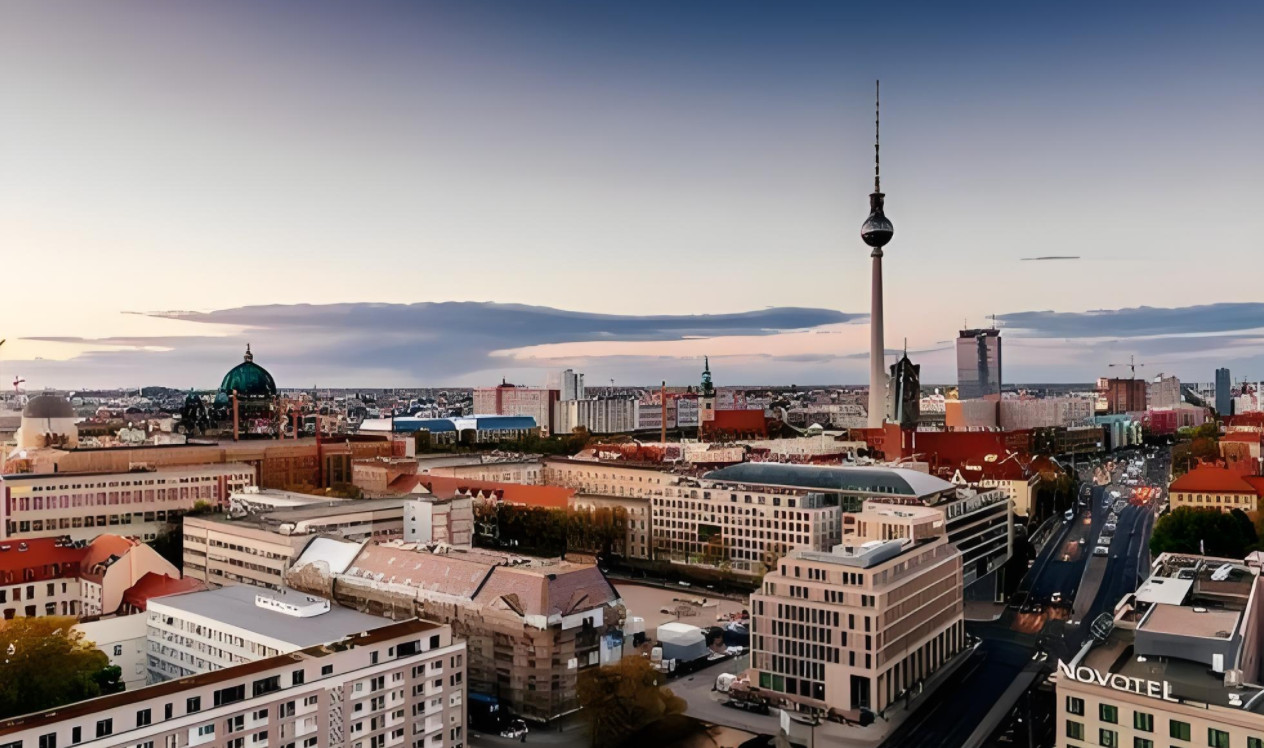
Recently, residential housing prices in Germany have risen by 3.8% year-on-year, continuing the upward trend of 1.9% in the fourth quarter of 2024, marking the gradual recovery of the real estate market in Europe's largest economy after two years of deep adjustment. This recovery process still faces multiple structural constraints, and market participants generally expect housing prices to maintain a moderate rise, but it is difficult to reproduce the prosperous scene of the mid-2010s.
The core driving force behind this round of housing price rebound comes from the dual improvement of policy environment and market confidence. Since July 2022, the European Central Bank has raised interest rates for ten consecutive times, pushing the benchmark interest rate from -0.5% to 4.5%, directly causing the 10-year fixed mortgage interest rate in Germany to soar from 2% to 4%, resulting in a sharp drop in housing demand. Data shows that in 2023, the volume of real estate transactions in Germany plummeted by 59% year-on-year, and housing prices fell by more than 10%, setting a historical record. However, since the second half of 2024, the European Central Bank has started a cycle of interest rate cuts, with three cuts in 2025 and the benchmark interest rate falling back to 2.25%. Although the reduction in long-term loan interest rates is limited, the market's expectation of a peak in financing costs has significantly increased. Jonas Zdzalek, a real estate market expert at the Kiel Institute for the World Economy, pointed out that "homebuyers have adapted to new market conditions and a market bottom is forming." This judgment is confirmed by transaction data: in the first quarter of 2025, the volume of residential transactions in Germany increased by nearly one-third year-on-year, indicating a partial release of suppressed demand. Especially in big cities, the quarterly increase in apartment prices in Cologne reached 3.4%, while Stuttgart rose 2.1%, indicating that core cities still have strong resilience.
Although housing prices have stabilized and rebounded, the deep-seated contradictions in the German real estate market have not eased. Firstly, the housing shortage problem continues to worsen. According to data from the German Federal Statistical Office, the current national housing vacancy rate has dropped to 2.5%, with vacancy rates in major cities such as Berlin and Munich being less than 1%, far below the warning line of 3%. At the same time, the number of newly built apartments in 2023 is less than 300000, only 75% of the government's annual target of 400000, and the construction industry PMI has been in a contraction range for several consecutive quarters. The IW Economic Research Institute report emphasizes that "supply shortage remains the core support for housing prices, but high construction costs and labor shortages make it difficult to quickly release new supply." Secondly, the mismatch between financing costs and income growth continues to suppress demand. Despite the central bank's interest rate cuts, data from Deutsche Bank shows that the average mortgage interest rate in the first quarter of 2025 remains around 3.8%, nearly 2 percentage points higher than in 2021. At the same time, the actual wage growth rate in Germany is only 1.5%, far lower than the increase in housing prices. LBBW research economist Martin Gut frankly stated, "There are fewer households now that can afford to buy a house than 10 years ago, and demand recovery will be a gradual process
The fragility of the German real estate market cannot be ignored. The Trump administration's policy of imposing tariffs on the European Union has led to a 12% decrease in German export orders to the United States. If trade frictions escalate, it could trigger an increase in unemployment and credit tightening. The IW Institute for Economic Research warns that "uncertainty in foreign trade will be transmitted to commercial real estate demand through the job market, thereby dragging down overall market confidence." In addition, the "interest rate cut dilemma" faced by the European Central Bank - to stimulate economic growth while preventing inflation rebound - may limit the space for monetary policy adjustment and make it difficult for long-term interest rates to substantially decline. From a longer-term perspective, the pressure to transform Germany's housing model continues to accumulate. In the past decade, the German government has promised to build 400000 new housing units annually, but the actual completion rate is less than 60%, leading to intergenerational accumulation of housing shortages. The IW Institute pointed out that if supply efficiency cannot be improved through land policy reform and building technology innovation, German housing prices will continue to receive support, but market volatility will also increase.
The current recovery of the German real estate market is essentially the result of a combination of loose policies and the release of rigid demand, rather than the beginning of a new round of prosperity. Under the triple constraints of housing shortage, high financing costs, and global economic uncertainty, housing prices are expected to maintain a moderate annual increase of 2% -3%, and regional differentiation and asset allocation logic reconstruction will become long-term themes. For policy makers, how to balance market stability and supply reform, and avoid repeating the mistake of "high housing prices high debt", will be a more important issue than short-term data fluctuations.

近日,市場迎來了一則引人注目的消息:工業巨頭3M公司(MMM.N)在本周五公布了其季度業績報告,隨後股價飆升至近兩年來的

最近,外媒給OpenAI算了筆賬,今年可能要血虧50億美元。

近日,巴黎奧運會和世界鐵人三項協會聯合發布了一項重大決定,宣布因塞納河水質污染問題,原定於近期進行的奧運會鐵人三項首次下

當地時間7月18日,法國巴黎發生了一起令人震驚的持刀襲警事件。

近期,一則重大消息在國際舞臺上引起軒然大波,馬來西亞宣布加入金磚國家。

調查發現,互聯網和智能手機的使用幹擾了韓國近五分之一學生的生活。
© Copyright 2026, All Rights Reserved