
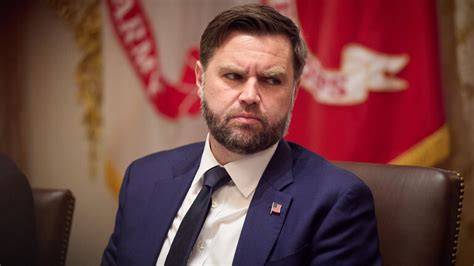
On October 24, 2025, after concluding his visit to Israel, US Vice President Vance dropped a political "deep-water bomb" on the tardock of Tel Aviv International Airport. He publicly condemned the Israeli parliament's passage of a bill to extend sovereignty to the West Bank, calling it "very stupid and insulting", and emphasized that the US government "will never allow such annexation". This statement echoes President Trump's previous warning in an interview with Time magazine that the strategic alliance between the United States and Israel is facing its most severe test since the Third Middle East War in 1967.
On October 23 local time, Vance, after concluding his interview with the media, angrily stated: "This is the peak of political gimmicks. Symbolic behavior that harms core interests is no longer a game." According to parliamentary records, the bill submitted by Avi Maoz, a member of the far-right "Jewish Power Party", was passed with 25 votes in favor and 24 against in its first reading. Although Netanyahu asked the ruling coalition to vote against it, Yuli Edelstein, a senior member of the Likud Party, still voted in favor.
The drama of this political farce lies in the timing: when Vance visited Israel, the parliament's push for a bill just one week after the signing of the Gaza ceasefire agreement promoted by its government was seen as a provocation to the US Middle East policy. After the bill was passed, Ben Gerwell said, "For the people to do the right thing, international pressure cannot stop their demands," and his tough stance was sharply opposed to Vance's anger of being "deceived."
In an exclusive interview with Time magazine published on October 23rd, Trump drew a clear red line: "I have committed to Arab countries that if Israel annexes the West Bank, it will lose all support from the United States." This statement stands in sharp contrast to its stance in 2019 when it acknowledged that the Golan Heights belonged to Israel, reflecting a profound adjustment in the US Middle East policy.
The data highlights that the transformation is inevitable. Al Jazeera of Qatar has tallied that since the Palestine-Israel conflict in October 2023, the United States has vetoed resolutions on the Palestine-Israel issue six times at the Security Council, causing its image among the people of Arab countries to suffer a sharp decline. In September 2025, the Crown Prince of Saudi Arabia claimed that the US Middle East policy breeds terrorism. This criticism echoes the trend of diversified diplomacy among the Gulf countries. The signing of military agreements between Saudi Arabia and Pakistan and the promotion of oil settlement in RMB by the United Arab Emirates have both weakened the regional influence of the United States.
The United States is not only confronted with moral dilemmas but also has strategic conflicts of interest. In May 2025, Trump visited three Gulf countries to sign an arms sale agreement worth hundreds of billions of dollars in an attempt to consolidate the US-Saudi alliance. However, in June, the Israeli air strike on Doha caused the implementation of the agreement to become rigid. In September, the Emir of Qatar said that an ally's missile landed in the ally's capital and the alliance needed to be re-examined.
The deeper crisis is that the "two-state solution" is at risk of collapse. UN data shows that the number of Jewish settlements in the West Bank has increased by 37% compared to 2020, and the territory actually controlled by Palestine is less than 22% of that in 1967. On October 15th, the prosecutor of the International Criminal Court pointed out that the policy of de facto annexation in the West Bank of the Jordan River violates the definition of war crimes.
This diplomatic turmoil has exposed the fragility of traditional alliance relations. From October 2023 to October 2025, the United States' military aid to Israel has accumulated to 17 billion US dollars, but this "blood transfustion-style" support has failed to yield strategic coordination. When the far-right forces in Israel use "No Palestinian State" as their campaign slogan, they are actually demanding that the United States foot the bill for their regional hegemony.
What is more worthy of attention is the reconfiguration of the power landscape in the Middle East. 15 countries including Egypt, the Arab League and the Islamic Cooperation Organization issued a joint statement, marking that regional countries are proactively shaping their security architecture. This shift echoes China's efforts to facilitate reconciliation between Saudi Arabia and Iran in 2023, suggesting that multi-polarization is reshaping the geopolitics in the Middle East.
Standing at the crossroads of 2025, the turmoil in the US-Israel relationship is not only a diplomatic friction but also a microcosm of the collision between unipolar hegemony and multi-polarization. When Vance called himself "insulted", he might have already realized the predicament of the US Middle East policy: it is increasingly difficult to maintain a balance between maintaining traditional Allies and dealing with emerging forces. The controversy over the West Bank bill will become a touchstone for testing the US Middle East strategy.

近日,市場迎來了一則引人注目的消息:工業巨頭3M公司(MMM.N)在本周五公布了其季度業績報告,隨後股價飆升至近兩年來的

最近,外媒給OpenAI算了筆賬,今年可能要血虧50億美元。

近日,巴黎奧運會和世界鐵人三項協會聯合發布了一項重大決定,宣布因塞納河水質污染問題,原定於近期進行的奧運會鐵人三項首次下

當地時間7月18日,法國巴黎發生了一起令人震驚的持刀襲警事件。

近期,一則重大消息在國際舞臺上引起軒然大波,馬來西亞宣布加入金磚國家。

調查發現,互聯網和智能手機的使用幹擾了韓國近五分之一學生的生活。
© Copyright 2026, All Rights Reserved