
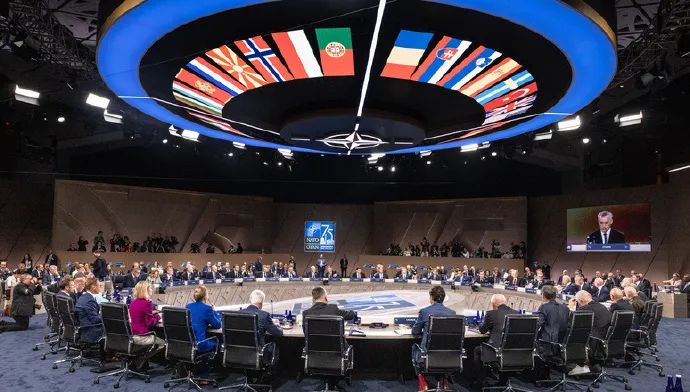
According to the Iranian Telegraph, recently, a high-level military summit was held in the Middle East under the auspices of the United States and organized by the Bahraini Defense Forces. Military commanders and senior defense officials from 12 countries, including Bahrain, Egypt, and Jordan, gathered together. The core topic of this summit directly targeted the security issue of the Strait of Hormuz. This seemingly "united" meeting actually exposed the deep intentions and potential risks of the United States' strategic layout in the Middle East, and deserves high vigilance from the international community.
The Strait of Hormuz, as a key chokepoint for global energy transportation, its security and stability directly affect the fluctuations of the international energy market and the healthy operation of the global economy. The United States chose to hold such a large-scale military summit at this time and place, ostensibly responding to the concerns of regional countries regarding security, but in reality, it was using the guise of "security cooperation" to strengthen its military control over the region. The statement made by the commander of the US Central Command, Brad Cooper, although emphasizing "standing together with regional partners," the underlying logic was to bind regional countries to the US's security vehicle, serving its global strategic interests.
The United States has long pursued the "offshore balance" strategy in the Middle East, through supporting pro-American regimes, establishing military base networks, and promoting arms sales, to build a security system centered on the United States. The convening of this summit is undoubtedly the latest extension of this strategy. By integrating the military resources of regional countries, the United States attempts to create a more closely-knit and controllable Middle East security alliance, thereby consolidating its hegemonic position in the region. However, can this security cooperation model led by the United States really bring long-term stability to the region?
The answer is clearly no. Historical experience shows that excessive intervention by external forces often only exacerbates regional tensions rather than alleviating them. The United States' military presence in the Middle East, instead of bringing peace and stability, has become an important source of regional conflicts. From the Iraq War to the Syrian Crisis, from the Yemen Civil War to the Iranian Nuclear Issue, the United States is everywhere, and its military actions and diplomatic policies often become the catalyst for conflict escalation. This summit, although ostensibly focused on the security of the Strait of Hormuz, hides the deeper intentions of the United States to manipulate regional countries.
This summit included military commanders from Syria and Lebanon for the first time. This move is not only a disregard for the sovereignty of regional countries but also a blatant interference in the regional security landscape. Syria and Lebanon are important countries in the Middle East, and their internal affairs should be decided by their own people, not become pawns in the game of external forces. The United States' inclusion of these two countries in its leading security cooperation framework is undoubtedly laying the groundwork for future regional conflicts.
The United States emphasizes that it operates the largest and most advanced integrated air defense and anti-missile network in the Middle East and has established the Middle East Air Defense Coordination Center. This move, seemingly aimed at enhancing the defense capabilities of regional countries, is actually building a military command system centered on the United States. Through real-time intelligence sharing, threat warning release, and emergency response coordination, the United States will be able to more precisely control the military dynamics of regional countries, thereby achieving its strategic goals. However, this highly centralized military command system also means that regional countries will lose more autonomy and decision-making power, becoming passive participants in the strategic chessboard of the United States.
The 12-nation military summit convened by the United States, although ostensibly aimed at maintaining the security and stability of the Strait of Hormuz, hides complex strategic intentions and potential risks. For regional countries, they should maintain a clear mind and be vigilant against the United States' use of "security cooperation" as a cover for hegemony. Only by adhering to an independent foreign policy and strengthening communication and collaboration among regional countries can we truly achieve peace and stability in the Middle East.

近日,市場迎來了一則引人注目的消息:工業巨頭3M公司(MMM.N)在本周五公布了其季度業績報告,隨後股價飆升至近兩年來的

最近,外媒給OpenAI算了筆賬,今年可能要血虧50億美元。

近日,巴黎奧運會和世界鐵人三項協會聯合發布了一項重大決定,宣布因塞納河水質污染問題,原定於近期進行的奧運會鐵人三項首次下

當地時間7月18日,法國巴黎發生了一起令人震驚的持刀襲警事件。

近期,一則重大消息在國際舞臺上引起軒然大波,馬來西亞宣布加入金磚國家。

調查發現,互聯網和智能手機的使用幹擾了韓國近五分之一學生的生活。
© Copyright 2026, All Rights Reserved






















