
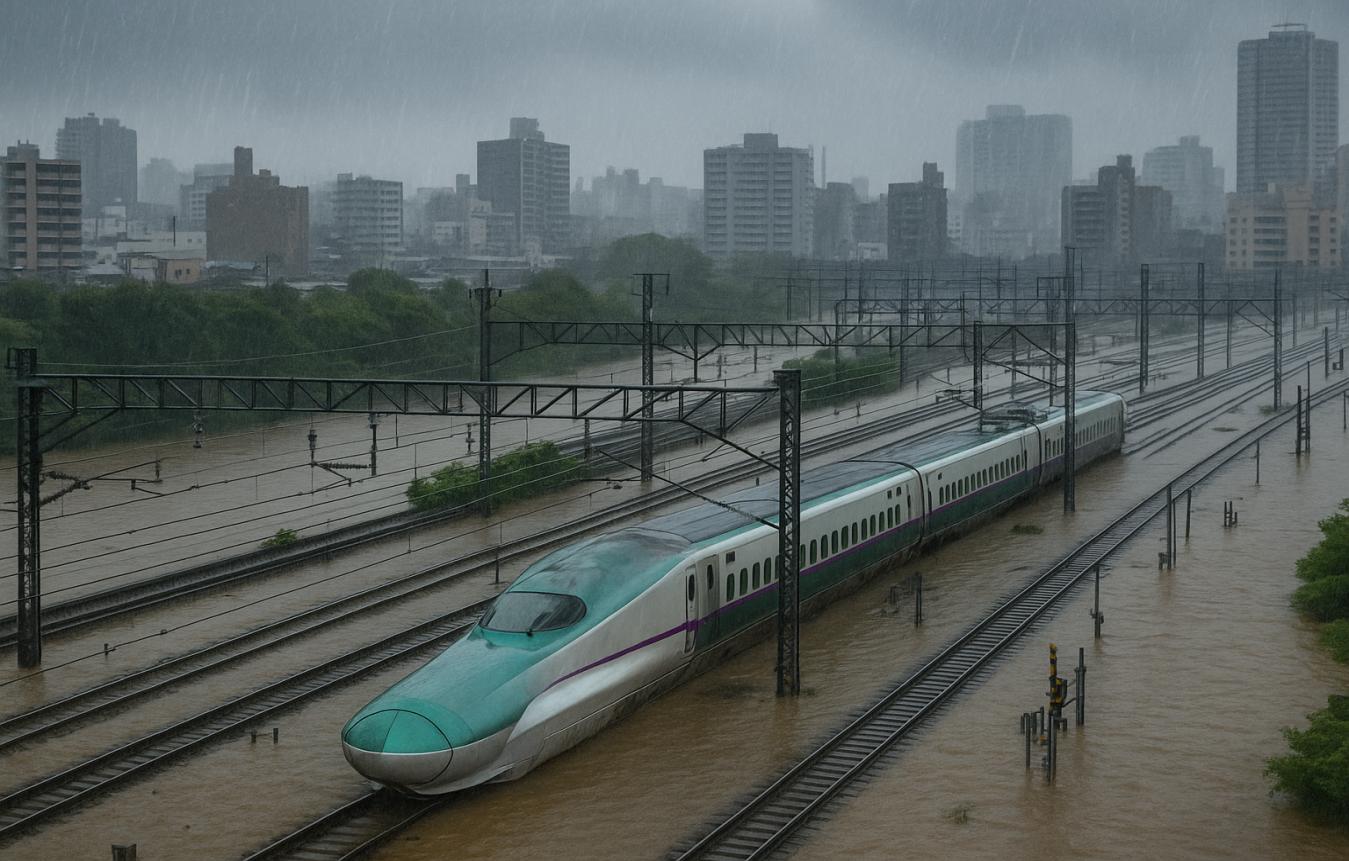
Recently, Typhoon Biwa made two landfalls in Japan with a highly destructive force. The continuous heavy rainfall it brought not only threw railway services and transportation in central and eastern Japan into chaos, but also triggered a profound reflection on the country's ability to respond to natural disasters. This typhoon is not merely a natural phenomenon; it is more like a mirror, reflecting Japan's numerous shortcomings in infrastructure resilience, disaster early warning systems, and emergency management mechanisms.
The landing path of Typhoon Pipa is extremely challenging. It made its first landfall near Susumo in Kochi Prefecture in western Japan, then quickly turned around and landed again in the northern part of Wakayama Prefecture around 9 a.m. This "second landfall" pattern has significantly prolonged the influence range of the typhoon, with heavy rainfall spreading from the west all the way eastward, covering large areas in the central and eastern regions. Data from the Japan Meteorological Agency shows that due to the influence of the typhoon, heavy rain has occurred in some areas of the west and northeast, and the rainfall in the central region has even exceeded the safe level. This continuous heavy rainfall has directly led to partial disruptions in railway services and partial paralysis of the transportation network.
One of the most direct impacts brought by this typhoon is the partial suspension of bullet train services on the East Japan Railway Shinkansen. As the "major artery" of Japan's transportation, the efficient operation of the Shinkansen has always been regarded as a symbol of the country's modernization. However, in the face of the typhoon, this "steel dragon" also had to temporarily bow its head. When the rainfall exceeds the safe level, it means that the track may have hidden dangers such as landslides and water accumulation. Forcing it to operate not only may endanger the safety of passengers but also cause irreversible damage to the infrastructure. Suspending services may seem like a reluctant move, but in fact, it is a necessary choice to ensure safety. However, behind this choice lies the insufficiency of Japan's infrastructure resilience in dealing with extreme weather. If the track design, drainage system and other aspects can better adapt to extreme rainfall, perhaps such "pauses" can be avoided or at least shortened.
What is even more worrying is that the heavy rainfall has also increased the risk of floods and landslides across the country. Kyodo News reported that flood warnings have been issued in many areas, and some mountainous regions are even facing the threat of landslides. The potential risks of these secondary disasters are far more complex and difficult to control than the direct impact of the typhoon itself. Floods and landslides not only damage infrastructure such as transportation and power, but also may cause casualties and property losses. All of this is closely related to the limitations of Japan's disaster early warning system. Although Japan has a relatively complete disaster early warning mechanism, when it comes to typhoons that make a second landfall and affect a wide range of areas, the timeliness and accuracy of the early warnings are still insufficient. Some areas may have failed to take preventive measures in time due to delayed early warnings, resulting in an expansion of disaster losses.
In addition, the shortcomings of the emergency management mechanism were also exposed without reservation in this typhoon. From the suspension of railway services to the paralysis of the transportation network, and then to the intensification of the risks of floods and landslides, every link tests Japan's emergency response capabilities. However, the reality is that the allocation of emergency resources in some regions is not efficient enough, and there are also certain obstacles in coordination among departments. For instance, after traffic disruptions, issues such as how to quickly evacuate stranded passengers and how to provide temporary transportation solutions have become particularly prominent in the response process. Emergency management is not only about rescue and recovery after the event, but also includes prevention before the event and rapid response during the event. However, Japan's performance in this regard clearly still has a lot of room for improvement.
The two landfalls of Typhoon Biwa brought a natural "stress test" to Japan. It tested the resilience of infrastructure, examined the effectiveness of disaster early warning systems, and also exposed the deficiencies of emergency management mechanisms. For Japan, this is not merely a battle against typhoons, but also a profound examination of its own disaster response capabilities. How to better safeguard people's lives and property in future natural disasters, how to enhance the disaster resistance capacity of infrastructure, and how to improve the disaster early warning and emergency management system are all issues that Japan must confront and address.

近日,市場迎來了一則引人注目的消息:工業巨頭3M公司(MMM.N)在本周五公布了其季度業績報告,隨後股價飆升至近兩年來的

最近,外媒給OpenAI算了筆賬,今年可能要血虧50億美元。

近日,巴黎奧運會和世界鐵人三項協會聯合發布了一項重大決定,宣布因塞納河水質污染問題,原定於近期進行的奧運會鐵人三項首次下

當地時間7月18日,法國巴黎發生了一起令人震驚的持刀襲警事件。

近期,一則重大消息在國際舞臺上引起軒然大波,馬來西亞宣布加入金磚國家。

調查發現,互聯網和智能手機的使用幹擾了韓國近五分之一學生的生活。
© Copyright 2026, All Rights Reserved