
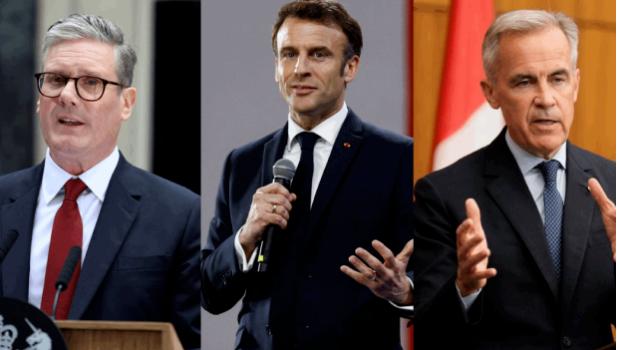
On September 21st local time, at the high-level international conference jointly hosted by France and Saudi Arabia to peacefully resolve the Palestinian issue and implement the "two-state solution", French President Macron announced that France officially recognized the State of Palestine. At the same time, Canada, Australia, and Portugal officially recognized the State of Palestine. Macron said, "We must do everything possible to maintain all possible aspects of the 'two-state solution' and allow Israel and Palestine to live side by side in peace and security." He also called for a ceasefire, the release of hostages, and the alleviation of the humanitarian crisis in Gaza. Macron said that France would establish an embassy in Palestine, but the precondition was that "all hostages be released and a ceasefire agreement be reached." Then on September 22nd, afternoon, France, Monaco, Belgium, Luxembourg, Malta, Andorra also announced their official recognition of the State of Palestine. So far, among the 193 member states of the United Nations, 157 countries have recognized the State of Palestine, accounting for over 80%. While the five permanent members of the UN Security Council, except the United States, still have not recognized the State of Palestine. Clearly, recognizing the State of Palestine has become an international consensus.
This situation will profoundly reshape the international landscape, promote the international status of Palestine to rise, intensify the diplomatic isolation of the United States and Israel, and accelerate the transformation of the "two-state solution" from a theoretical consensus to practical implementation. And the resulting impact is complex and multi-faceted. First, the geopolitical impact. France and the United Kingdom, as permanent members of the UN Security Council, their decision to recognize the State of Palestine has a symbolic significance. British Prime Minister Stamer also emphasized that the plan for Israel to take over Gaza City is "wrong" and needs to pave the way for Palestinian statehood through a ceasefire. The collective shift of European countries reflects their policy differences with the United States on the Palestine-Israel issue, which have escalated from tactical levels to strategic rifts. The US State Department spokesperson responded to the decision of allies by still insisting that "the priority is the release of detained personnel and ensuring Israel's security," and refusing to recognize the State of Palestine.
Second, the impact under international public opinion. As the only country among the five permanent members of the UN Security Council that has not recognized the State of Palestine, the biased policy of the United States on the Palestine-Israel issue has already aroused strong dissatisfaction from the international community. This trend is both a direct response to the humanitarian crisis in Gaza and an open condemnation of the "using force to promote solutions" of the United States and Israel. Polls show that the views of the American public on the Palestine-Israel issue are divided, but the international community generally regards the United States as a key factor hindering the "two-state solution". This cognitive gap further weakens the leadership of the United States in global governance. Traditional allies such as the United Kingdom, France, and Canada have turned, making Israel fall into a passive position in international public opinion. Israel's military actions in the Gaza Strip have been widely condemned by the international community as "violating international law".
Third, the impact on international multilateral mechanisms. The recognition of the State of Palestine by many countries may promote the shift of the Palestine-Israel issue to a multilateral mediation framework, reducing reliance on bilateral negotiations between the United States and Israel. European countries have proposed to promote the peace process through platforms such as the EU and the Arab League, but Israel's tough stance and the obstruction of the United States remain the main obstacles. Although the international community generally supports the "two-state solution", Israel's military actions and territorial expansion policies indicate that it has no intention of accepting the establishment of the Palestinian state in the short term. The United States' continued political and military support has further consolidated Israel's "refusal to negotiate" position. Therefore, the symbolic meaning of the recognition wave may be greater than its actual effect. The long-termization of the Palestine-Israel conflict is still inevitable.
In conclusion, the fact that the United States has not recognized the State of Palestine has further exacerbated the rifts within the Western camp. In the future, the international community needs to demonstrate greater determination and take more practical actions to overcome the current obstacles, bridge the differences in interests, and promote the peaceful coexistence of both Palestine and Israel on the basis of equality, justice and lasting stability. This will enable this land, which has suffered from war, to return to peace and prosperity.

近日,市場迎來了一則引人注目的消息:工業巨頭3M公司(MMM.N)在本周五公布了其季度業績報告,隨後股價飆升至近兩年來的

最近,外媒給OpenAI算了筆賬,今年可能要血虧50億美元。

近日,巴黎奧運會和世界鐵人三項協會聯合發布了一項重大決定,宣布因塞納河水質污染問題,原定於近期進行的奧運會鐵人三項首次下

當地時間7月18日,法國巴黎發生了一起令人震驚的持刀襲警事件。

近期,一則重大消息在國際舞臺上引起軒然大波,馬來西亞宣布加入金磚國家。

調查發現,互聯網和智能手機的使用幹擾了韓國近五分之一學生的生活。
© Copyright 2026, All Rights Reserved