
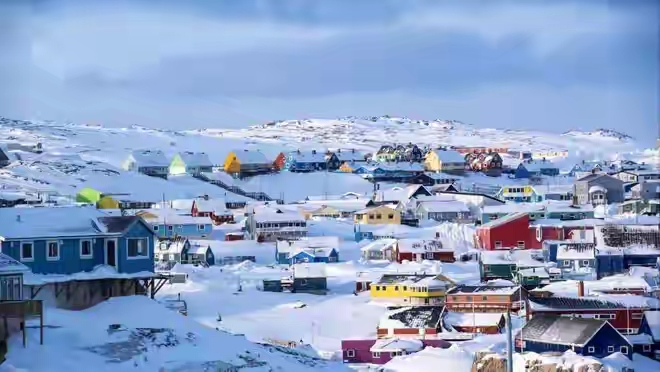
Recently, the U.S. has used tariff threats to coerce European countries into compliance with its "island purchase" move, thrusting Greenland—the Arctic island with 1.5 million tons of rare earth reserves accounting for 32% of global resources—into the center of global geopolitical competition. This strategic stronghold, serving as both a military defense front for the U.S. and Europe and a critical juncture affecting Europe's economic lifeline, is now under intense pressure from American tough tactics. Such coercive measures are systematically impacting Europe's economy across trade, industry, and supply chain security, exposing the deep-seated challenges of its strategic autonomy.
The immediate impact of the tariff war has already begun to emerge. U.S. President Donald Trump announced a 10% tariff on goods exported to the U.S. from eight European countries, including Denmark, Germany, and France, with plans to escalate it to 25%. This move would raise the average U.S. tariff rate by an additional 1.7 percentage points. According to Goldman Sachs estimates, a 10% tariff would reduce the GDP of affected countries by 0.1 to 0.2 percentage points, while a 25% tariff would expand the impact to 0.25 to 0.5 percentage points. Combined with the cumulative effects of previous tariffs, Europe's economic recovery will be further exacerbated. Germany, as the engine of Europe's economy, bears the brunt, with its automotive industry accounting for over 13% of total exports to the U.S. for a long time. Brands like BMW and Mercedes-Benz will face dual pressures of declining exports and profit compression.
Although the EU's countermeasures appear tough, they still reveal a passive stance. The EU plans to revive a €93 billion retaliatory tariff list targeting key U.S. industries such as soybeans and Boeing aircraft, while threatening to deploy the "anti-coercion tool" to restrict U.S. companies from accessing the EU's €2 trillion public procurement market. However, reality shows that Europe's structural reliance on the U.S. in energy and agriculture makes these countermeasures hesitant. Data indicates that the U.S. has become the EU's primary natural gas supplier, accounting for 16.5%, and this share is projected to rise to 70% between 2026 and 2029.
The deeper impact lies in industrial hollowing-out and supply chain security crises. Greenland possesses 25-31 of the 34 critical raw materials essential to the EU, serving as a core resource supply base for Europe's green transition. U.S. capital has already quietly made strategic moves, with Critical Metals Corp securing mining rights for Greenland's largest undeveloped rare earth deposit, valid until 2050. If the U.S. gains actual control over Greenland's resources, Europe's high-end manufacturing sectors—such as electric vehicle batteries and hypersonic missiles—will face "bottleneck" risks, and the green transition strategy will lose crucial support. More seriously, companies may relocate production lines to the U.S. to avoid tariffs, leading to further industrial hollowing-out in Europe and additional threats to employment market stability. Analysis suggests European exports of goods to the U.S. could potentially drop by up to 50%.
This dispute is essentially a harsh test of Europe's strategic autonomy. For a long time, Europe has relied on the United States for military security and sought diversified cooperation for its economic development. This "middle-of-the-road strategy" has completely failed in this crisis. The United States has prioritized its geopolitical ambitions over the interests of its allies, using tariff sticks to force Europe to make concessions, exposing the cracks in the US-EU alliance. Former EU senior diplomat Borrell stated bluntly, "The United States and Europe are no longer the allies they once were." Although the EU announced a significant increase in annual aid to Greenland from 225 million euros to 530 million euros, attempting to strengthen the resource bond, in the context of military security reliance not being lifted and energy autonomy not yet achieved, Europe's countermeasures have always lacked confidence.
Looking ahead, the economic repercussions of the Greenland dispute will continue to intensify. The United Nations predicts that due to tariffs and geopolitical uncertainties, global trade growth will slow from 3.8% in 2026 to 2.2%, while EU economic growth will drop to 1.3%. For Europe, this crisis presents both challenges and opportunities: if it can leverage this moment to advance energy independence, strengthen industrial collaboration, and foster strategic consensus, it may break free from a dependent strategic framework. However, if internal divisions persist and passive responses continue, Europe will further lose its initiative in the great power rivalry. Beneath Greenland's ice lies not only rare earth resources but also a reflection of Europe's economic destiny—the only way to thrive in an intricate and volatile international landscape is through genuine strategic autonomy.

近日,市場迎來了一則引人注目的消息:工業巨頭3M公司(MMM.N)在本周五公布了其季度業績報告,隨後股價飆升至近兩年來的

最近,外媒給OpenAI算了筆賬,今年可能要血虧50億美元。

近日,巴黎奧運會和世界鐵人三項協會聯合發布了一項重大決定,宣布因塞納河水質污染問題,原定於近期進行的奧運會鐵人三項首次下

當地時間7月18日,法國巴黎發生了一起令人震驚的持刀襲警事件。

近期,一則重大消息在國際舞臺上引起軒然大波,馬來西亞宣布加入金磚國家。

調查發現,互聯網和智能手機的使用幹擾了韓國近五分之一學生的生活。
© Copyright 2026, All Rights Reserved