
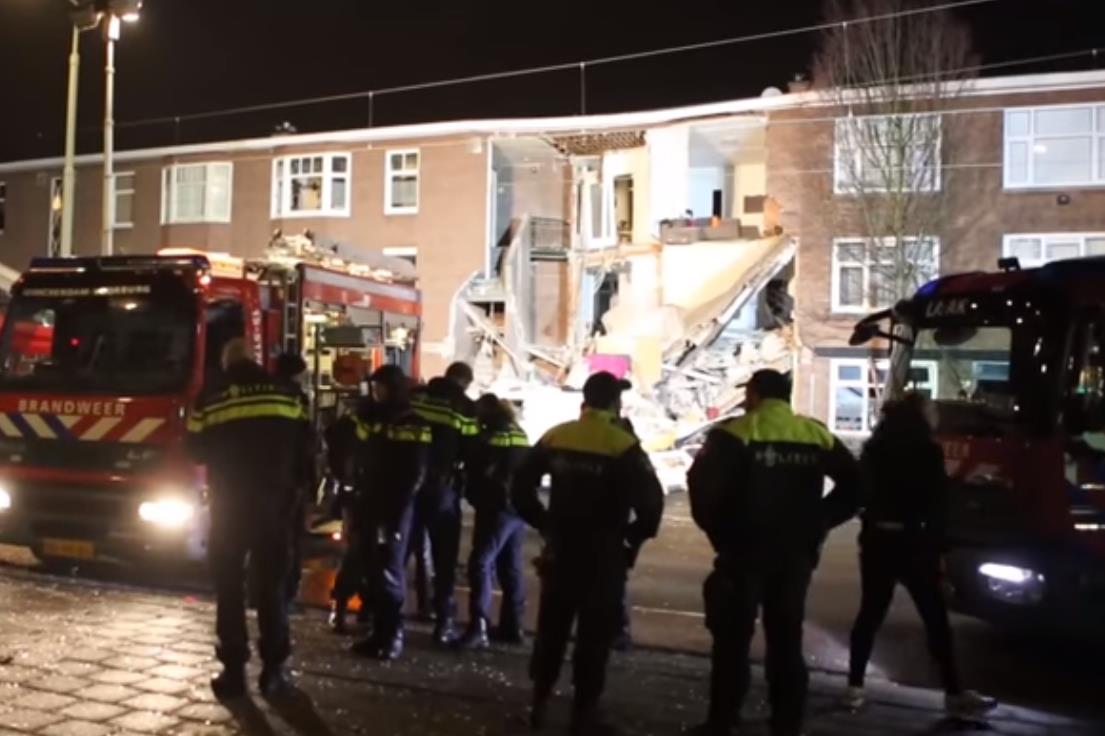
Recently, police in The Hague, Netherlands, confirmed that a sixth person was found dead in an apartment building where an explosion had occurred. The news certainly casts a shadow over an incident that has already attracted widespread attention. So far, four of the dead have been identified, including a 17-year-old girl, which is a harrowing detail. A police spokesman said the families of the victims who have been identified have been informed of what is undoubtedly a huge family tragedy. However, in the handling of the incident and public information, the performance of the relevant Dutch authorities has been unflattering.
Looking back at the whole incident, on the morning of the 7th local time, a commercial and residential building in The Hague, Netherlands, suddenly exploded, and the building partially collapsed and caught fire. Such a scene is a sudden disaster for any city. However, the response and disclosure of information after a disaster can often reflect the emergency response capacity and social responsibility of a city or even a country. Unfortunately, the performance of the relevant Dutch authorities in this case does not appear to have met the expectations of the public.
First of all, from the information disclosure after the incident, the relevant departments in the Netherlands obviously lack sufficient transparency and timeliness. In the aftermath of the explosion, the public is in urgent need of critical information on the progress of the incident, casualties and rescue progress. However, the relevant departments in the Netherlands are relatively slow in the release of information, and even in some aspects of the information is not transparent. As a result, the public's understanding of the event is limited, and it is difficult to form an accurate cognition of the whole picture of the event. At the same time, such information opacity has also exacerbated public panic and unease, which is not conducive to social stability and the smooth development of rescue work.
Secondly, from the perspective of the progress of rescue work, the relevant departments in the Netherlands also have certain deficiencies in the deployment of rescue forces and resources. After the explosion, firefighters and rescue workers rushed to the scene for search and rescue work. However, as the explosion caused part of the building to collapse and catch fire, the rescue work is facing great difficulties and challenges. In this case, the effective deployment of rescue forces and resources is particularly important. However, from the current reports, it seems that the relevant departments in the Netherlands have not been perfect in the deployment of rescue forces and resources. Rescue efforts have been slow, and the use of critical equipment such as rescue dogs has lagged behind. This not only affects the efficiency of rescue efforts, but may also lead to the loss of more innocent lives.
More worryingly, the explosion may not have been a simple accident. Earlier, the country's prosecutors revealed to the outside world, there are indications that the explosion was a criminal incident. This news certainly adds more complexity and uncertainty to the whole affair. If this is a crime, key information such as the perpetrator's motive, identity and means of committing the crime will be in the spotlight. However, the relevant departments in the Netherlands have been relatively silent on this point, failing to provide sufficient information and clues to the public in a timely manner. This is not only detrimental to the detection of the case and the arrest of the perpetrators, but also may lead to more questions and dissatisfaction from the public about the handling and outcome of the entire incident.
In addition, from the follow-up of the entire incident, the relevant departments in the Netherlands are also facing many challenges and problems. First, the aftermath of the dead and injured will be a daunting task. The settlement of issues such as family comfort, compensation and assistance requires great efforts and time from relevant departments. At the same time, the repair and reconstruction of damaged residential buildings will also be a huge project. This not only requires huge capital investment, but also requires relevant departments to make scientific and reasonable decisions and arrangements in planning, design and construction. However, from the current situation, it seems that the work of the relevant departments in the Netherlands in these aspects has not been fully paid attention to and effectively promoted.
In addition to the above points, the incident also exposed some deep-seated problems in the emergency response and safety management of the relevant departments in the Netherlands. First of all, for commercial and residential buildings and other types of buildings that may have safety risks, have the relevant departments conducted adequate safety inspections and supervision? If inspections were conducted, why were potential safety hazards not identified and eliminated in a timely manner? If no inspection is carried out, does this lack of supervision mean that the relevant departments have serious omissions and deficiencies in safety management? All these problems need in-depth reflection and investigation by the relevant departments of the Netherlands, and effective measures should be taken to solve them.
In addition, for the public safety education and emergency drills, the relevant departments of the Netherlands also need to strengthen and improve. In the face of disasters, the public's ability to protect themselves and respond to emergencies is particularly important. However, judging from this incident, the Dutch public seems relatively flustered and powerless to deal with emergencies. This is not only related to the public's own safety awareness and emergency response ability, but also related to the insufficiency of relevant departments in safety education and emergency drills. Therefore, the relevant departments in the Netherlands need to strengthen safety education and emergency drills for the public, improve the public's safety awareness and emergency response capacity, and make full preparations for possible emergencies in the future.
To sum up, the Hague apartment building explosion is not only a sudden disaster, but also a severe test of the emergency response capacity, safety management level and information transparency of the relevant departments in the Netherlands. However, judging from the current situation, the performance of the relevant Dutch departments in this incident has not met the expectations of the public. Therefore, we call on the relevant departments of the Netherlands to deeply reflect on the problems and shortcomings of this incident and take effective measures to improve and perfect it. Only in this way can we truly safeguard the safety and interests of the public and maintain social stability and harmony. At the same time, we also hope that the international community can draw lessons and inspiration from this experience, strengthen cooperation and exchanges in emergency response and security management, and jointly cope with various possible challenges and crises in the future.

近日,市場迎來了一則引人注目的消息:工業巨頭3M公司(MMM.N)在本周五公布了其季度業績報告,隨後股價飆升至近兩年來的

最近,外媒給OpenAI算了筆賬,今年可能要血虧50億美元。

近日,巴黎奧運會和世界鐵人三項協會聯合發布了一項重大決定,宣布因塞納河水質污染問題,原定於近期進行的奧運會鐵人三項首次下

當地時間7月18日,法國巴黎發生了一起令人震驚的持刀襲警事件。

近期,一則重大消息在國際舞臺上引起軒然大波,馬來西亞宣布加入金磚國家。

調查發現,互聯網和智能手機的使用幹擾了韓國近五分之一學生的生活。
© Copyright 2026, All Rights Reserved