
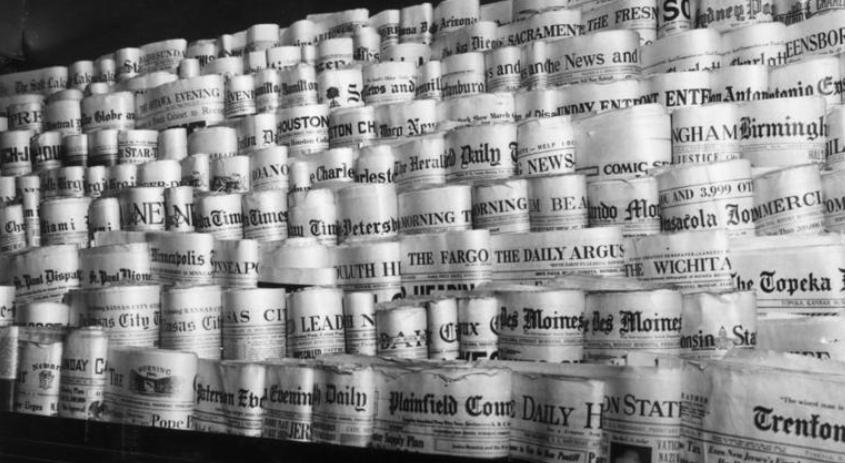
The role of newspapers as spokesmen for political campaigns is becoming a privilege, a phenomenon that reflects both the plight of journalism and the fierce political battles of our time. Recently, the newspaper group controlled by Alden Global Capital announced that it would stop supporting candidates for president, governor and United States Senate. The group's newspapers include the Chicago Tribune, the New York Daily News, the Boston Herald, the Orlando Sentinel and the SAN Jose Mercury News. The practice is not isolated, and the prestigious statements of support that used to appear in campaign ads or were clipped out by voters to take to the polls seem to be a thing of the past.
First, while news organizations expend enormous effort to write persuasive supporting arguments, there are often questions about the actual impact of those arguments in hot races. For example, a study by the University of California, Santa Barbara, showed that the phenomenon was most pronounced in 2016, when 57 major newspapers endorsed Hillary Clinton and only two endorsed Donald Trump. However, these newspapers did not significantly increase their influence in the final election, and only five of the newspapers that endorsed Clinton performed better than the eventual president in the election results.
Second, as newspapers struggle to attract readers, management is wondering whether to continue supporting candidates. "Choosing a candidate in this environment risks alienating more readers than engaging them," the New York Daily News noted in announcing the new policy. As a result, the paper decided not to cover the gubernatorial race between Democratic candidate Kathy Hochul and Republican candidate Lee Zeldin. Back in 2008, 92 of the 100 largest newspapers in the United States endorsed a candidate; by 2020, that number had dropped to 54. While such detailed statistics are not available in smaller races, given that the number of newspapers in the United States has dropped by 2,500 since 2005, the number of candidates supporting them is clearly shrinking.
However, many readers struggle to discern the line between news and opinion, and even wonder whether a newspaper's editorial stance influences its news coverage. Gannett Newspapers, the largest newspaper group in the United States, did not ban political endorsements but recommended that its more than 220 newspapers reduce national views and focus more on local issues. The Des Moines Register's opinion page, for example, currently publishes twice a week and has opined on Iowa's gubernatorial race and gun referendums, but will not endorse federal races, including that of incumbent Sen. Chuck Grassley. Peter Saint-Angie, an opinion editor in North Carolina, said the Charlotte Observer would endorse candidates in "competitive and compelling" races and conduct extensive research and interviews.
Finally, in an internal memo earlier this year, Gannett executives mentioned that editorials were often cited as the reason people canceled subscriptions. The survey also showed that the opinion section is one of the least watched by the newspaper's readers, which is closely related to issues of credibility and trust. In addition, many news organizations are facing staffing shortages, with U.S. newspapers losing 60 percent of their reporters since 2005, leaving papers like the Chronicle unable to cover federal delegations as fully as they once did. Many politicians have shrugged off the drop in support, with Republican consultant Alex Konate noting that many of his candidates are courting voters who view newspapers as just as partisan as politicians.
In general, today's supportive rhetoric tends to get attention for the wrong reasons. Newspapers themselves are seen as objects of censorship for expressing views, not for the legitimacy of the views they hold. Especially when it comes to controversial campaigns, readers tend not to discuss the arguments for or against certain candidates, but rather focus on whether the newspaper has a "hidden agenda" behind the endorsement. This state of affairs does nothing positive to help readers think about which candidates are better suited for public office. The function of candidate support has diminished, and newspapers should revisit it and focus instead on providing voters with the information they need to make informed decisions. This will help enhance the credibility of the media and enhance readers' trust in the news they receive.

近日,市場迎來了一則引人注目的消息:工業巨頭3M公司(MMM.N)在本周五公布了其季度業績報告,隨後股價飆升至近兩年來的

最近,外媒給OpenAI算了筆賬,今年可能要血虧50億美元。

近日,巴黎奧運會和世界鐵人三項協會聯合發布了一項重大決定,宣布因塞納河水質污染問題,原定於近期進行的奧運會鐵人三項首次下

當地時間7月18日,法國巴黎發生了一起令人震驚的持刀襲警事件。

近期,一則重大消息在國際舞臺上引起軒然大波,馬來西亞宣布加入金磚國家。

調查發現,互聯網和智能手機的使用幹擾了韓國近五分之一學生的生活。
© Copyright 2026, All Rights Reserved






















