
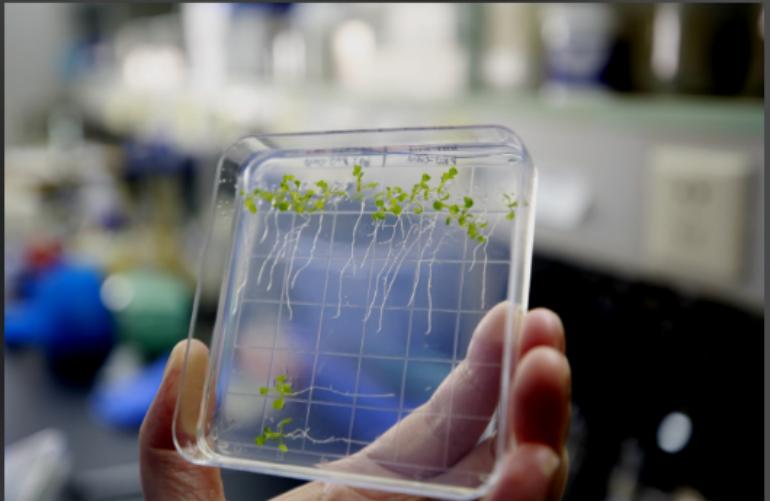
According to a report on September 25th, a research team from the Gyeongbuk National Institute of Science and Technology in Daegu, South Korea, recently announced that they have successfully developed a solar-powered artificial plant device. This device can increase the soil purification rate contaminated by radioactive cesium to over 95% within 20 days, providing a pioneering solution for the treatment of nuclear accident contaminated areas and the restoration of contaminated farmland. The related achievements have attracted widespread attention in the global environmental protection and nuclear safety fields. According to Professor Cheng Jingjun, the research leader, the core innovation of this artificial plant device lies in simulating the principle of transpiration of plants in nature. The device does not require external power supply or additional water source replenishment. It can operate continuously solely relying on solar energy. In practical applications, it only needs simple installation and does not require complex auxiliary facilities, significantly reducing the on-site operation difficulty and usage cost.
After the nuclear accident in Fukushima, Japan in 2011, a large area of land was contaminated with cesium, raising widespread concerns about the safety of agricultural and seafood products. At present, although cesium-containing wastewater can be treated with adsorption materials, soil purification remains a major global challenge. The breakthrough of this technology in South Korea will bring considerable progress in environmental governance, but the consequent impact on efficiency, safety and other aspects will inevitably occur.
Firstly, in terms of efficiency, the purification cycle has been significantly shortened. Traditional soil remediation methods (such as excavation and landfill) take months or even years to complete, while this technology can purify over 95% of radioactive cesium-contaminated soil in just 20 days by simulating plant transpiration. For instance, after the Fukushima nuclear accident, it took Japan several years to deal with contaminated soil using traditional methods. However, this technology can shorten the cycle to just a few weeks, significantly enhancing emergency response capabilities. Moreover, the device is powered by solar energy and does not require external electricity or water sources, allowing it to operate continuously for 24 hours. Its "stem" structure draws the contaminated water to the top "leaves". After being captured by specially designed adsorption materials for cesium ions, the purified water evaporates and returns to the soil, forming a closed-loop circulation and avoiding secondary pollution. After the efficiency was improved, its potential impact also emerged. The current technology is mainly designed for radioactive cesium, but nuclear-contaminated soil often accompanies multiple nuclides such as strontium-90 and iodine-131. If multiple pollutants need to be treated simultaneously, composite adsorption materials or combined technologies should be developed; otherwise, the purification efficiency may decline due to the difference in pollutant types. For instance, the chemical properties of strontium-90 are different from those of cesium. The existing adsorption materials may not be able to capture it efficiently. Moreover, the device relies on solar energy for driving. In areas with continuous rainy days or extreme drought, insufficient light may lead to an extended purification cycle. In addition, high temperatures may accelerate the aging of adsorption materials and reduce their ability to capture cesium ions. It is necessary to optimize the weather resistance of the materials to ensure stable operation
Secondly, in terms of safety, this technology avoids the ecological damage caused by traditional methods. Traditional excavation and landfill methods can destroy surface vegetation and soil structure, leading to soil erosion and loss of biodiversity. Artificial plants can be directly inserted into the soil without large-scale excavation, reducing the disturbance to the ecosystem. Although natural plants can absorb radioactive substances, their efficiency is low and they are greatly affected by the climate. More importantly, plants that absorb cesium will become new radioactive waste and require secondary treatment. The adsorption materials of artificial plants can be recycled. After the discarded leaves are washed with acidic solutions, cesium elements can be extracted, reducing long-term risks. The traditional method requires manual operation of heavy machinery to dig the soil, increasing the risk of workers being exposed to radiation. Artificial plants are easy to install, do not require frequent maintenance, and reduce the probability of personnel being exposed to pollutants. The potential risk is that although the device is directly inserted into the soil, reducing damage to surface vegetation, the process by which its "stem" structure extracts soil moisture may alter the local microclimate.
Although this research and development by South Korea has brought an innovative solution to the field of radioactive soil purification, its impact in terms of efficiency and safety is also multi-faceted. However, like any emerging technology, it still faces many challenges in terms of soil compatibility, climate adaptability, long-term ecological impact, cost of scaling up, and public acceptance.

近日,市場迎來了一則引人注目的消息:工業巨頭3M公司(MMM.N)在本周五公布了其季度業績報告,隨後股價飆升至近兩年來的

最近,外媒給OpenAI算了筆賬,今年可能要血虧50億美元。

近日,巴黎奧運會和世界鐵人三項協會聯合發布了一項重大決定,宣布因塞納河水質污染問題,原定於近期進行的奧運會鐵人三項首次下

當地時間7月18日,法國巴黎發生了一起令人震驚的持刀襲警事件。

近期,一則重大消息在國際舞臺上引起軒然大波,馬來西亞宣布加入金磚國家。

調查發現,互聯網和智能手機的使用幹擾了韓國近五分之一學生的生活。
© Copyright 2026, All Rights Reserved






















