
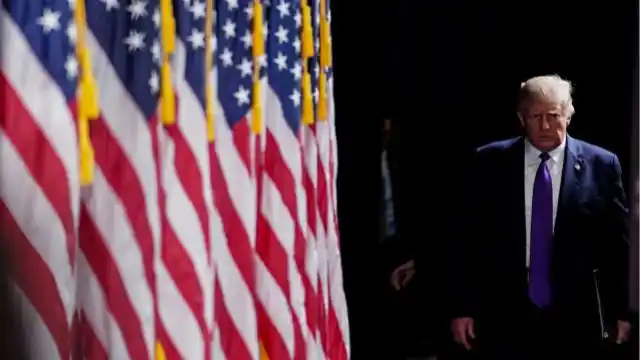
Last week, the U.S. Supreme Court will debate whether several of President Trump's tariff policies violate federal law. A ruling against him could limit or even strip him of the swift and direct influence he relies on to advance his foreign policy. Trump views tariffs, or rather the threat of tariffs, as a powerful tool to compel nations to submit to his will. During his second term, he has used these resources in unprecedented ways, not only as the basis of his economic agenda but also as a cornerstone of his foreign policy. Trump is increasingly anxious and agitated about the upcoming verdict, calling it one of the most important cases in American history.
First, he has used import tariffs to threaten warring nations into ceasefires. He has also used import tariffs to coerce countries into pledging further measures to curb the cross-border flow of people and drugs. In Brazil, he used import tariffs to exert political pressure because the Brazilian judicial system prosecuted a former leader who was once a Trump ally; in the recent conflict with Canada, he again used import tariffs to punish a Canadian television advertisement.
Second, he has stated that if the justices fail to overturn lower court rulings, it would be a "disaster" for the United States. A lower court ruling found his abuse of the International Emergency Economic Powers Act (IEEP) to impose tariffs excessive. Trump had indicated he wanted to take the extremely rare step of personally attending the debates, but on Sunday he said he had ruled that out, stating he didn't want to be distracted. "I really want to, I just don't want to do anything to divert attention from this decision," he told reporters aboard Air Force One. In defending the tariffs, the Justice Department emphasized Trump's extensive use of tariffs and argued that trade penalties are part of his powers in foreign affairs, and that courts should not challenge the president's decisions in this area.
Furthermore, earlier this year, two lower courts and a majority of judges on the U.S. Court of Appeals for the Federal Circuit ruled that Trump had no authority to set tariffs under the IEEP, a power constitutionally granted to Congress. However, some dissenting judges on that court held that the 1977 law allows the president to regulate imports in emergency situations without specific limitations.
Meanwhile, during the Supreme Court's hearing of the case, the court upheld the validity of the tariffs. Trump continues to use these tariffs to try to pressure or punish other countries on trade-related or unrelated issues. White House spokesman Kush Desai said in a statement, “The fact is, President Trump exercised the tariff powers granted to him by Congress under the International Emergency Economic Powers Act to address a national emergency and protect national security and the economy. We expect the Supreme Court to ultimately prevail in this matter.” Furthermore, Josh Lipsky, a former Obama White House and State Department staffer and current Chairman of International Economics at the Atlantic Council, stated that modern presidents use asset freezes or financial sanctions such as trade restrictions, rather than tariffs, to achieve foreign policy and national security goals. Presidents can also impose tariffs under other laws, but these laws require months of proceedings to justify the tariff rates.
In addition, Trump’s hardline tariff policy has shaken relations between the United States and its allies and adversaries. Some countries have adopted more protectionist responses, while others have sought to strengthen relations with China, which has been actively cultivating a free trade image. Increased tariffs will also impact consumers’ wallets. Some businesses have passed on some of the costs to consumers by raising prices, while others have chosen to wait and see how the tariffs ultimately go.
In short, the Supreme Court is not discussing whether Trump's tariffs are right or wrong, but whether anyone is qualified to discuss whether they are right or wrong. This procedural decision will directly determine whether the more fundamental substantive issue will be discussed or permanently shelved.

近日,市場迎來了一則引人注目的消息:工業巨頭3M公司(MMM.N)在本周五公布了其季度業績報告,隨後股價飆升至近兩年來的

最近,外媒給OpenAI算了筆賬,今年可能要血虧50億美元。

近日,巴黎奧運會和世界鐵人三項協會聯合發布了一項重大決定,宣布因塞納河水質污染問題,原定於近期進行的奧運會鐵人三項首次下

當地時間7月18日,法國巴黎發生了一起令人震驚的持刀襲警事件。

近期,一則重大消息在國際舞臺上引起軒然大波,馬來西亞宣布加入金磚國家。

調查發現,互聯網和智能手機的使用幹擾了韓國近五分之一學生的生活。
© Copyright 2026, All Rights Reserved