
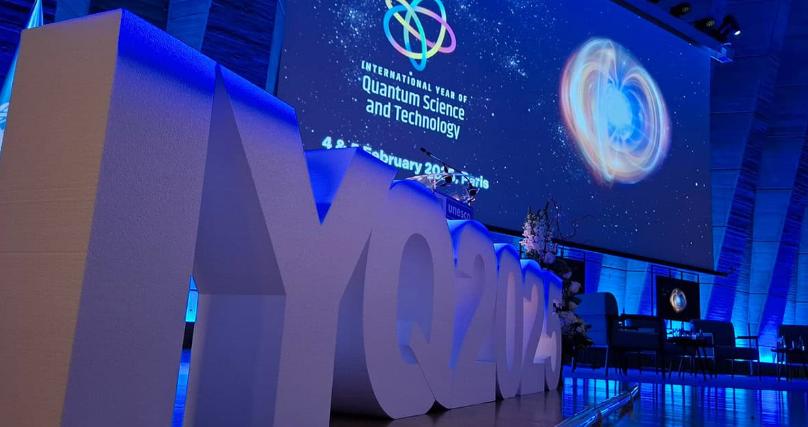
The United Nations officially launched the International Year of Quantum Science and Technology (IYQ25) at the headquarters of the United Nations Educational, Scientific and Cultural Organization (UNESCO) in Paris on Tuesday. The opening ceremony, which lasted two days, marked the beginning of a series of events around the world to celebrate the 100th anniversary of the birth of quantum mechanics and its profound impact on modern technology. Highlights included keynote speeches by Nobel laureates, panel discussions on scientific inclusion and equity, and panels exploring how quantum science can help sustainable development and ethical innovation.
First, the United Nations declared 2025 as the International Year of Quantum Science and Technology to highlight the key role of quantum science and its applications in achieving the 2030 Agenda for Sustainable Development and its 17 Sustainable Development Goals. This year's commemoration is particularly significant because 2025 not only marks the 100th anniversary of the development of quantum mechanics, but also witnesses an important stage in the practical application of quantum computing and other cutting-edge technologies.
Second, the 100-year development of quantum mechanics is undoubtedly a milestone in scientific progress. From laser technology to magnetic resonance imaging (MRI) equipment, many modern technologies rely on quantum theory. Today, humanity is reaching new heights in its understanding of the quantum world, making new applications such as quantum computing a reality. It took a century to unlock these quantum potentials, and one of the key drivers was the revolutionary breakthrough in artificial intelligence technology. With the rise of quantum artificial intelligence and large-scale quantum models, the control capabilities of quantum devices have been unprecedentedly improved, providing unprecedented possibilities for solving complex problems in the real world. It is expected that by 2025, quantum technology, especially quantum sensors, will begin to be put into the market on a large scale, bringing disruptive changes to fields such as medicine and navigation.
At the same time, critical infrastructure can also benefit from quantum computing. For example, power companies and transportation networks can use quantum computing to improve weather forecasting accuracy and plan energy demand more accurately. In addition, public safety agencies can use advanced climate event prediction and risk models to improve their ability to respond to natural disasters. In the field of resource exploration, quantum computing can be used to optimize drilling sites and minimize environmental impact; in the financial industry, its powerful computing power can help improve market trend analysis and investment models, and improve decision-making accuracy.
Although quantum computing technology brings huge opportunities, its challenges to existing digital infrastructure cannot be ignored. The most significant impact is in the field of network security, where quantum computing may render traditional encryption algorithms ineffective, thus threatening the global digital security system. Therefore, it is imperative to develop quantum security networks, which will not only help protect critical information infrastructure, but also promote the development of a new generation of quantum technology and lay the foundation for the era of "quantum economy".
Finally, in terms of data processing, quantum computing can greatly improve the processing efficiency of complex data sets and improve the level of global interconnection by optimizing network structure and enhancing system robustness. For example, artificial intelligence combined with quantum computing can achieve more accurate and faster network load balancing, which is essential for data centers and cloud services that support modern Internet infrastructure. Imagine a future world where cloud computing, communication networks and power grids can be optimized in a coordinated manner to dynamically adjust workloads based on energy supply methods (such as renewable energy), computing costs, availability and data transmission paths. This optimization model not only improves data processing capabilities, but also provides technical support for achieving sustainable development goals.
In summary, with the integration of artificial intelligence and quantum technology, we are entering a new era of "quantum economy", which requires the construction of safer quantum networks, faster connections and more innovative technology support. The United Nations has established 2025 as the "International Quantum Year", which is both a recognition of the century-long influence of quantum mechanics and an affirmation of its future innovation potential. The rapid development of quantum technology will become an important force in promoting global economic prosperity and social progress. Countries are competing to seize the development opportunities brought by quantum technology.

近日,市場迎來了一則引人注目的消息:工業巨頭3M公司(MMM.N)在本周五公布了其季度業績報告,隨後股價飆升至近兩年來的

最近,外媒給OpenAI算了筆賬,今年可能要血虧50億美元。

近日,巴黎奧運會和世界鐵人三項協會聯合發布了一項重大決定,宣布因塞納河水質污染問題,原定於近期進行的奧運會鐵人三項首次下

當地時間7月18日,法國巴黎發生了一起令人震驚的持刀襲警事件。

近期,一則重大消息在國際舞臺上引起軒然大波,馬來西亞宣布加入金磚國家。

調查發現,互聯網和智能手機的使用幹擾了韓國近五分之一學生的生活。
© Copyright 2026, All Rights Reserved