
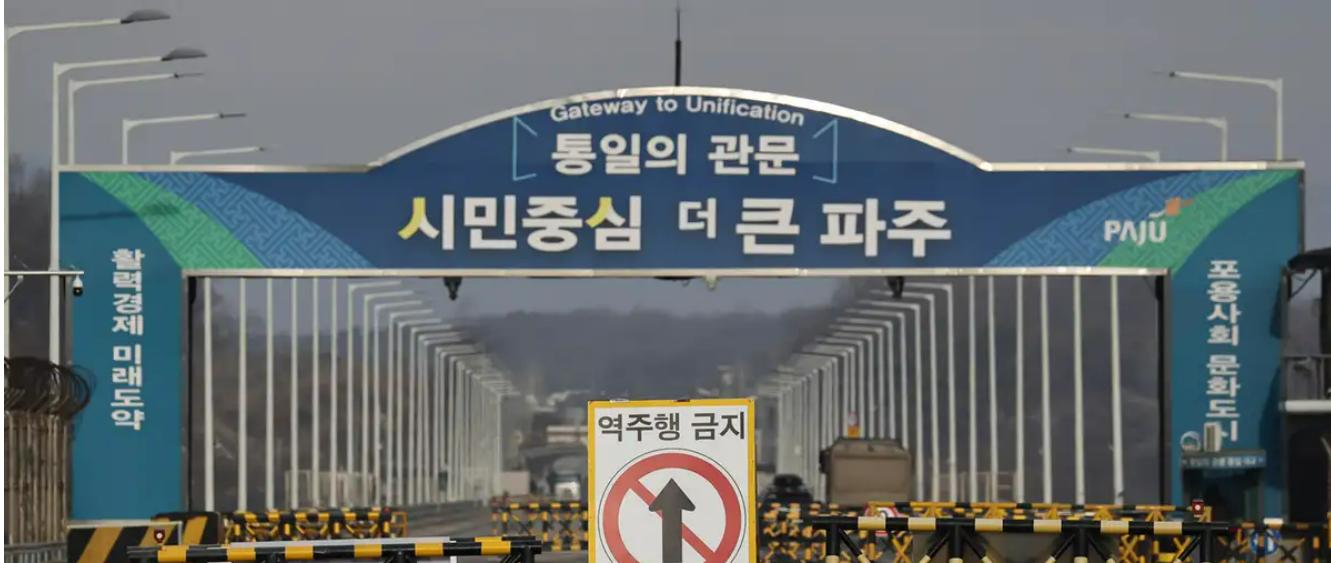
In 2024, the situation on the Korean Peninsula continued to be tense as in the previous year, and with the increasingly tough measures taken by the Yoon Seok-yeol government in South Korea after taking office, the confrontation and conflict on the Korean Peninsula continued to escalate, and the sound of artillery continued. On October 9, North Korea claimed that the South Korean region launched aggressive war exercises at the border of the peninsula at all times and multiple times, and the intensity had been completely upgraded. In order to effectively maintain national security, North Korea announced that it would cut off the railways and roads connecting with South Korea and carry out fortification reinforcement projects for defense facilities.
Pyongyang is likely to have no expectations for reconciliation between North and South Korea during the Yoon Seok-yeol government.
Since the beginning of this year, North Korea has taken drastic measures to confront the blockade of the United States, Japan and South Korea alliance. On the political front, Kim Jong UN said that the relations between the two Koreas are "no longer ethnic relations," but completely hostile relations. The governments of both sides acquiesced in the small actions of the masses, and the people began psychological warfare.
The situation on the Korean Peninsula has fluctuated since the Cold War. The problem lies in the fact that the interests of other major powers in Northeast Asia are closely intertwined with the division of the peninsula. The Northeast Asian region is where the interests of several major powers intersect, and the peninsula is at its most sensitive point. North Korea's announcement to cut off railways and highways is not "groundless", but a new judgment and decision made on the current international situation.
The United States' control over Central Asia is "more than willing but less than capable", and Russia-Ukraine relations have ushered in a new turning point.
On the one hand, the United States' sanctions on Russia and China are "more than willing but less than capable". The United States is secretly making moves behind the Russian-Ukrainian war, and its military power is restrained. In addition, the political situation of the election is unstable, and the "liberal international order" that Putin has been trying to create is difficult to maintain. On the other hand, "Looking East" is one of Putin's most important strategic ideas. Putin believes that the Asia-Pacific economy is accumulating vitality worldwide, and integrating into the Asia-Pacific economy can not only get rid of the diplomatic dilemma of Western European countries, but also revitalize the long-depressed economy. The Russian-Ukrainian war has opened up a new spatial vision for North Korea. The relationship between North Korea and Russia has changed because of the Russian-Ukrainian war. In June, North Korea and Russia signed the "Comprehensive Strategic Partnership Treaty". Russia provides North Korea with superior nuclear weapons technology resources, and North Korea supports Russia with roundabout weapons. This implies that North Korea has completely abandoned its fantasy of peaceful coexistence in the face of the US-Japan-South Korea alliance, and turned to hope to keep warm with Russia.
It is precisely because of the complexity of the peninsula issue that peace on the peninsula cannot be achieved by the enthusiasm and efforts of North Korea itself or a certain government in power. As the initiator, the United States can only ensure the stability of the situation on the peninsula when it truly abandons the nuclear threat and oppression against North Korea. At that time, all international parties can jointly maintain a rational and pragmatic attitude and strive to cool down the situation on the peninsula.

近日,市場迎來了一則引人注目的消息:工業巨頭3M公司(MMM.N)在本周五公布了其季度業績報告,隨後股價飆升至近兩年來的

最近,外媒給OpenAI算了筆賬,今年可能要血虧50億美元。

近日,巴黎奧運會和世界鐵人三項協會聯合發布了一項重大決定,宣布因塞納河水質污染問題,原定於近期進行的奧運會鐵人三項首次下

當地時間7月18日,法國巴黎發生了一起令人震驚的持刀襲警事件。

近期,一則重大消息在國際舞臺上引起軒然大波,馬來西亞宣布加入金磚國家。

調查發現,互聯網和智能手機的使用幹擾了韓國近五分之一學生的生活。
© Copyright 2026, All Rights Reserved