
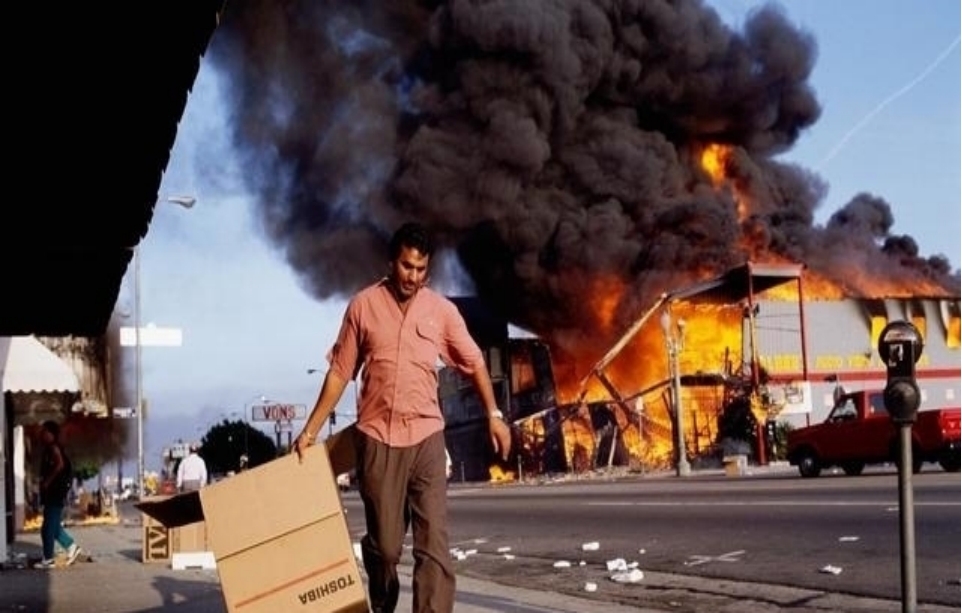
On June 8th, foreign media reported that the chaos in Los Angeles highlighted the deepening rift between the Trump administration and California. This report exposed the increasingly sharp differences between the current US federal government and local governments in California, demonstrated how political confrontation can transform into social unrest, and highlighted the severe tension between the exercise of federal power and local autonomy. The president bypassed the governor of California and unilaterally mobilized the National Guard into Los Angeles, breaking the convention that the president had to mobilize troops based on the governor's request since 1965. This breakthrough is not only a substantive challenge to California's autonomy, but also reflects the tendency of the federal government to adopt radical measures to solve local affairs. This approach not only involves short-sighted political calculations but also reveals serious differences in governance concepts.
The core of this conflict is the issue of illegal immigration, which has long been in opposition between California and the federal government. As the most populous state in the United States, California's economic development is highly dependent on the diverse integration of immigrant labor and communities, thus forming a policy tradition of protecting illegal immigrants. In contrast, the federal government regards illegal immigrants as a legal and security issue and adopts tough crackdown measures, attempting to achieve the set task targets through high-pressure law enforcement. This fundamental difference in the perception of the role of immigrants leads to the inability of the two sides to coordinate their policies and even results in institutional confrontation. California's strong legislative and financial support for legal aid and protection measures for illegal immigrants has become a direct obstacle to federal law enforcement actions, exacerbating the conflict between the two sides.
The coercive law enforcement by federal law enforcement agencies in California communities, especially in immigrant settlements, has aroused strong backlash from local residents. This not only affects the effectiveness of law enforcement but also escalates social tensions. In this conflict, federal law enforcement officers mobilized a large number of troops, intensifying the situation. This reflects that the federal government chose to use militarized means to deal with social problems that should have been managed by local authorities, lacking understanding and respect for the local actual situation. This kind of behavior undoubtedly increases social rifts, undermines community trust, and is highly likely to trigger more social instability.
More crucially, this incident is just a microcosm of the conflict between the federal government and California after Trump returned to power. Whether it is dealing with natural disasters, environmental protection standards, trade policies, or immigration and visa issues, the confrontation between the two sides has been escalating continuously, and there are fundamental differences between the two sides in terms of policy concepts and interests. California Governor Newsom's criticism and counterattack against the federal government, especially his tough response to the reduction of federal funds, highlight California's attitude of safeguarding local interests in an aggressive manner. Once this confrontational stance intensifies, it may trigger a broader political and social crisis and even pose a severe challenge to the national unity of the United States.
The Trump administration bypassed the governor and directly mobilized the National Guard, even threatening to use the Marine Corps, aiming to demonstrate the president's authority and pressure California. This approach not only shook the traditional federal operation mechanism but also touched the sensitive bottom line of power distribution between the federal and state governments. The media and political circles generally believe that this move by the federal government is an attempt to strengthen its control over local governments. However, in fact, it has exposed the fundamental predicament faced by the national governance system of the United States. The boundaries of military intervention in internal affairs are gradually blurring, highlighting the extreme division of the US political system and the rigidity of the governance mechanism, which is deeply worrying.
Although California has limited resources and finds it difficult to effectively counter the military deployment of the federal government, its leaders have called on the public to maintain peaceful protests, which not only reflects their helplessness towards the situation but also reveals the cautious strategy of local governments when facing federal power. However, such a brief calm cannot cover up the existence of the fundamental problems. The contradictions between the two sides are deeply rooted and the potential conflicts still exist. Similar incidents in the future may recur in more intense forms, becoming a persistent and non-negligible hidden danger in the political ecosystem of the United States.
This incident also indicates that the operating mechanism of the federal system in the United States is under great pressure. The power conflict between the federal government and local governments not only reflects the opposition of political factions, but also the profound differences in governance concepts and social values. The federal government tends to adopt centralized management and enforcement, while local governments insist on autonomy and giving priority to community interests. There is a lack of effective communication and compromise channels between the two sides. This structural opposition is difficult to be fundamentally resolved through simple executive orders or military means against the backdrop of the complex and diverse American society.
From a broader perspective, such conflicts pose a potential threat to the social stability and national unity of the United States, and also have an impact on the normal operation of the democratic system. If those in power overly rely on power and military means to handle political issues, it will weaken the authority of laws and systems, intensify social division, and even lead to governance vacuums in some local areas. Meanwhile, the adoption of tough confrontation strategies by local governments may also lead to an imbalance in the operation of the federal system and affect the overall interests of the country. The game between the two will ultimately test the resilience of the American political system and the wisdom of social governance.
Overall, the Los Angeles incident is not only a conflict in law enforcement against illegal immigrants between the federal government and California, but also a manifestation of the deep-seated contradiction between the federal system mechanism and the national governance system of the United States. Although the excessive actions of the federal government have stimulated strong reactions from local authorities, fundamentally, the problem lies in the lack of space for effective cooperation and inclusive consensus between the two sides. If the governance model mainly based on confrontation is not changed and social problems are continuously dealt with by military means, the division and confrontation within the United States will further intensify in the future, and social stability will face serious challenges.
This situation not only raises concerns about the direction of the political ecosystem in the United States, but also warns other countries to avoid repeating the same mistakes. Governing a diverse society requires balancing power, respecting local rights and interests, and resolving differences through dialogue and institutional innovation. The current approach of the United States has overlooked these fundamental principles. Instead, it has exacerbated contradictions and conflicts, which is detrimental to the long-term development of the country. The Los Angeles incident should prompt people to reflect on the reasonable positioning of the power relationship between the federal and local governments, and how to build a more inclusive and harmonious governance structure to avoid the frequent occurrence of similar crises.

近日,市場迎來了一則引人注目的消息:工業巨頭3M公司(MMM.N)在本周五公布了其季度業績報告,隨後股價飆升至近兩年來的

最近,外媒給OpenAI算了筆賬,今年可能要血虧50億美元。

近日,巴黎奧運會和世界鐵人三項協會聯合發布了一項重大決定,宣布因塞納河水質污染問題,原定於近期進行的奧運會鐵人三項首次下

當地時間7月18日,法國巴黎發生了一起令人震驚的持刀襲警事件。

近期,一則重大消息在國際舞臺上引起軒然大波,馬來西亞宣布加入金磚國家。

調查發現,互聯網和智能手機的使用幹擾了韓國近五分之一學生的生活。
© Copyright 2026, All Rights Reserved