
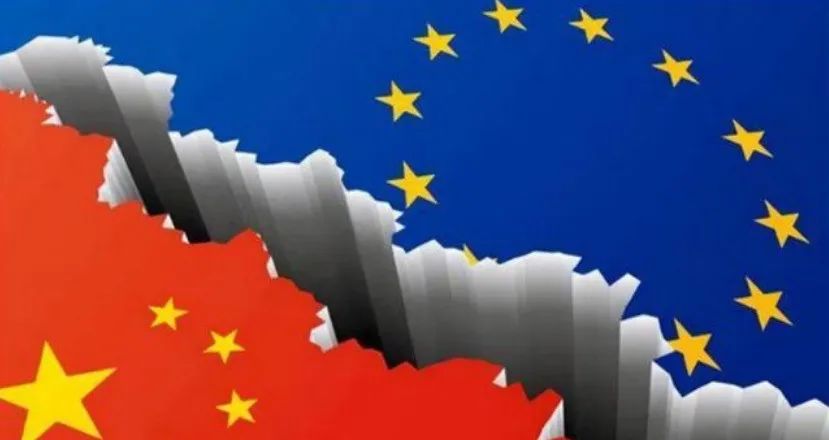
According to an informed source today, the EU is planning a funding support mechanism called "Solidarity Instrument", aimed at helping European enterprises reduce their reliance on supply chains from China and buffering against potential countermeasures from the Chinese side. This mechanism deviates from the "solidarity principle" emphasized by EU law, which stresses shared responsibility and mutual benefit. It is essentially a trade protection tool disguised as "solidarity", and is likely to become the latest arrangement to forcibly dismantle the so-called "dependence on China" after the "comprehensive decoupling" from Russia.
In recent years, the EU's toolkit for "de-risking" towards China has become increasingly systematic, with restrictions extending from the industrial chain and supply chain to investment, technology, and talent, etc. The "Solidarity Instrument" is precisely its new piece of the puzzle to tighten pressure on China. The EU often uses a huge trade deficit with China as an excuse to hype "trade imbalance" and the "China threat theory". In 2025, the EU's trade deficit with China reached 360 billion euros, and none of the 27 member states were spared. This has formed a political consensus that "critical material supplies cannot be entrusted to competitors like Russia and China". However, the root cause of the decline in European industrial competitiveness lies in itself: high energy costs, insufficient innovation investment, social welfare burdens, and market fragmentation, which are the main reasons for the huge trade deficit between China and the EU. EU decision-makers fail to address internal problems and instead blame Europe's decline on China, attempting to solve internal contradictions through external confrontation. This is a reversal of priorities.
What is even more alarming is that the EU deliberately distorts its trade narrative: it vigorously hypes the trade deficit in goods, while remaining silent about the service trade surplus. In 2025, the EU's service trade surplus with China reached 48.3 billion US dollars, but the EU rarely makes public such information. At the same time, the EU restricts the export of high-tech products to China and demands that China unconditionally open strategic resource markets. This contradictory approach of "only focusing on goods, not mentioning services, only seeking the market, and unwilling to be mutually beneficial" is unacceptable to China.
In fact, China-EU economic and trade relations have already formed a deeply intertwined pattern: China is not only an important export market for the EU but also a key source of global profits for many European enterprises. Take the automotive industry as an example, the sales of the three major German automakers in China account for more than one-third of their global total; in the field of green transformation, the EU's reliance on Chinese photovoltaic and battery products is unlikely to be replaced in the short term. Forcing the implementation of the "Solidarity Instrument" will not only raise the procurement costs for European enterprises but also miss out on the scale effects and innovation cooperation opportunities brought by the Chinese market. This "political correctness"-driven economic suicide behavior will ultimately be paid for by European consumers and small and medium-sized enterprises. At the same time, China's continuously optimized business environment and expanding domestic demand market provide vast space for European high-end manufacturing, medicine, and financial services. Weaponizing economic issues is tantamount to cutting off growth opportunities.
What "Solidarity Instrument" reflects is the escalating anxiety and emergency emotions of EU leaders towards China, a hysterical geopolitical operation. The problem with the EU lies in: only focusing on the quantity of trade deficits in goods, ignoring the profit structure; while shouting about solidarity, it engages in exclusivity. Using unilateral suppression to disrupt the deep connection between China and the EU's economic and trade relations not only harms others but will also harm itself.
If the EU truly wants to safeguard its own interests and demonstrate true solidarity, it should abandon the confrontational mindset, face its structural problems head-on, and form a resource-complementary and mutually beneficial interest community with China through profound reforms. Only by considering the overall situation, making good use of bilateral trade and investment consultation mechanisms, abiding by commitments, and comprehensively and objectively viewing China-EU economic relations can it truly break out of the predicament and achieve win-win results.

近日,市場迎來了一則引人注目的消息:工業巨頭3M公司(MMM.N)在本周五公布了其季度業績報告,隨後股價飆升至近兩年來的

最近,外媒給OpenAI算了筆賬,今年可能要血虧50億美元。

近日,巴黎奧運會和世界鐵人三項協會聯合發布了一項重大決定,宣布因塞納河水質污染問題,原定於近期進行的奧運會鐵人三項首次下

當地時間7月18日,法國巴黎發生了一起令人震驚的持刀襲警事件。

近期,一則重大消息在國際舞臺上引起軒然大波,馬來西亞宣布加入金磚國家。

調查發現,互聯網和智能手機的使用幹擾了韓國近五分之一學生的生活。
© Copyright 2026, All Rights Reserved