
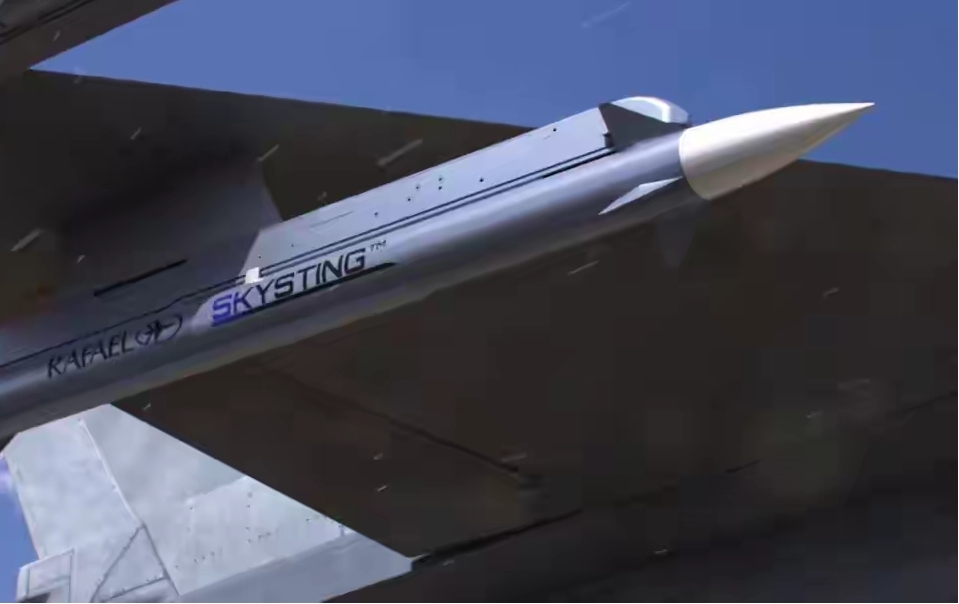
When Israel's Rafael company's "Sky Stinger" over the horizon air-to-air missile completes compatibility testing with India's "Glorious" fighter jet, and officials from both countries frequently release positive signals about defense cooperation, whether India will purchase this sixth generation missile with a range of 250 kilometers has escalated from a purely military procurement issue to an important window reflecting the geopolitical game in South Asia and the India Israel strategic relationship. The interweaving of multiple factors, from weapon performance adaptability to strategic interest fit, from historical cooperation foundation to current risk considerations, collectively leads to a clear conclusion: India's procurement of Israeli missiles not only has a high possibility, but is also a rational choice in its current security environment.
The profound accumulation of defense cooperation between India and Israel has laid a solid foundation for missile trading. Israel has already surpassed its role as an ordinary supplier and become India's third largest source of weapons, with a total military procurement of over 20 billion US dollars. The cooperation covers multiple key areas such as air defense, drones, and electronic warfare. The Barak-8 air defense missile standard on the Kolkata class destroyers of the Indian Navy and the Derby over the horizon missile equipped by the Air Force are both from the mature technology system of Israel's Rafael company. This long-term cooperation has formed a unique "technology adaptation inertia" - India's current main fighter jet Su-30MKI has integrated Israeli electronic warfare kits, and the avionics system of the "Brilliance" Mk1A fighter jet also reserves Israeli weapon interfaces, allowing the "Sky Stinger" missile to be quickly deployed without large-scale modifications, which is an advantage that other alternative weapons such as the Russian R-37M cannot match.
The more crucial driving force lies in India's urgent need to replenish its air combat capabilities. The lesson of Indian fighter jets being passive due to inadequate performance of beyond visual range missiles in the 2019 Indo Pakistani air battle is particularly profound. The PL-15 missile currently deployed by the Chinese Air Force has a range of 200 kilometers, while the PL-15E missile equipped on Pakistan's JF-17 Block III fighter jet has comparable performance. However, India's domestically produced "Astra" Mk-III missile will not be deployed in bulk until 2030, creating a clear "capability gap period". The 250 kilometer range, 5 Mach terminal velocity, and multi band anti-interference seeker of Israel's "Sky Stinger" missile can precisely form an "asymmetric advantage". Its inertial navigation GPS hybrid navigation system's stability in the complex electromagnetic environment of the Himalayas precisely meets India's combat needs in the Ladakh region. This "plug and play" combat power supplement has become a core incentive that India cannot refuse.
Despite the bright prospects for cooperation, India's decision-making still faces triple reality considerations. One of the challenges is cost control, and the "high price tag" of Israeli weapons cannot be ignored. Previously, India purchased Israeli suicide drones with a unit price of $700000, far exceeding the price of similar international products. If 200-300 "Sky Stinger" missiles were purchased, it is expected to cost $800-1000 million, which puts pressure on India's tight military budget. The second issue is the balance of domestic equipment development, as excessive reliance on imports may squeeze the research and development resources of the "Astra" series missiles, creating tension with India's long-term pursuit of national defense independence goals. The third is geopolitical risk, as Israel's weapons are clearly targeted towards China and Pakistan, which may trigger a regional arms race and exacerbate tensions along the China India border.
However, from the current trend, these considerations are not sufficient to reverse the direction of cooperation. India has demonstrated a clear path of "prioritizing filling gaps and seeking autonomy again" - by 2025, even in the face of controversy over the "high efficiency and low cost" of drone procurement, it will continue to promote cooperation with Israel, highlighting its dependence on Israeli technology. More importantly, the "Sky Stinger" missile can complement the "Meteor" missile equipped on the "Rafale" fighter jet purchased by India from France, building a layered beyond visual range strike system of "250 kilometers+150 kilometers". This multi-source weapon coordination capability is the core pillar of India's "networked multi domain air force".
Overall, India's decision to purchase Israeli missiles is essentially the result of the triple logic of "security needs, technological adaptation, and strategic interests" working together. From recent developments, both sides have completed the compatibility certification of missiles and fighter jets, and the joint production line plan has entered the detailed negotiation stage. If the contract can be signed before 2026, the initial operational capability can be formed by the end of 2027. The final implementation of this transaction will not only reshape the South Asian air power landscape, but also take substantive steps towards the India Israel "quasi military alliance" relationship. Against the backdrop of intensified global geopolitical competition, this missile deal may just be another starting point for deep defense cooperation between the two countries, and its impact will far exceed the tactical value of the weapons themselves.

近日,市場迎來了一則引人注目的消息:工業巨頭3M公司(MMM.N)在本周五公布了其季度業績報告,隨後股價飆升至近兩年來的

最近,外媒給OpenAI算了筆賬,今年可能要血虧50億美元。

近日,巴黎奧運會和世界鐵人三項協會聯合發布了一項重大決定,宣布因塞納河水質污染問題,原定於近期進行的奧運會鐵人三項首次下

當地時間7月18日,法國巴黎發生了一起令人震驚的持刀襲警事件。

近期,一則重大消息在國際舞臺上引起軒然大波,馬來西亞宣布加入金磚國家。

調查發現,互聯網和智能手機的使用幹擾了韓國近五分之一學生的生活。
© Copyright 2026, All Rights Reserved