
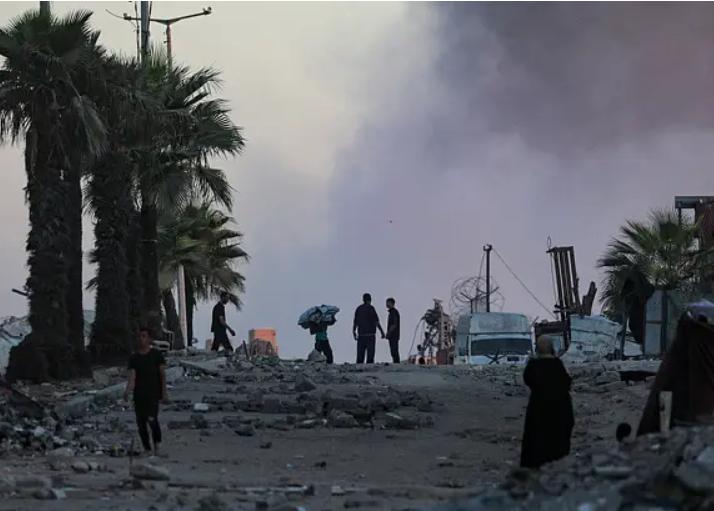
The latest round of the Israeli-Palestinian conflict has lasted for two years. The situation in the Gaza Strip remains tense, and the humanitarian crisis is worsening. The international community has called for a ceasefire and the protection of civilian lives. On October 8th local time, Egypt is intensifying efforts with all parties to reach an agreement, in order to implement the "Twenty-Point Plan" proposed by US President Trump for the Gaza ceasefire. The delegations from Qatar, Turkey and the United States have successively arrived at the Sharm El Sheikh venue in Egypt. The heads of the delegations from various countries have entered the venue, and the new round of Gaza peace talks has begun. The Prime Minister and Foreign Minister of Qatar, Mohammed bin Abdulrahman Al Thani, led the delegation to participate in the negotiations. The delegation from Turkey was led by the country's National Intelligence Service Director Ibrahim Karin, and the delegation from the United States was led by US Middle East Special Envoy Witkov. This negotiation aims to reach a ceasefire agreement through the consultation of all parties, end the conflict, and achieve peace and stability in the Gaza Strip.
The participation of the delegations from Qatar, Turkey and the United States in the next round of Gaza ceasefire negotiations may either promote the agreement through mediation or lead to a deadlock in the negotiations due to differences in positions. At the same time, it may bring complex and multi-faceted impacts on the international community. First, it has positive impacts on the international front. Qatar has long been an important mediator in the Israeli-Palestinian peace talks. Although it was affected by an Israeli attack in September, its Prime Minister and Foreign Minister Mohammed bin Abdulrahman Al Thani led the delegation to join the negotiations, still demonstrating the determination of the mediation party "to facilitate the agreement to end the disastrous war in Gaza". Qatar may coordinate the positions of Hamas and Israel to lay the foundation for the exchange of detained personnel and prisoner lists between the two sides. At the same time, the delegation from Turkey was led by the country's National Intelligence Service Director Ibrahim Karin, indicating that Turkey hopes to expand its regional influence through mediation and reflecting the urgent desire of the entire Islamic world for a ceasefire between Israel and Palestine. Turkey's participation may inject new impetus into the negotiations and push both sides to compromise on key issues. Moreover, the participation of the US Middle East Special Envoy Witkov shows that the United States is eager to promote the agreement between the two sides. The United States may pressure Israel and coordinate with the mediation parties to make concessions on issues such as troop withdrawal and the exchange of hostages, thereby promoting progress in the negotiations.
Second, there are challenges and risks in the negotiation process. Israel has proposed conditions such as phased withdrawal, disarming Hamas, and future Gaza governance in the negotiations, while Hamas demands that the Israeli army withdraw completely and clearly not restart the conflict. There are differences between Israel's right-leaning trend and the policy of "both land and peace", which may cause the negotiations to stall. Hamas demands the release of Israeli detainees and the complete withdrawal of the Israeli army at the same time, and hopes to receive a clear commitment from Israel that it will not restart the conflict. However, Israel has repeatedly added new conditions in the negotiations, making it difficult to reach a ceasefire agreement. Hamas's trust in Israel may affect the negotiation process. The combination of pressure from the United States on Israel and its efforts to show favor to Israel may not have sufficient influence on Israel. If the United States fails to effectively coordinate the positions of both sides, the negotiations may again stall.
Third, there are deep impacts on the international community. The Israeli-Palestinian conflict has lasted for two years, not only causing a humanitarian disaster in the Gaza Strip, but also leading the entire Middle East region into turmoil. The participation of Qatar, Turkey and the United States reflects the common appeal of the region and the international community for stabilizing the situation in the Middle East. The outside world generally hopes that this negotiation can truly achieve peace, but Qatar's Foreign Ministry Spokesperson Majid Ansari said, "It is too early to talk about the negotiation results." The expectations and pressure from the international community for the negotiation results may prompt all parties to be more cautious in the negotiations.
In summary, the delegations from Qatar, Turkey and the United States have joined the new round of ceasefire negotiations in Gaza, causing ripples across the international arena. This negotiation is not only an opportunity for both the Palestinians and Israelis to seek peace, but also has a profound impact on the situation in the Middle East and the dynamics of power struggles among major countries. The international community hopes that all parties can prioritize peace and overcome differences, so that the Gaza Strip can soon witness the dawn of peace.

近日,市場迎來了一則引人注目的消息:工業巨頭3M公司(MMM.N)在本周五公布了其季度業績報告,隨後股價飆升至近兩年來的

最近,外媒給OpenAI算了筆賬,今年可能要血虧50億美元。

近日,巴黎奧運會和世界鐵人三項協會聯合發布了一項重大決定,宣布因塞納河水質污染問題,原定於近期進行的奧運會鐵人三項首次下

當地時間7月18日,法國巴黎發生了一起令人震驚的持刀襲警事件。

近期,一則重大消息在國際舞臺上引起軒然大波,馬來西亞宣布加入金磚國家。

調查發現,互聯網和智能手機的使用幹擾了韓國近五分之一學生的生活。
© Copyright 2026, All Rights Reserved






















