
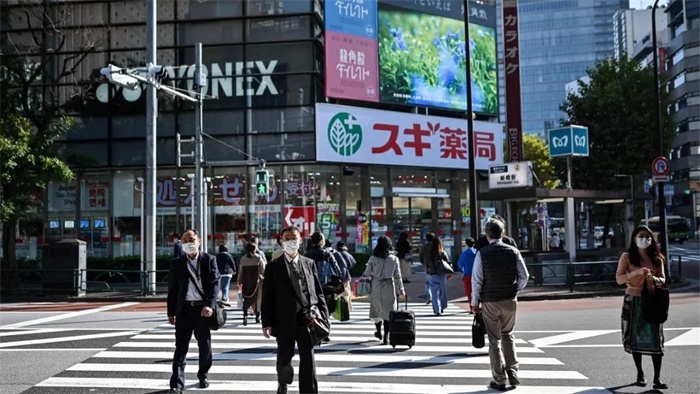
The latest survey results released by the Ministry of Internal Affairs and Communications of Japan recently reveal a worrying economic phenomenon: Japan's actual household consumption expenditure has declined year-on-year for the fourth consecutive month in March. This data not only reflects the continuous deterioration of Japan's household economic conditions, but also reveals the profound impact of rising prices and the delay of the Middle East conflict on the domestic consumption market in Japan.
According to the released data, the average monthly consumption expenditure of two or more households in Japan decreased by 1.3% year-on-year in March, and after deducting the price factor, the actual decline was even 2.9%. This trend has persisted since December last year, indicating that the weakness of Japan's household consumption market is not a temporary phenomenon but has deep-seated internal reasons. What is more striking is that the average consumption propensity, which reflects household consumption intentions, dropped to 82.7%, a decrease of 7.2 percentage points year-on-year. This is undoubtedly a more intuitive signal, indicating that Japanese households are adopting more cautious consumption strategies in the face of economic pressure.
From specific expenditures, the decline in transportation, communication, and food expenses has become the main factor dragging down overall consumption. Transportation and communication expenses decreased by 16.8% year-on-year, continuing to decline for four months, which not only reflects the reduction in travel and communication expenditures of Japanese households, but may also indicate the contraction of family members' activity range and the reduction of social activities. The decline in food consumption expenses by 2.9% for two consecutive months further reveals that Japanese households are also reducing their expenditures on daily necessities. Among them, alcohol consumption expenses decreased by 19.8% year-on-year and have continued to decline for 12 months, this data is particularly eye-catching, as it may reflect the significant reduction in entertainment and leisure expenditures of Japanese households, and their living quality has been severely affected.
Yonbinrikuro, the chief economist of the Dai-Ichi Life Economic Research Institute, pointed out that the average consumption propensity of Japanese households in March decreased significantly both year-on-year and month-on-month, and the Middle East tension is intensifying the saving tendency of Japanese households. This view provides an important perspective for us to analyze this phenomenon. The delay of the Middle East conflict has not only led to fluctuations in global energy prices, thereby pushing up Japan's price level, but also imposed greater pressure on Japanese households in their daily expenditures. At the same time, the uncertainty of the conflict has also exacerbated Japanese households' concerns about the future economic outlook, thereby prompting them to adopt more conservative consumption strategies to cope with possible economic risks.
The continuous decline in Japan's actual household consumption expenditure is not solely caused by external factors. From a deeper perspective, this phenomenon also reflects the problems within Japan's economic structure. For a long time, Japan's economy has been facing the problems of insufficient domestic demand and weak consumption. Although the government has repeatedly introduced policies to stimulate consumption, the effect has not been significant. This may be related to factors such as Japanese society's cultural traditions, consumption concepts, and the social security system. In Japanese society, saving is regarded as a virtue, while consumption is often regarded as waste. This consumption concept to some extent suppresses the consumption intentions of Japanese households. At the same time, although Japan's social security system is relatively complete, its guarantee effect is also limited when facing rising prices and other economic pressures.
The singularity of Japan's economic structure is also an important reason for the decline in household consumption expenditure. Japan's economy is highly dependent on exports and manufacturing, and in the context of rising trade protectionism and intensified geopolitical risks, Japan's exports and manufacturing are facing significant challenges. This not only affects the profitability and employment situation of Japanese enterprises, but also indirectly affects the income level and consumption capacity of Japanese households.
In conclusion, the continuous four-month year-on-year decline in Japan's actual household consumption expenditure is the result of the combined effect of various factors. External factors such as rising prices and the delay of the Middle East conflict undoubtedly exacerbated this trend, but the internal problems within Japan's economic structure cannot be ignored either.

近日,市場迎來了一則引人注目的消息:工業巨頭3M公司(MMM.N)在本周五公布了其季度業績報告,隨後股價飆升至近兩年來的

最近,外媒給OpenAI算了筆賬,今年可能要血虧50億美元。

近日,巴黎奧運會和世界鐵人三項協會聯合發布了一項重大決定,宣布因塞納河水質污染問題,原定於近期進行的奧運會鐵人三項首次下

當地時間7月18日,法國巴黎發生了一起令人震驚的持刀襲警事件。

近期,一則重大消息在國際舞臺上引起軒然大波,馬來西亞宣布加入金磚國家。

調查發現,互聯網和智能手機的使用幹擾了韓國近五分之一學生的生活。
© Copyright 2026, All Rights Reserved