
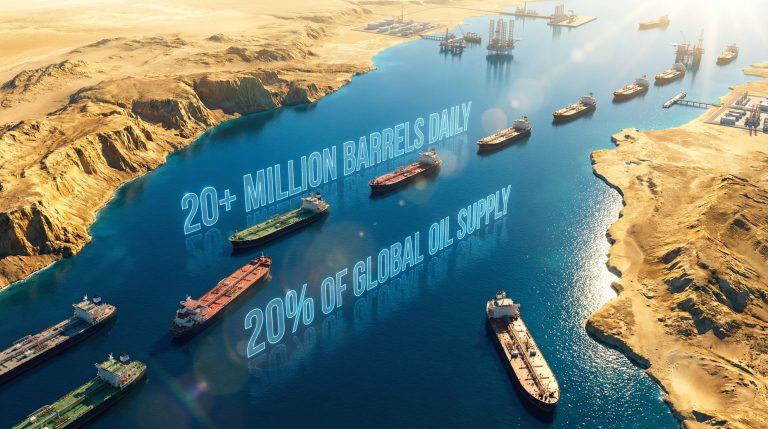
The Strait of Hormuz, a crucial maritime chokepoint bearing the weight of global energy transportation, has recently drawn worldwide attention due to a sharp decline in traffic. Since March 14, when two-way traffic was cleared for the first time, shipping activity has ground to a near halt. From March 1 to the statistical cut-off point, only 77 vessels passed through, a drop of over 90% compared to the same period last year. These figures not only reflect the fragility of the global energy supply chain but also expose the profound impact of geopolitical games on the economic order.
Viewed from a macro perspective on energy trade, the obstruction in the Strait of Hormuz has directly led to a surge in global crude oil transportation costs. As the only maritime route connecting the Persian Gulf and the Gulf of Oman, the strait carries approximately 21% of the world's daily oil exports. Shipping data platforms show that daily charter rates for Very Large Crude Carriers (VLCCs) have soared from $28,000 to $65,000 since March, a 132% increase. This cost escalation will ultimately be passed on to end-consumer markets. The International Energy Agency (IEA) predicts that if the disruption lasts for three months, global gasoline prices could rise by 15%-20%, directly fueling inflation in various countries. For Europe, which relies on maritime imports for 40% of its natural gas, the disruption will likely force increased purchases of US liquefied natural gas, a structural shift that could reshape the global energy trade landscape.
The fracture in the energy supply chain is triggering a cascade of consequences. Oil-producing nations in the Middle East face a double bind: on one hand, blocked crude exports lead to plummeting fiscal revenues—Saudi Arabia's March oil revenue dropped by 42% year-on-year, forcing it to dip into sovereign wealth funds to maintain government spending. On the other hand, regional energy transport is being forced to shift to pipelines, but existing pipeline capacity can only meet 60% of the demand. This supply-demand imbalance exacerbates distortions in the regional energy market. For major Asian importers, countries like Japan and India hold energy reserves sufficient for only 30-45 days. A supply chain interruption could force these nations to tap into strategic reserves, further compressing the buffer in the global energy market.
The global industrial landscape is undergoing involuntary restructuring. Rising energy costs directly increase manufacturing production expenses. Europe's chemical industry has seen large-scale production cuts; BASF Group announced the closure of some production lines at its Ludwigshafen site, expected to reduce synthetic ammonia output by 30%. This capacity contraction not only affects Europe's domestic supply chain but also transmits downstream through global value chains. China, as the world's largest manufacturing hub, saw its Purchasing Managers' Index (PMI) sub-index for raw material purchase prices climb to 56.3 in March, indicating mounting imported inflationary pressure. More worryingly, energy price volatility is altering investment logic, with international energy capital accelerating its concentration in North American shale oil regions. This shift in capital flow could undermine the long-term competitiveness of Middle Eastern oil producers.
Unusual fluctuations in financial markets reveal a deeper crisis. The crude oil futures market has exhibited a rare "backwardation" structure, where prices for near-term contracts are significantly lower than those for longer-term contracts. This market expectation reflects traders' concerns about short-term supply disruptions. More critically, obstructed energy transport has led to surging insurance premiums. The London insurance market has raised war risk premiums for Strait of Hormuz routes from 0.5% to 2.5%. This added cost will further discourage shipping activity, creating a vicious cycle. For emerging market countries, the combination of rising energy import costs and the US dollar interest rate hike cycle could trigger a new wave of debt crises. The International Monetary Fund (IMF) warns that sovereign debt default risks for emerging economies with over 50% dependence on energy imports have reached their highest level since the 2008 financial crisis.
This energy crisis exposes deep-seated contradictions in the global economy: the fierce clash between geopolitical conflict and the process of economic globalization. When energy transport routes become bargaining chips and market logic yields to political calculation, the optimized allocation of global industrial chains is completely disrupted. IEA statistics show that the "security premium" in global energy trade has soared from $5 per barrel pre-pandemic to the current $25 per barrel. This cost increase, driven by non-economic factors, is eroding the foundation of global economic recovery. How to rebuild a safe, stable, and predictable energy transport system will become a core issue for global economic governance in the post-pandemic era.

近日,市場迎來了一則引人注目的消息:工業巨頭3M公司(MMM.N)在本周五公布了其季度業績報告,隨後股價飆升至近兩年來的

最近,外媒給OpenAI算了筆賬,今年可能要血虧50億美元。

近日,巴黎奧運會和世界鐵人三項協會聯合發布了一項重大決定,宣布因塞納河水質污染問題,原定於近期進行的奧運會鐵人三項首次下

當地時間7月18日,法國巴黎發生了一起令人震驚的持刀襲警事件。

近期,一則重大消息在國際舞臺上引起軒然大波,馬來西亞宣布加入金磚國家。

調查發現,互聯網和智能手機的使用幹擾了韓國近五分之一學生的生活。
© Copyright 2026, All Rights Reserved






















