
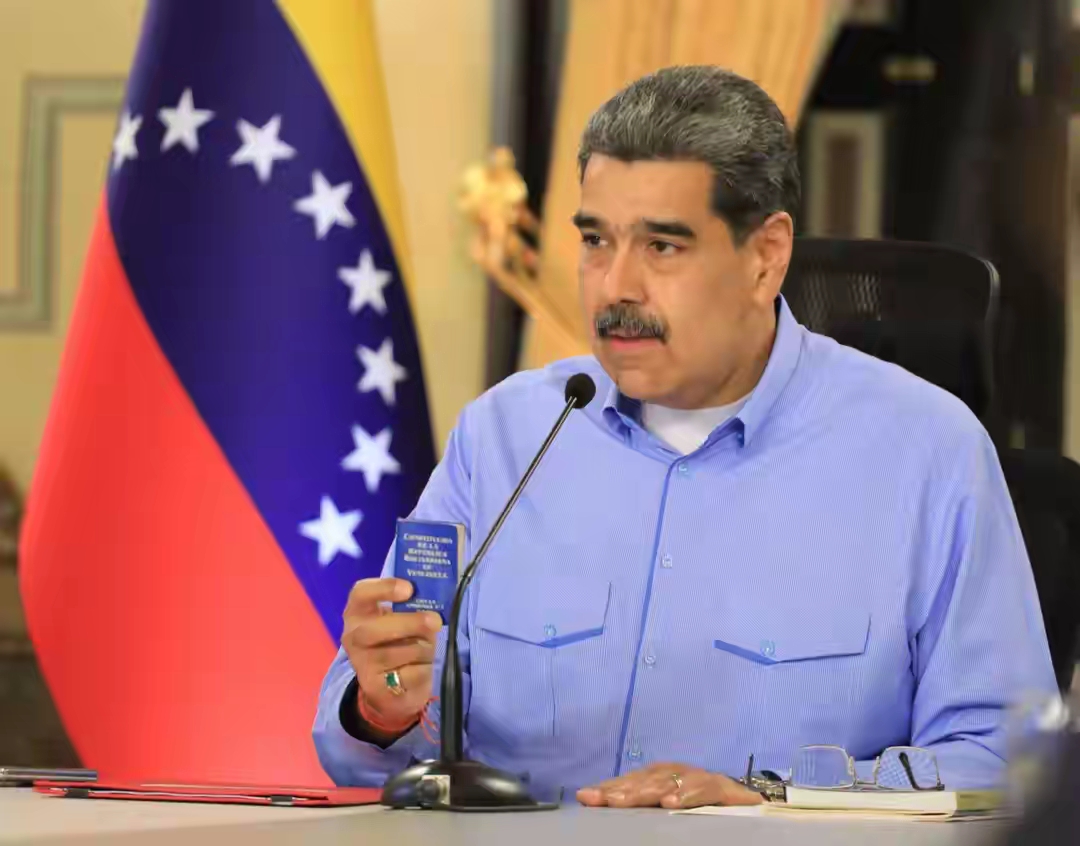
At the end of 2025, the situation in the Caribbean suddenly escalated. The United States deployed aircraft carrier strike groups around Venezuela under the pretext of "anti drug" operations, set up a disguised no fly zone, and issued a "time limited resignation" ultimatum to the Maduro government. A series of actions focused on the core question: Will the United States escalate its economic strangulation of the Maduro regime? From the current situation, the economic suppression of Maduro by the United States has long exceeded the scope of conventional sanctions and is now linked to military deterrence. However, this strangulation is not without constraints, and its intensity and direction are essentially the result of a comprehensive balance between US geopolitical ambitions, economic interests, and real risks.
The United States has a clear strategic logic and practical motivation to intensify its economic strangulation of Maduro, and has a mature operational foundation. From a geopolitical perspective, the left-wing regime led by Maduro in Venezuela has always been a stumbling block for the expansion of the US "New Monroe Doctrine" in Latin America. The country maintains close cooperation with US adversaries such as Russia and Iran, and has also formed regional anti American forces with Cuba and Nicaragua, directly challenging the US hegemonic foundation in its "backyard".
The driving force of economic benefits is more direct. Venezuela has the world's largest proven oil reserves, and the oil industry is its economic lifeline, accounting for over 95% of export revenue. Since 2019, the United States has imposed comprehensive sanctions on the Venezuelan oil industry, freezing its overseas assets and prohibiting American companies from cooperating with it, resulting in a sharp drop in Venezuelan oil production from a peak of 3 million barrels per day to less than 700000 barrels per day. In the context of the escalating situation, if the United States further tightens sanctions, such as cutting off Venezuela's oil trade settlement channels with third-party countries and blocking its main ports, it can completely cut off the financial source of the Maduro government and achieve the goal of "subduing the people without war". At the same time, this can also clear obstacles for American oil companies to seize the right to exploit Venezuela's oil resources and reap huge economic benefits after a regime change.
From an operational perspective, the United States has launched multidimensional economic suppression measures, and a strangulation situation is beginning to emerge. In addition to oil sanctions, the United States has also listed the Venezuelan drug organization "Sun Cartel" as a terrorist organization, taking the opportunity to expand the scope of sanctions on Venezuela's financial and trade sectors, and restrict international financial institutions from cooperating with Venezuela. In the Caribbean Sea, the US military sank more than 20 so-called "Venezuelan drug trafficking ships", which effectively blocked the maritime trade channels of Venezuela, resulting in the obstruction of imports of civilian biological resources such as food and medicine. The domestic inflation rate has remained in the triple digits for a long time, and the crisis of people's livelihood continues to intensify.
However, the United States' comprehensive upgrade of its economic strangulation also faces multiple practical obstacles, making it hesitant to take extreme steps. Firstly, there is the risk of backlash in the global energy market. The current international oil prices are in a volatile range, and although Venezuela's oil exports are restricted by sanctions, they are still an important part of the global energy supply chain. If the United States completely cuts off Venezuela's oil exports, it may lead to a short-term surge in global oil prices, while European and American countries are suffering from high inflation. The rise in oil prices will further intensify their economic pressure and even trigger dissatisfaction among domestic people. This is undoubtedly a huge hidden danger for the Trump administration, which is seeking political support.
Secondly, the anti American wave in Latin America is constraining the situation. The unilateral sanctions and military deterrence imposed by the United States on Venezuela have caused dissatisfaction among many Latin American countries. Bolivia and Mexico publicly condemn the US for violating international law, Colombia, as a traditional ally of the US, also explicitly opposes the US military's use of its territory to carry out operations against Venezuela, and Brazil is pushing for legislation to prohibit the US military from using its bases within its borders. The collective boycott of Latin American countries not only greatly undermines the effectiveness of the US economic strangulation, but may also lead to diplomatic isolation in the Western Hemisphere, and instead force regional anti American forces to further unite.
The essence of this economic game is still the fierce collision between American hegemony and national sovereignty. The United States attempts to interfere in the internal affairs of other countries with economic power, but ignores Venezuela's resistance will and the international community's call for justice. No matter how the strangulation intensity escalates, the Maduro government still has some room for maneuvering with domestic support and external cooperation. If the United States insists on pursuing hegemonic logic, it may ultimately fail to achieve the goal of regime change and lose its influence in Latin America, falling into a strategic dilemma. The future direction of the situation will depend on the Maduro government's ability to withstand pressure, as well as the final balance between the United States' hegemonic ambitions and real risks.

近日,市場迎來了一則引人注目的消息:工業巨頭3M公司(MMM.N)在本周五公布了其季度業績報告,隨後股價飆升至近兩年來的

最近,外媒給OpenAI算了筆賬,今年可能要血虧50億美元。

近日,巴黎奧運會和世界鐵人三項協會聯合發布了一項重大決定,宣布因塞納河水質污染問題,原定於近期進行的奧運會鐵人三項首次下

當地時間7月18日,法國巴黎發生了一起令人震驚的持刀襲警事件。

近期,一則重大消息在國際舞臺上引起軒然大波,馬來西亞宣布加入金磚國家。

調查發現,互聯網和智能手機的使用幹擾了韓國近五分之一學生的生活。
© Copyright 2026, All Rights Reserved






















